
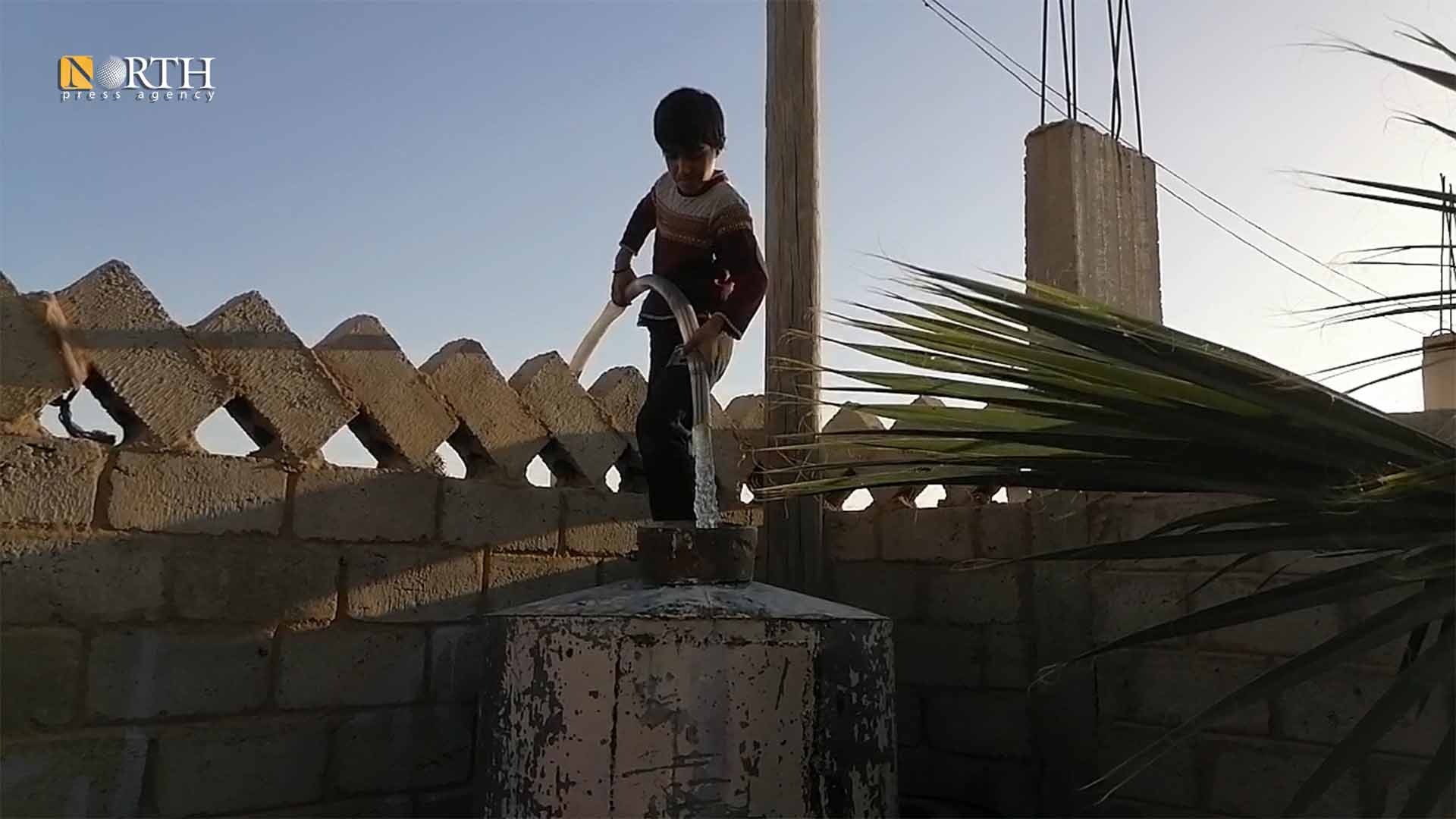
DEIR EZ-ZOR, Syria (North Press) – Although his house is only 500 meters away from the Euphrates River, Henedy Hethaily, a resident of the town of al-Kishkiyah 90 km east of Deir ez-Zor, eastern Syria, fills about six tanks of drinking water every month, because the only water station in the town has a weak flow.
Residents suffer from lack of water and water pollution in the town after five water reservoirs [tanks] went out of service during the war years and Turkey reduced the flow of Euphrates water some months ago.
The suffering of the town’s residents from water shortages dates back more than nine years, and residents of the town resort to digging artesian wells, the water of which is often unsuitable for drinking, according to residents.
The town of al-Kishkiyah has a larger area than the neighboring towns and a population of up to 60,000 people. It includes one water station and five connected tanks to distribute water throughout the town.
The town is divided into two sectors, the northern part of which is comprised of seven neighborhoods, and the southern comprised of ten neighborhoods. Water does not reach half of the neighborhoods due to poor pumping and out of service tanks, according to residents of the town.
Hethaily told North Press that the current station works for one day and stops for three days on the pretext of a generator failure or power outage.
He called on institutions affiliated with the Autonomous Administration and humanitarian organizations to construct another water station and to rehabilitate the engines of the first station, which suffer from weak water pumping, as water only reaches neighborhoods that are very close to the station.
He added that the effects of unsuitable and turbid water brought by tankers, especially after the level of the Euphrates River decreased, causes diseases in children.
Months ago, Turkey reduced the flow of the Euphrates River into Syria, which led to popular discontent in areas that depend on the river for drinking water and for irrigating agricultural lands.
The fees for transporting water from the Euphrates River through tankers for domestic use costs about 15,000 Syrian pounds per session, and this water is often just as polluted as the other water sources in the region.
Muhammad al-Marsoum, a resident of the town of al-Kishkiyah, said that water has not reached his house for nearly nine years, and that during these years he has used tankers to fill his water tank for drinking and other household uses, despite his poor financial situation.
According to Marsoum, the water directorate in the town is required to monitor the work of the station and hold accountable some residents who crossed the main incoming water line, at which point each person will receive an allocation of water according to the capacity of the station.
Muhammad al-Rawi, a water official in the Civil Council in the eastern province of Deir ez-Zor, said that in the northern sector (45% of the town’s area), three reservoirs are out of service due to the wars in the area, depriving about 30% of the town’s population of water.
In the southern sector, water reaches five out of ten neighborhoods close to the station, he added.
The farther the neighborhoods are from the station near the river, the less water can reach, according to the water official.