
Government siege on northern Aleppo exacerbates poor health situation
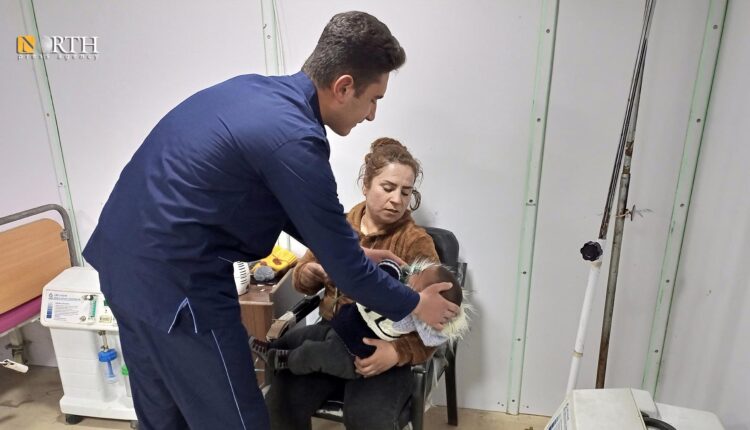
ALEPPO, Syria (North Press)— In the shade of the ongoing siege imposed by Syrian government forces on the northern countryside of Aleppo, the residents of this region suffer from the increased disease cases due to lack of fuel in a harsh winter.
The government has imposed, for the last two months, a tight siege on Tel Rifaat town and five camps in northern Aleppo which contains displaced people from Afrin. The blockade prevents the entry of the basic needs, fuel, medications and others into the region.
The northern countryside of Aleppo governorate, also known as Shahba region, houses IDPs of the Kurdish city of Afrin which was occupied in 2018 by Turkey following a military operation called “Olive Branch” to push away the Kurdish People’s Protection Units (YPG) under the pretext of protecting Turkey’s “national security”.
The operation caused the displacement of about 300.000 of the original inhabitants of the Kurds of Afrin who have been taking shelter in 40 villages and five camps in Shahba region since then.
There are about 16.000 displaced families from Afrin distributed over 42 villages and towns in Shahba region, in addition to 1.870 families, comprising 7.500 individuals, now living in the camps of Barkhodan, Sardam, Afrin, al-Awda, and Shahba, according to the Social Affairs and Labor Board of the Afrin region, which is affiliated with the Autonomous Administration of North and East Syria (AANES) and currently operating in Aleppo northern countryside.
The hospital of Tel Rifaat recorded 4000 disease cases during last December, 2500 of which were severe flu with most patients children and elderly.
Local sources told North Press that the residents have resorted to burn their wooden furniture or plastic materials as substitutes of heating oil despite of the danger of using them.
Jewan Nasser, an official at Tel Rifaat hospital, told North Press, “The health sector was the most affected by the imposed siege due to the lack of medication and fuel. The hospital and the dialysis center were about to be out of service.”
“We hardly provide electricity due to the severe fuel shortage and we are forced to shorten the time of operating the generators to 12 hours in the daytime and only three hours at night to run the devices. This, in turn, exposes the patients to an extreme cold due to the inability to operate the heaters,” he added.
He noted the hospital lacks some medications such as serums and the those used for dialysis and others.
An official of the Kurdish Red Crescent told North Press that the health situation is deteriorated due to lack of medications in the region, which comes in light of no action by humanitarian organization.