
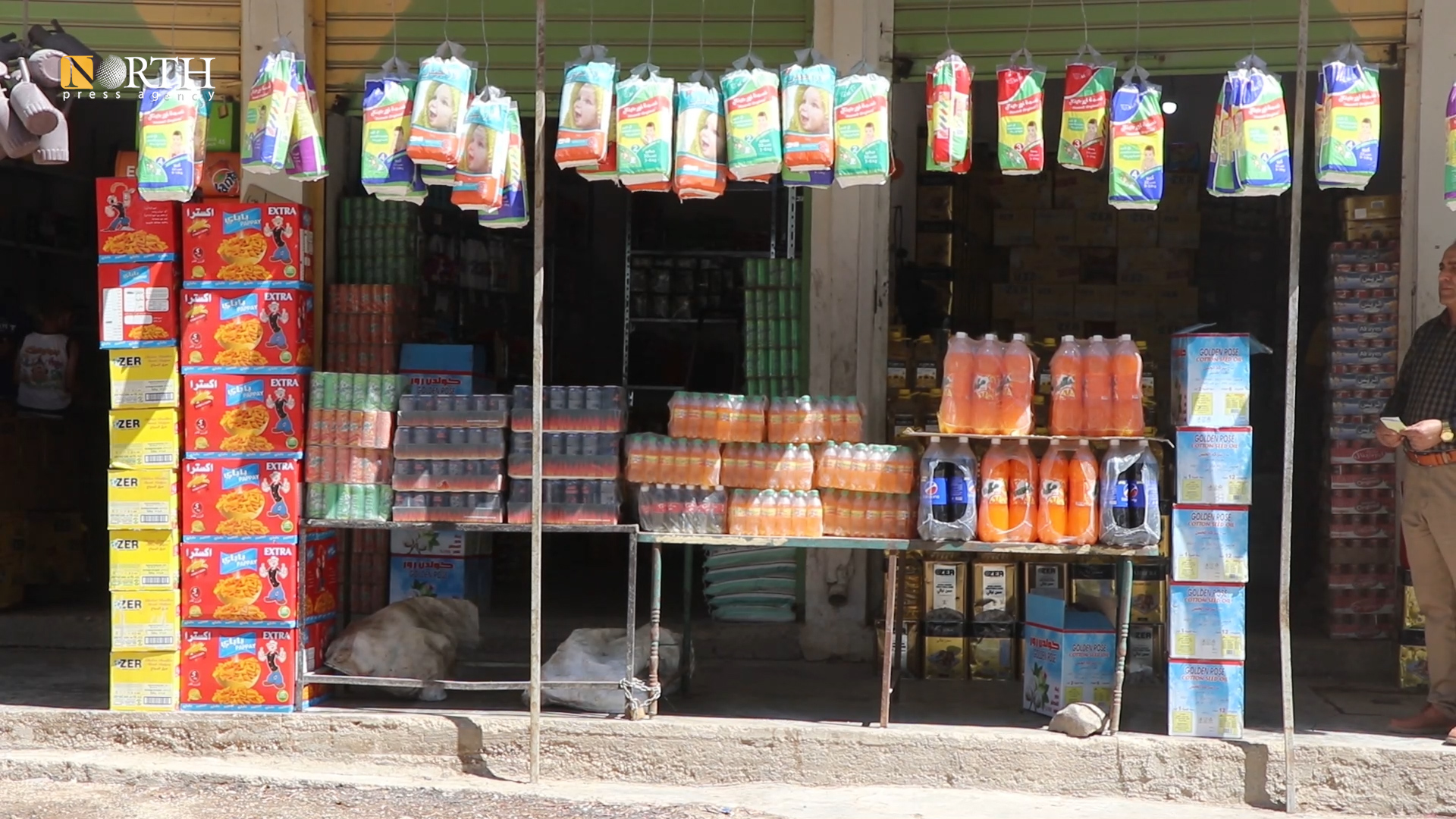
TEL TAMR, Syria (North Press) – Mahmoud Na’mo, a merchant in the town of Tel Tamr, northeastern Syria, inspects the few remaining types of goods produced in Damascus, Aleppo, and other areas held by government forces in light of the continued closure by the Damascus government of internal commercial crossings with Autonomous Administration areas.
Smuggling has become the way for traders to import most of the unavailable goods and spare parts in shops in northeastern Syria.
Na’mo said that their prices have doubled because of their import through long roads and royalties imposed on trucks by groups which use those roads.
Smuggling routes
“We haven’t received Syrian goods for three months, and this affects the prices because we resort to smuggling routes,” Na’mo said.
“Many food items aren’t available; that affects our work, the prices, and the purchasing power,” Na’mo added.
The areas of the Autonomous Administration of North and East Syria (AANES) are linked with areas held by the government by three main crossings; the al-Tayha crossing in Manbij, the Tabqa crossing, and al-Akershi in Raqqa.
Since March 21, the Syrian government has closed three crossings – al-Tayha, Tabqa and Abu Asi – which link government-held areas with those of the AANES. Only humanitarian cases, students, and government employees were allowed to cross.
High prices for imported goods
In May, Deputy Co-chair of the Legislative Council in Manbij Jum’a Haydar called on Russian forces to pressure the Syrian government to reopen the crossing and leave civilians out of political or economic pressures that Damascus puts on northeast Syria.
Other resources from the AANES told North Press that the main reason after the closure is the Russian-Iranian conflict over the crossings, and has nothing to do with political dispute between the government and the AANES.
In light of the loss of Syrian goods, merchants in Tel Tamr and other areas in northern and eastern Syria are forced to request goods arriving through smuggling routes, or import Iraqi, Turkish, and Iranian alternative products through Semalka border crossing with the Kurdistan Region of Iraq.
“Now we are forced to buy alternative products, it is Syrian but low in quality. Turkish goods or Iraqi ones are not as good as Syrian goods,” Na’mo Said.
Na’mo said that residents do not like imported items from neighboring countries because of their low quality and high prices compared to local and Syrian ones.
The situation of the people and the IDPs in northeastern Syria is exacerbated by the closure of Yaroubiyah (Tel Kocher) humanitarian crossing between Syria and Iraq.
Yaroubiyah crossing, which sits on the Syria-Iraq border and is the only crossing through which UN aid may enter the Autonomous Administration regions in Syria’s northeast, has been closed for over two years after Moscow and Beijing used their veto in the UN Security Council to close the crossing to the passage of UN aid.
In late May, UK Deputy Permanent Ambassador to the UN Jonathan Allen criticized the insufficient delivery of aid to Syria through UN-approved border crossings, and called for the re-opening of Yaroubiyah border crossing between Iraq and Syria.
“There are hundreds of thousands of IDPs and refugees in northeast Syria that need urgent humanitarian support,” an official at Human Rights Organization in Jazira region, Avin Juma’ said.
Losing their income
The situation of Ibrahim al-Shawakh, an electronics shop owner in the town of Tel Tamr, is not different from that of the merchant in terms of the lack of maintenance parts.
“We can’t secure spare parts for TVs and plasma screens. Now I ordered some spare parts, but all crossings are closed. How can do my work without these spare parts?” al-Shawakh said.
“There are subwoofers which needed to be fixed for more than a year, but I can’t. There are no spare parts.”
He added, “We recommend materials from Damascus and Aleppo, but the goods are not coming.”
Al-Shawakh wondered how he can continue to work amid the lack of spare parts he needs, as his work is now limited to manual maintenance and selling the devices available to him, which causes a loss of part of his profits.
According to market workers in the town of Tel Tamr, merchants in the cities of Qamishli and Hasakah monopolize the unavailable goods and sell them at high prices.
“Shops have monopolized the parts and raised their prices. Many spare parts aren’t available, and if we manage to secure them, their prices will be high. The customers are shocked at the prices,” he said.