
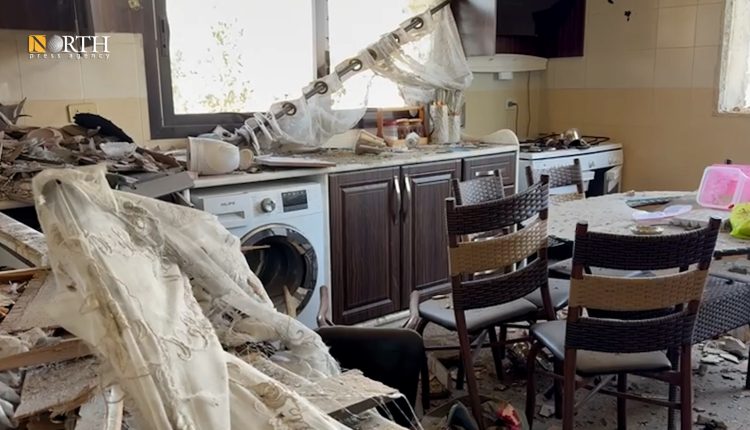
SUWAYDA, Syria (North Press) – Survivors have recounted horrifying details of an armed raid carried out by militants wearing Syrian army and General Security uniforms—some bearing ISIS insignia—on the home of Hussam Saraya, a U.S. citizen of Druze origin. Saraya and seven of his family members were later executed in a public square in the city of Suwayda, southern Syria.
On Tuesday, the U.S. State Department confirmed the killing of an American citizen during the recent wave of violence in Suwayda, which erupted in mid-July. This confirmation came after disturbing reports and graphic videos surfaced showing a mass execution, including that of Saraya and seven of his Druze relatives.
The victim was identified as 35-year-old Hussam Saraya, a Syrian Druze originally from Oklahoma, where he had studied before returning to Syria to care for his ailing father. He was among eight men executed in the Tishrin Square in Suwayda on July 15.
In this report, women who survived the attack recount to North Press how gunmen stormed the family home at dawn with machine guns and grenades, dragged the men outside, and later executed them in what has been described as a premeditated massacre.
“Some were General Security forces”
A relative of Hussam Saraya, who spoke on condition of anonymity, said, “All seven male members of the family and a friend were summarily executed by armed men, some of whom were from the General Security Directorate.”
She added that the family members were asleep when the attackers broke into the home and dragged the men out barefoot and in their sleepwear.
Describing the attack, she said, “At dawn, as everyone was sleeping, we woke to the sound of armed men surrounding the neighborhood. Then came gunfire, grenade explosions, and RPG blasts that shook the walls and turned the house upside down.”
What followed was one of the bloodiest massacres to shake public opinion in recent months—leaving at least eight young men dead, including one with U.S. citizenship—alongside systematic looting and threats of annihilation.
“They besieged us, bombed us, and took our sons,” she said. “One of the victims, Karim Saraya, sensed something suspicious outside. Moments later, bullets were flying at the house.”
The attackers launched grenades and RPGs, destroying parts of the home. The witness said the number of gunmen was large, and they encircled the house from all sides.
She recalled hearing chants of “Allahu Akbar,” and one attacker calling out to a man named Abu Qutaiba to ask how many young men were inside. Abu Qutaiba responded that there were six family members, plus a nephew and a visiting friend—eight in total.
“Some wore ISIS insignia”
The witness, who survived the assault, said the men tried to retreat to the upper floor to defend themselves with the limited weapons they had, even though they had committed no crime. After about 30 minutes of clashes, one man was wounded. The group then offered to surrender in exchange for safety. The attackers agreed.
“Once they surrendered, other gunmen entered, ordered us into one room, threatened us, and searched the house for weapons,” she said.
Some of the attackers wore military uniforms, others wore clothing marked with ISIS symbols.
“Later, I saw a video showing one of the attackers—dressed entirely in black and affiliated with General Security—leaving our home. His name is Abu Jaafar, and he’s from Deir ez-Zor. He seems to be the regional commander.”
The victims were identified as: Ghassan Saraya, his sons Hussam Saraya (U.S. citizen), Karim, Ali, Walid, and Yahya Saraya, their nephew Ismail Janbi, and a family friend Amer Faqih.
“The killings were accompanied by looting and threats. The attackers raided our home four times—searching, stealing, and eventually taking car keys, jewelry, money, and three vehicles,” she said.
Eventually, the surviving women fled to a neighbor’s home.
There was no form of terror, threat, or theft we didn’t experience,” she said.
“Republican Guard involvement”
Another relative and survivor said the attack began around 5:30 AM when she noticed unusual movement in Tishrin Square.
“I looked out and saw dozens of gunmen in black uniforms surrounding our building. I told my sister they looked unfamiliar. She said, ‘They’re probably our people.’ We didn’t expect what came next.”
Gunfire erupted, and one man attempted to flee but was cut down in a hail of bullets. As explosions grew more violent, the family hid in the bathroom.
“One of the loudest blasts hit the kitchen—it blew the door off.”
She managed to speak briefly with her husband during the raid. He told her to stay hidden and not ask questions. Later, a cousin informed her that the men had been taken hostage—and that the gunmen were also looking for the women.
“Crying, I walked toward the door with my daughters. Two gunmen blocked our path. We were rounded up into a room and locked in. Then two others entered, demanded our gold, car keys, and started emptying the house.”
One group of looters was startled to find the women still inside.
“One gunman pointed his weapon and shouted, ‘Why didn’t you say you were here?’ We told him we thought all the groups were working together since the morning.”
“He locked the door and said, ‘We’ll exterminate them.’ But another came later, opened the door, and said, ‘Don’t kill them. Some are beautiful. Leave them.’”
The militants then moved the women to a corner of the room and continued looting. One man who claimed to be from the Republican Guard entered and asked them to stop crying, promising to take them to his family in Daraa. The women requested to go to the neighbors instead, and he allowed it.
They spent the night with neighbors while the looting continued. In the morning, more armed groups arrived and told the women to leave the area.
“My husband, four of my brothers-in-law, and two of their sons were killed. They didn’t spare a single young man in the house,” she said. “Only my husband’s nephew survived—he was on vacation from the UAE.”
U.S. State Department calls for accountability
Suwayda has witnessed bloody clashes in recent weeks between local Druze factions and armed groups from Arab tribes backed by the transitional government led by Ahmad al-Shaara. The violence has claimed hundreds of lives, including civilians executed in summary fashion.
Widely circulated videos show the Saraya family members kneeling before being executed by gunmen in military uniform, amid religious chants.
In a statement to North Press, the U.S. State Department expressed deep concern over harm to American citizens abroad, offered condolences to the victim’s family, and confirmed it is providing consular assistance.
The Department emphasized that the U.S. government calls for accountability in all cases where its citizens are harmed abroad.
The killing of Hussam Saraya comes amid fierce conflict in Suwayda that has left over a thousand people dead or wounded. The fighting has primarily pitted Druze factions against tribal and Bedouin fighters, further complicated by the government’s involvement. A fragile ceasefire has been in place for two days.