
By Malin Mohammed
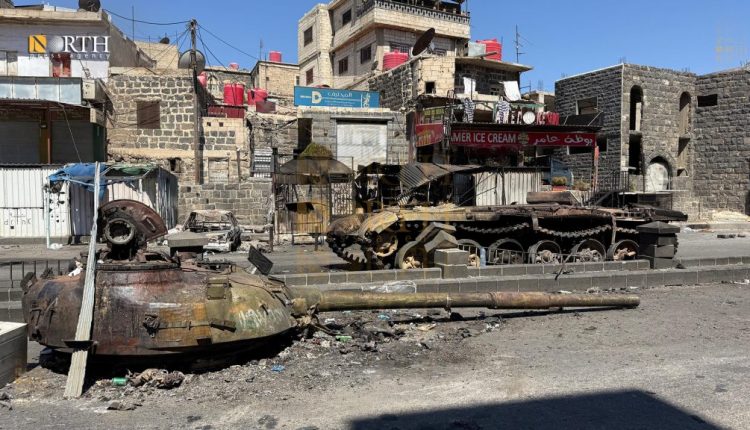
SUWAYDA, Syria (North Press) – Images of destruction now define the streets of Suwayda in southern Syria, following the deadliest wave of violence the city and its countryside have seen in years. Days of intense clashes since July 13 have left wide swaths of devastation, revealing the depth of the tragedy endured by local residents.
The violence erupted after an incident involving armed robbery and the kidnapping of a driver on the Suwayda–Damascus highway. Tensions quickly escalated into full-scale clashes between Druze armed factions and Bedouin tribal militants. According to field sources, the fighting resulted in approximately 2,000 people killed or wounded.
North Press obtained testimonies from survivors who lived through what many described as the darkest days of their lives—recounting mass killings, human rights violations, and widespread fear.
Eyewitness accounts of massacres
Ismail Badr, a local resident, shared a chilling account of a massacre in the guest house of his extended family, saying, “Claimed to be General Security forces, seven or eight members entered our house. They came here, we gave them coffee and cold water, and they left.”
He added, “They came back the next day at seven in the evening. The same people came here and committed this massacre. 16 people were killed in the massacre.”
He named the victims, including relatives and neighbors: Saeed Badr, Mohammed Ali Badr, Amjad Ismail Badr, Nabil Suleiman Badr, Nasser Kamal, Manaf al-Malham, Ghassan Ishtayy, Jawad al-Taqi, Jiyad al-Taqi, Kinan al-Los, Alaa Nabil Badr, Shadi Saeed Badr, Omar Ghassan Badr, and Ziad Saeed Badr.
He also recalled how the attackers humiliated a respected elder before executing him, “they shaved his mustache and killed him. They insulted him in an unreasonable way.”
Firas Badr described the initial attack on the city, “They started shelling the market first on Sunday. They searched and destroyed the entire market.”
Another resident, Safwat Ridwan, narrowly escaped with his wife when a missile struck just three meters from their home on the morning of July 14, as the clashes reached their peak.
“We were surprised how they began with rocket launchers, tanks, and mortars against civilians.”
Government response
On July 14, Syria’s Ministries of Defense and Interior announced the deployment of security forces and reinforcements to Suwayda countryside in an effort to quell the violence between local Druze factions, Bedouin militants, and armed groups from neighboring Daraa.
Interior Ministry spokesperson Nouredin al-Baba blamed what he called “separatist elements” for the escalating unrest.
“There is no solution for Suwayda,” al-Baba said, “except through the return of state authority, activation of state institutions, and restoration of the security and military apparatus to protect civilians.”
The situation grew even more complex following Israeli airstrikes that targeted Syrian government positions in Damascus, Daraa, and Suwayda. Subsequent international mediation led to a nationwide ceasefire order issued by the Syrian presidency, which also included a redistribution of internal security forces comprised of local residents.
In the past two days, the first group of trapped families was evacuated from Suwayda toward Daraa under an agreement between the Syrian government and local armed factions. On Wednesday, North Press documented the evacuation of 400 individuals from inside the city.
International reactions
The international community has begun to respond to the crisis. U.S. Special Envoy for Syria, Thomas Barrack, warned that the risks in Syria were dangerously high and revealed that he had advised Syrian President Ahmad al-Sharaa to reconsider the current composition of the military.
Turkish President Recep Tayyip Erdoğan, speaking during his return from Cyprus earlier this week, accused Israel of deliberately destabilizing the region. He said that Israel continues its provocations and clearly believes a unified Syria is not in its interest.
France expressed deep concern over the escalation in southern Syria. In a statement, it called on all parties to strictly adhere to the ceasefire, ensure civilian protection, resume humanitarian aid, and restore basic services in the region.
Human Rights Watch also issued a report on Wednesday, stating that the fighting between Druze-led local factions and armed Bedouin tribes was significantly worsened by both Syrian government intervention and Israeli airstrikes. The organization warned that the result has been a serious humanitarian crisis.