
By Khalaf Ma’o
SUWAYDA, Syria (North Press) – In a stark reflection of Syria’s deepening internal divisions, money transfer and exchange companies in Aleppo, Daraa, Idlib, and Damascus announced a complete suspension of dealings with merchants in Suwayda, following recent violent clashes in the southern city and Israeli airstrikes on the capital.
In a statement issued by the Aleppo Merchants’ Association, both domestic and abroad, the Druze factions’ actions in Suwayda were labeled “a betrayal of the nation,” warning that any merchant engaging with financial entities in Suwayda “will be publicly exposed and banned from all exchange and remittance platforms.”
What happened in Suwayda?
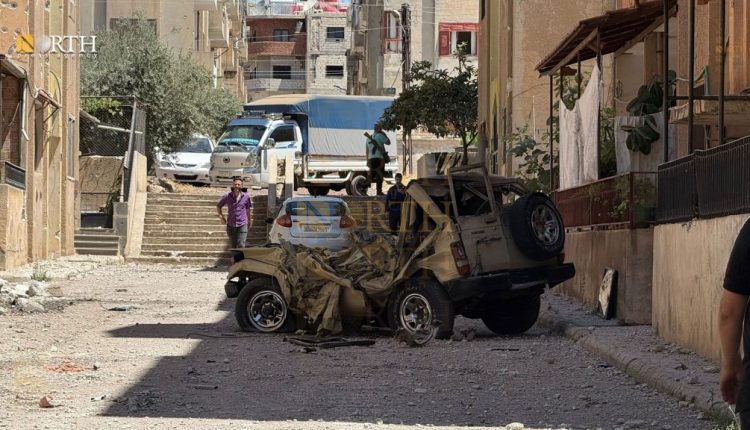
The economic boycott comes in the wake of rapid security escalations in Suwayda since July 13. Clashes erupted between Syrian security forces and local Druze factions, resulting in over 300 civilian and combatant casualties.
Following an initial agreement permitting government forces to enter the city, spiritual leader Sheikh Hikmat al-Hajri accused the government of violating the deal and waging a campaign of “extermination.” In a video statement, he called on the Druze community to resist the military incursion, citing extrajudicial killings and abuses committed against civilians.
In a related development, Israeli airstrikes targeted military and security installations in Damascus, Suwayda, and Daraa, including the presidential palace and the Syrian army’s general command.
Responding to the strikes, Syria’s Transitional President, Ahmad al-Sharaa, said in a televised speech that Israel was attempting to derail the ceasefire and drag Syria into open war. He emphasized that the government chose de-escalation by empowering local Druze leaders to mediate, rather than risking nationwide civil war. Al-Sharaa reiterated the state’s commitment to protecting the rights of the Druze community as an integral part of the Syrian national fabric.
International mediation and ceasefire
As tensions mounted, the United States reportedly engaged in behind-the-scenes diplomacy to halt the Israeli airstrikes in exchange for a government withdrawal from Suwayda. Heavy military units pulled out of the city by July 16, with al-Sharaa confirming that Arab, American, and Turkish mediations had helped avert further escalation.
By July 17, the Syrian security forces had completed its withdrawal from Suwayda, coinciding with the official start of a ceasefire in the governorate, according to field sources reported by North Press.
Meanwhile, Syria’s state news agency SANA reported that France had expressed its support for the Syrian government’s efforts to resume dialogue in Suwayda. The French Foreign Ministry voiced concern over the ongoing conflict and urged all parties to prioritize civilian safety and restore calm, affirming its commitment to the principles of the February 13 joint declaration and ongoing engagement with all stakeholders.
Suwayda declared a disaster zone
The Druze community’s spiritual leadership declared Suwayda a “disaster-stricken city” on Thursday, stating:
“In these difficult hours, and after purging Suwayda of terrorists, we announce a general mourning for the martyrs.”
They called on medical and human rights teams to be allowed full access to the city and urged for humanitarian corridors to be opened, especially toward the Kurds in northeastern Syria. Additionally, the leadership appealed to Jordan’s King Abdullah II to open a border crossing between Suwayda and Jordan for humanitarian purposes.
In a gesture of solidarity, the Autonomous Administration of North and East Syria (AANES) announced the dispatch of urgent aid to Suwayda, describing it as a “first step in a series of forthcoming initiatives.” It called for the protection of civilians and condemned the politicization of their suffering.
The AANES reaffirmed its full solidarity with the people of Suwayda and stressed the need to shield civilians from the devastating impact of political and military conflicts.
Now caught between internal economic sanctions, northern aid efforts, and international interventions, Suwayda stands as a stark intersection of all the fault lines in Syria’s enduring conflict.