
ALEPPO COUNTRYSIDE, Syria (North Press) – Three years ago, Nazliya Jemmo, a resident of the village of Soghana in Sherawa district, south of Afrin, northwestern Syria, has been unable to harvest olive trees from her land near the areas occupied by the Turkish forces and the opposition factions, as the latter deliberately shoot those who try to approach those lands.
“We have lands that we cannot cultivate, and olive trees that we cannot pick their fruits, we often hurt when we look at our trees. We currently rely on vegetable oil, we regret the olive oil and its grains, for four years, we have not been able to get close to our lands,” Jemmo said.
She completed with regret and heartbreak “They set fire to land and trees and cut them down, they burned 350 olive trees in our land on the edge of the village of Gobaleh.”
“From the rooftop, I watched my trees burn, I cried then started slapping my face, I cursed Erdogan.”
Jemmo, with the help of some young men from the village, tried to put out the fire, but the Turkish forces and the factions shot everyone who tried to approach the fire at the time.
“I preferred to die in my land than to see my trees burning. After several attempts, we put out the fire, and after we returned to the village, they set the fire again,” she added.
Soghana is less than 2 km away from the Turkish-held areas of Afrin, thus forming the dividing line between Turkey and the armed Syrian opposition factions on the one hand, and the Syrian government forces on the other.
“We bemoan our olive oil”
The city of Afrin and its villages, north of Aleppo, have been controlled by Turkish forces and the affiliated factions since March 18, 2018, which caused the displacement of more than 300,000 of Afrin’s indigenous people to Shahba area in the eastern countryside of Aleppo.
At that time, Turkey did not impose its grip on Soghana and other villages in the Sherawa district (Aqiba, Ziyara, Mar’anaz, Ibbin, Mayasa, Zarna’it, Burj al-Qas, Zouq al-Kabeer, Kalouta), as the Syrian government forces took possession of them after the withdrawal of the People’s Protection Units (YPG) from them.
However, the presence of the government forces in those villages did not prevent Turkey and the Turkish-backed factions from targeting them from their positions in Afrin with artillery shells on an almost daily basis.
Jemmo bemoans her situation in the village, which has become almost empty of its residents. “We bemoan our olive trees. We currently rely on vegetable oils for cooking, and we haven’t tasted green olives for years.”
As Jemmo wanders between the destroyed and empty houses of her village, she talks about what the village witnessed about ten days ago, “A shell came from the village of Kimar, we did not know where it fell, seconds later other shells fell, we could not get out of the house because of the intensity of the shelling. They bombard us randomly. We panicked.”
A few kilometers from the village of Soghana, Yahya Hamid, a resident of the village of Burj al-Qas, owns more than 600 olive trees located in the western end of the village.
“For four years, I haven’t been able to pick a single grain of it. The opposition factions that control the neighboring village of Brad have planted mines in the land,” he said.
He added, “I feel a pain in my heart when I can’t find an olive for breakfast or olive oil to use in cooking.”
Only 20 families
About ten days ago, the Turkish forces and the affiliated armed opposition factions targeted villages in Sherawa district with dozens of shells, causing material damage to the residents’ property.
On June 4, a 14-year-old girl was killed, and her brother and father were wounded, in a Turkish bombardment of the family’s home in the village of Kalouta, in Afrin’s Sherawa district.
Few days before, several villages in Afrin countryside were subjected to Turkish bombardment, damaging livestock and civilian property.
Additionally, the shelling caused fire to break out in the forest between Aqiba and Soghana villages in the same area.
Out of 120 families that lived in the village of Soghana, only 20 remained, as the families were displaced to neighboring villages and areas in the northern countryside of Aleppo, after several houses were destroyed and people were injured, including several women and one child according to residents of the village.
On August 4/ 2019, the Turkish-backed armed factions bombed the village of Soghana with more than 100 mortar shells, wounding four people from one family.
Madina Youssef, with her husband and two children, who lived in the eastern side of Soghana, moved to the house of one of their relatives in the center of the village to be close to the caves during the bombing.
During the intensification of the bombardment, the remaining residents take shelter in the natural caves that are abundant in the village.
Youssef said that during the bombing they stay in the cave for more than eight hours. “We don’t know when they will bomb us. You have to be near the cave so you don’t die. They bomb us at dawn, noon or late at night.”
Destroyed houses
The bombing causes fear and panic to the residents, especially children and adults, “They cannot sleep because of fear. A few days ago, while we were going to take shelter in a cave, an aircraft bombed the nearby village of Basila. My children panicked and slept without eating dinner,” Youssef said.
Youssef can’t go to her family’s olive trees farmland, “they burned part of it and the other part we cannot approach.”
Despite the difficult security conditions in the village, the 82 year-old Hanifa Khalil refused to leave her house, “To where should I go and leave my house that I built stone upon stone, I will not leave my homes.”
With her old age, the woman finds it difficult to go to the caves during the bombing, “I cannot walk properly, I face difficulty while heading to the cave, sometimes shells fall on the village while I head to the cave.”
During the past year, Khalil’s family lost 20 head of sheep in a bombing and the explosion of mines.
The village of Soghanah is surrounded on several sides by a belt of mines, which killed three residents of the village, in addition to the injury of a woman, during the past years.
According to the Sherawa district council, the Turkish bombing of villages in the district has caused the destruction and damage of more than 40 houses.
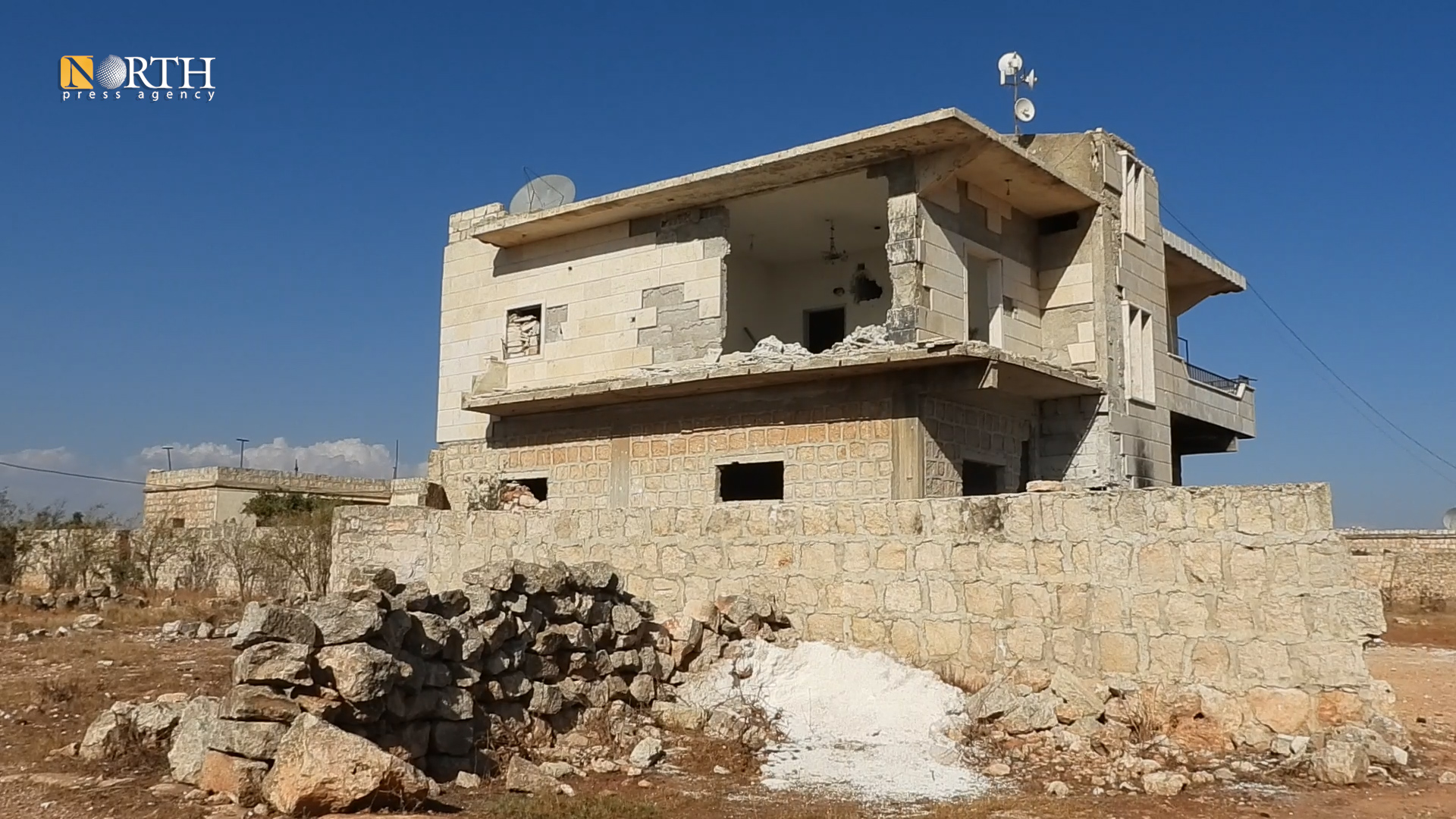
In March 2020, the opposition factions, based in the village of Brad, targeted the house of Zuhair Ahmed, a resident of Burj al-Qas, with artillery shells, destroying parts of it.
Ahmed was forced to leave his house and move to another house in the village. “My house is no longer habitable, because I am afraid that it will be demolished over our heads, and I do not have the money to rebuild it again.”