
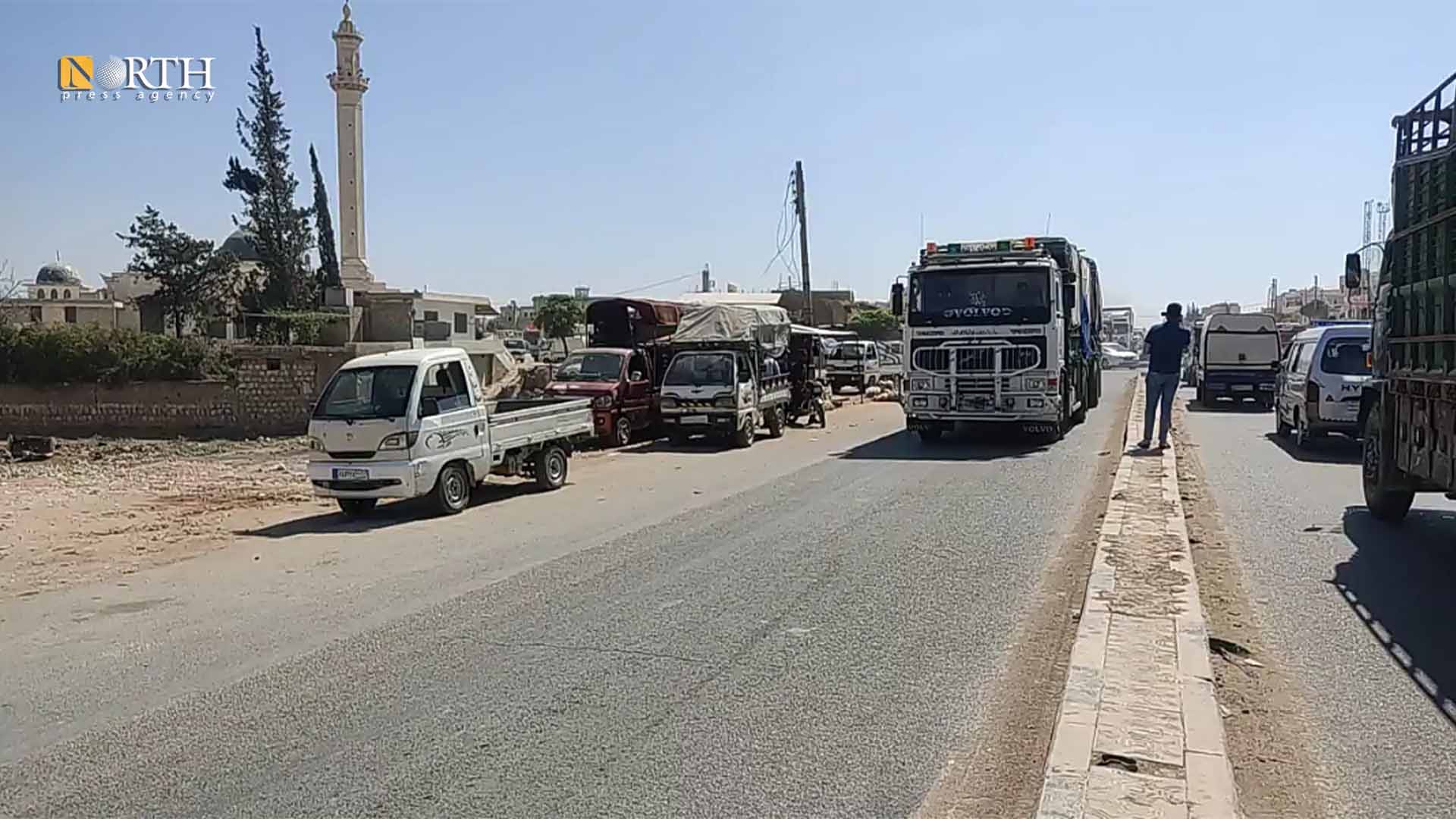
IDLIB, Syria (North Press) – Political analysts and politicians in Idlib, northwest Syria, fear that the mechanism of the entry of aid and its future distribution will be carried out through Damascus only, following the opening of a crossing between government-held areas and areas controlled by Hayat Tahrir al-Sham (HTS, formerly al-Nusra Front).
On August 30, three trucks carrying humanitarian aid affiliated with the World Food Programme entered HTS-controlled areas through the Ma’aret al-Na’san-Miznaz crossing, coming from government-held areas.
On August 31, 15 trucks carrying international aid entered opposition areas from the same crossing.
The opening of the crossing shocked the popular base of the opposition factions and HTS, and raised questions over HTS’ aim behind providing full protection for the trucks, which arrived at warehouses near the Syrian-Turkish border after travelling 45 kilometers within the opposition-held areas.
The HTS Administration of Crossings said that the opening of the Ma’aret al-Na’san-Miznaz crossing was “for relief purposes and to facilitate the entry of some international relief convoys to the Assad regime-controlled areas to reach our people there.”
The Administration explained that some materials from the warehouses of international humanitarian organizations will be transferred from government-controlled areas in Aleppo to the opposition-controlled ones, and then the aid that arrives through the Bab al-Hawa border crossing, north of Idlib, will be distributed to all areas according to an agreed-upon plan.
The opening of the new crossing faced popular rejection and calls for protests and blocking of roads to the entry of these trucks, as residents believe that political goals may be behind it, while others questioned the reasons for the opening of the crossing in light of the existence of Bab al-Hawa crossing, through which UN aid already enters Idlib.
Legitimizing the Assad regime
Activists in Idlib consider the opening of the crossing “an attempt to legitimize the Assad regime” before the international community. They also accused HTS of exploiting the Syrian crisis in the areas it controls, especially as the opening of the crossing came after a military escalation by government forces in Zawiya Mountain, south of Idlib, and Ghab Plain, in the western countryside of Hama.
“The opening of the crossing is due to the deliberations that took place prior to the adoption of the recent Security Council resolution, which announced the extension of the entry of humanitarian aid through the Bab al-Hawa border crossing with Turkey,” Nasr al-Youssef, a political analyst specializing in Russian affairs, said.
On July 9, the United Nations Security Council issued a decision to extend the mechanism of the entry of humanitarian aid through the Bab al-Hawa border crossing with Turkey into northwest Syria in two stages, each lasting for six months, without opening or authorizing any other crossings.
However, one of the conditions that prevented Russia from using its veto is “the opening of crossings with the Syrian regime and the entry of some aid from the areas the government controls to the opposition-held areas. It is what Russia managed to achieve to confirm the legitimacy of the regime,” according to al-Youssef.
Two days before the issuance of the decision of extending the aid, Russia demanded through the Russian President’s Special Envoy to Syria Alexander Lavrentiev that the mechanism for delivering aid across the Syrian border be halted, and that it should only arrive through Damascus.
Opening of commercial crossings
Military analyst Ahmed Rahal expressed his fears that after the end of the first stage of the delivery of humanitarian aid, Russia will submit a report to the Security Council confirming that humanitarian relief entered opposition-held areas from government-held areas without issue.
“This may lead to the closure of Bab al-Hawa crossing and the transfer of all UN aid to the Syrian regime, and it is certain that the regime will not distribute any of this aid to the people,” according to Rahal.
“The entry of this aid is very important to Russia and the regime, as it breaks Assad’s isolation because he has been trying for nearly two years to open crossings between it and the opposition-controlled areas under Russian pressure.”
He pointed out that HTS leader Abu Mohammad al-Jolani is the only one making decisions, “which allowed him today to make a decision on behalf of the Syrian revolution.”
He described this situation as “very dangerous.”
Meanwhile, official spokesman of the Turkish backed Jaysh al-Izza opposition group Colonel Mustafa Bakour said that opening the crossings with the government “contributes to alleviating suffering in its areas of control, thus strengthening it and showing it that it provides services to areas outside its control, especially the delivery of humanitarian aid.”
From Bakour’s point of view, it is natural for Russia to object to the renewal of the authorization to enter aid through Bab al-Hawa crossing next time, given that whoever controls Bab al-Hawa is an “illegal authority in their perspective, and that the regime does not impede the delivery of aid to all areas.”
Bakour did not rule out opening commercial crossings with government-controlled areas in the coming period.