
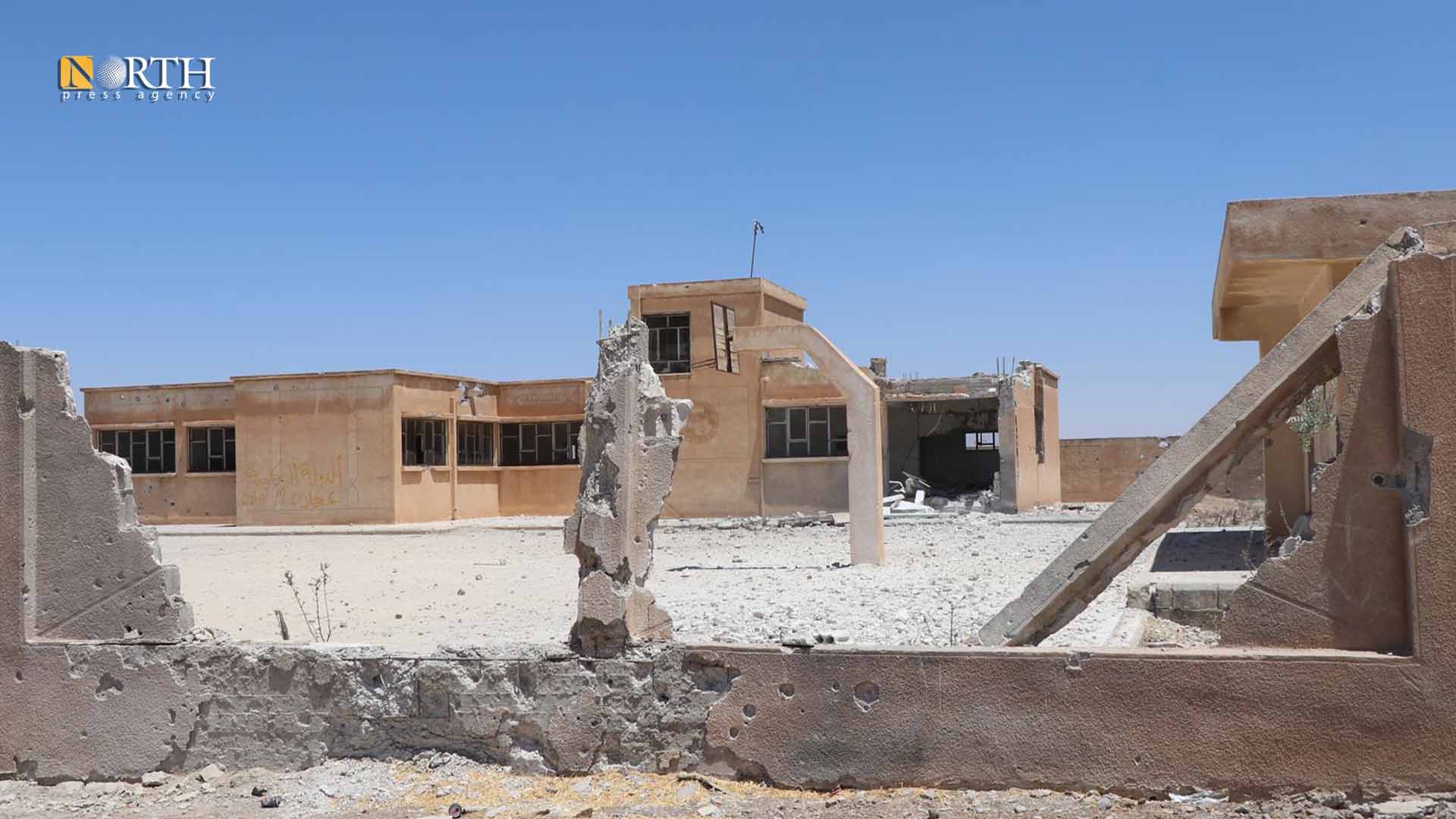
TEL TAMR, Syria (North Press) – Less than a kilometer from the front line with Turkish-backed factions west of the town of Tel Tamr, northeastern Syria, Qatana Mara’i, from the village of al-Gozaliya, stands near her sheep barn, which was destroyed by the Turkish bombing a few days ago, and talks about the moments of terror experienced by the residents few days ago.
“They bombed us; we were afraid and we rushed to our neighbor. They destroyed our barn and our generator,” Mara’i said of the Turkish bombing of her area a few days ago.
Since late 2019, dozens of villages west of Tel Tamr have turned into a front line after the Turkish invasion of Tel Abyad (Gere Spi) and Sere Kaniye (Ras al-Ain) until Tel Tamr’s borders in late 2019.
The M4 Highway became the dividing line between the areas of deployment of the Turkish-backed armed factions and the government forces that were stationed near the front lines under Russian auspices.
Since the Turkish army and the Turkish-backed armed groups were stationed along a length of 40 km in the countryside of Tel Tamr, residents of villages on the front have suffered from repeated attacks despite the existence of a ceasefire between the Syrian Democratic Forces (SDF) and the Turkish army following US-Turkish and Russian-Turkish agreements.
The Turkish army and opposition groups stationed in the villages of al-Arbaeen and al-Amiriya, located along the M4 Highway west of the town, cause the residents to flee the villages and spend their nights in the open.
“We sleep in the open; every day after sunset we leave our homes. We don’t dare to stay at home,” Mara’i added.
Destroyed school
On June 29, Turkish bombing targeted the village of al-Arisha on the M4 Highway, west of Tel Tamr, with heavy weapons.
The Turkish bombardment of al-Arisha came three days after a similar bombardment on the village of al-Gozaliya, adjacent to the front lines west of Tel Tamr, which resulted in the death of 18 sheep and material damage to civilian property.
More than 70% of the village school, which was attended by primary school students in the area, is destroyed and is now out of service due to the Turkish bombardment.
Mara’i, looking at the ruins of the school, says that one of her children used to attend it and that she does not know how her children will continue their education in this state of destruction.
She further explains: “They destroyed the school; my four sons were studying here, my ninth grade son was studying at Arba’in school, and it was also destroyed. I had a fourth grade son who was supposed to get his school certificate, but due to the bombing he didn’t take it.”
“We can’t send them to schools in other towns. We can’t afford to send them to other towns. They won’t finish their education, what will they do in their life?” the mother said.
We sleep in the open
Last week, Turkish bombing caused damage to the electricity networks and left holes in the outer walls of the village homes due to the shrapnel from the shells.
On May 16, Turkish-backed armed opposition groups attacked a shepherd in the village of Tel Karabit, 10 km west of the town of Tel Tamr, and stole 200 of his sheep.
On May 30, pro-Turkish armed opposition groups tried to infiltrate from the village of al-Qasimiyah, which is under their control, towards the village of Umm al-Keif, 2km from the town.
Since the beginning of the year, Turkish forces and their affiliated armed groups have bombed the countryside of Ain Issa and Tel Tamr 206 times, in addition to launching more than ten ground attacks, according to a statement by SDF Media Center.
Within the same village, the elderly Fatima Khalil walks around, and also talks about sleeping in the open.
“We spend the night there and come back in the morning. Everyone is leaving the village. We sleep on the ground, taking our blankets with us.”
The eighty-year-old pointed out that even the tin panels covering the roof of her house were not spared from the Turkish bombing.
“As you can see, our homes and property were all damaged. Even the tin covering the roof of the house was not spared from the bombing. Our corn, cotton, and vegetable crops were destroyed. We fled to the open because of the bombing.”