
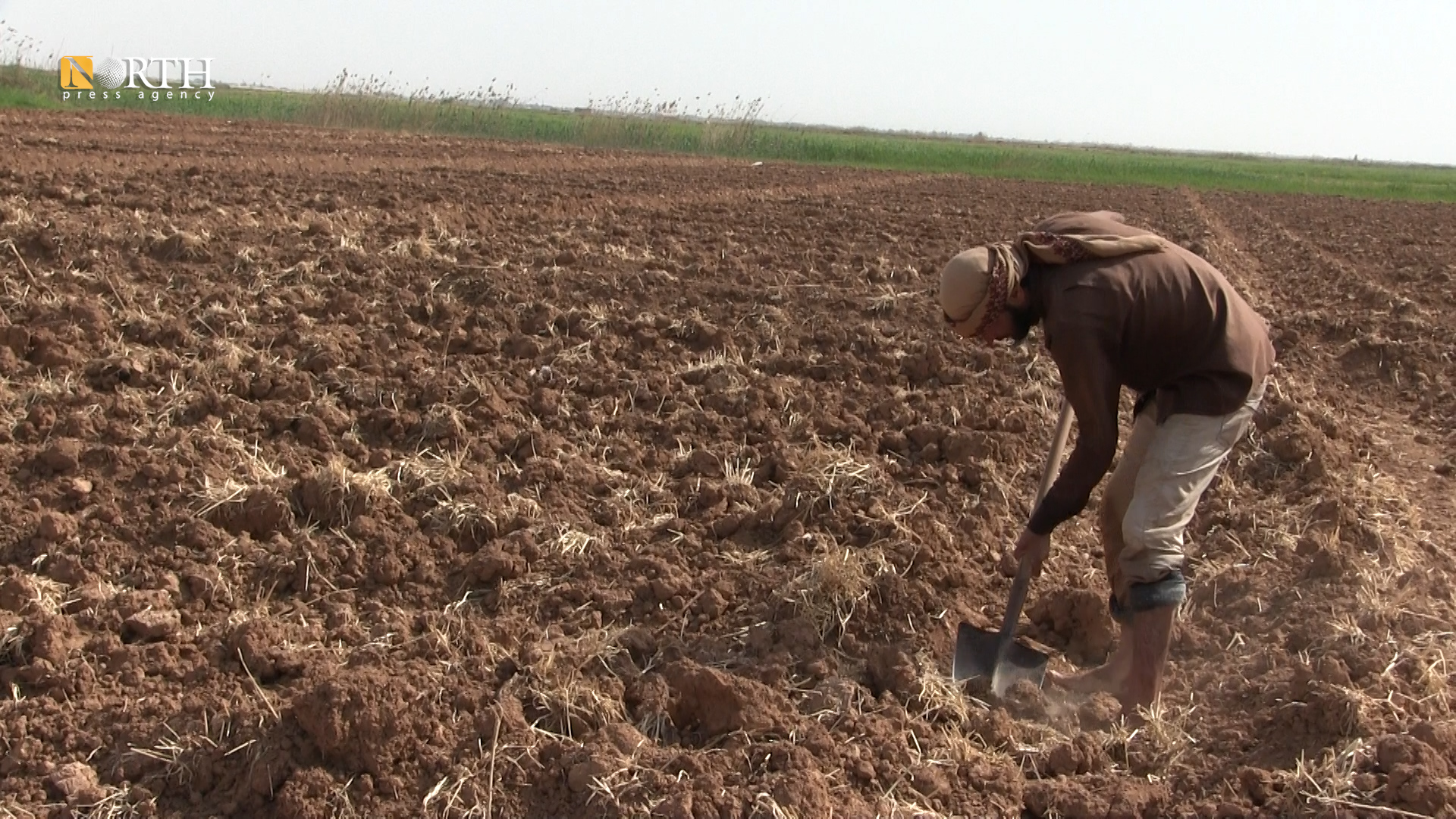
RAQQA, Syria (North Press) – This year, Aboud al-Abd, a farmer from the village of al-Mizallah, north of the city of Raqqa, is plowing his land in preparation for cultivating it with cotton.
However, al-Abd did not use the needed fertilizers for this stage of cultivation because he did not receive his allocation from the Agriculture Committee.
Expensive fertilizers
Each acre of cotton needs a special formulation of fertilizers to be sprinkled during plowing in order to fertilize and strengthen the plant during growth.
Each acre needs 15 kg of nitrogen fertilizer and 15 kg of urea fertilizer, according to al-Abd.
However, the high cost of these types of fertilizers in the black market prevented the farmers from buying them, as the price of a 50-kg-bag of nitrogen fertilizer on the black market is 85,000 Syrian pounds (SYP), while it is 60,000 SYP in the Agricultural Development Company.
Meanwhile, a 50-kg-bag of urea fertilizer in the black market is 75,000 SYP, while it is 50,000 SYP in the company.
“We had to have received our allocations since the beginning of April.”
However, this year, farmers did not receive their allocations, pushing most of them to cultivate their lands without fertilizing them.
Al-Abd pointed out that they visited the Agriculture Committee asking for an answer, but the committee “argued that the farmers did not complete the documents proving each farmer’s ownership of his land and did not complete the necessary data.”
Delaying support
“They ask us to bring documents from the Syrian government Land Register, knowing that most farmers lost their documents during war that the city of Raqqa went through and during their displacement, and the majority is also unable to go to regime-held areas to bring those documents for fear of arrest,” he added.
The number of members of the Peasant Association to which al-Abd belongs is 90 farmers, which requires more time and delay until the completion of these papers.
Rich farmers have been preparing their lands since early April and bought their supplies from the black market.
“Meanwhile, we are losing time in waiting for the support; however, we prepared our land inadequately due to our poor financial conditions,” he stated.
Farmers pay the difference between the fertilizer prices in the black market and that of the company, as wages to the workers in the land, according to the farmer.
“We are late this year, our lands were supposed to have sprouted cotton at this time of the season,” said Muhammad al-Jasem, a farmer from Raqqa northern countryside.
Farmers are supported with agricultural supplies through peasants associations, which are local organizations that coordinate between the farmers and the Agricultural Community Development Company.
New method
Muhammad al-Rajab, head of the Statistics Office of the Agriculture Committee at Raqqa Civil Council, attributed the reason for the delay in support to a new mechanism followed by the Agriculture Committee to accurately count the cultivated lands.
The mechanism aims to develop an appropriate study, estimate the quantity of fertilizers and fuel that farmers need, and to ensure that the corrupt people cannot tamper with, such as receiving allocations in fictitious names and selling them in the black market.
According to this mechanism, each farmer has to hand over the documents that approve his ownership of the land that he has licensed in the Agriculture Committee through peasants associations, which number is 250.
The Agriculture Committee provides a quantity of 10 kg of urea fertilizers, 15 kg of nitrogen fertilizer, and six liters of diesel for each acre in the first batch.
“Agriculture Committee is working at a high pace in order to complete gathering all data to start providing the agriculture support as soon as possible,” al-Rajab added.