
By Fattah Issa
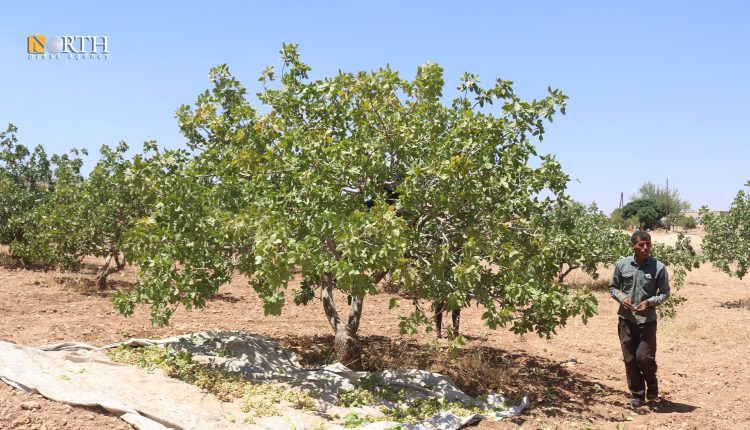
KOBANI, Syria (North Press) – The pistachio harvest in Kobani, northern Syria, has seen a sharp drop in production this year, impacted by low rainfall, high temperatures, and climate change.
Khabat Ahmad, 30, a farmer who owns 200 pistachio trees, told North Press that this season’s yield is only about 10 percent of last year’s.
He explained that last year, his trees produced about 800 kilograms, earning him more than $2,000. This year, however, production will not exceed 100 kilograms, making it an extremely poor season.
Ahmad attributed the decline to low rainfall, climate change, a drop in groundwater levels, and the lack of sufficient humidity needed for fruit growth.
He added that last year’s harvest benefited from adequate humidity, irrigation water, and high-quality pesticides and fertilizers. This year, however, farmers have been unable to secure the right pesticides due to security conditions and the closure of the trade route to Manbij.
Pistachio trees typically produce well every two years, but Ahmad noted that the number of buds expected to yield next year’s harvest is already very low. This signals another weak season ahead, due to the absence of the moisture required for bud growth.
He pointed out that groundwater levels for irrigation have dropped significantly, especially as more wells have been dug in the area this year.
Higher prices, lower output
Despite the doubling of pistachio prices this year, last season’s financial returns were much better due to the higher output.
In good seasons, a single tree yields between 14 and 25 kilograms, but in poor seasons, production may not exceed one kilogram per tree.
Mustafa Baki, 46, a farmer from the village of Boban in Kobani western countryside, told North Press that comparing this year to last year reveals the magnitude of the decline. Last season, 20 workers picked the crop daily from his 150 trees, producing more than three tons. This year, he has harvested only with his family, producing little to nothing so far.
He added that this year’s harvest was heavily affected by high temperatures, with production reaching only 400 kilograms compared to last year’s three tons — despite pistachios usually producing well every two years.
Closed routes
Seif al-Din Ali, 51, a pistachio trader from Kobani, told North Press that the price of pistachios rose from about $1.90 per kilogram last year to $3.80 this year.
He explained that low production this season has hurt farmers’ earnings despite higher prices. He noted that the closure of the trade route between Kobani and Manbij has significantly impacted pistachio trade.
Now, traders sell their harvest to Sarmada in Idlib countryside, from where it is exported to Gulf countries such as the UAE and Saudi Arabia.
Ali said higher prices are directly tied to lower production, following the basic rule of supply and demand. The absence of traders from Manbij has reduced the number of buyers, giving the remaining few greater control over prices.
Currently, pistachios are sold in Manbij for about $4 per kilogram, while they are bought locally for $3.80, factoring in taxes and transportation costs to Sarmada.
Ali estimated that Kobani produced more than 2,000 tons of pistachios last year, while this year’s output will not exceed 200 tons. He expects the buying and selling season to last only 15 days this year, compared to 45 days last season, due to the small crop.
Threatened livelihood
Most farmers in western Kobani countryside villages rely on pistachio farming as a main source of income, with around 150 trees planted per hectare on average.
Pistachios are considered more profitable than wheat or barley, leading many farmers in recent years to expand their pistachio plantations at the expense of traditional crops.
A mature pistachio tree can yield between 70 and 80 kilograms, and each hectare produces about four tons annually on average, according to farmers’ estimates.
Kobani recorded a pistachio boom in 2024, encouraging expansion of cultivated areas. However, this year’s climatic, security, and trade challenges have put that growth at risk, threatening farmers with heavy losses.