
A look at a year of Ukraine’s war, its effects on the Middle East
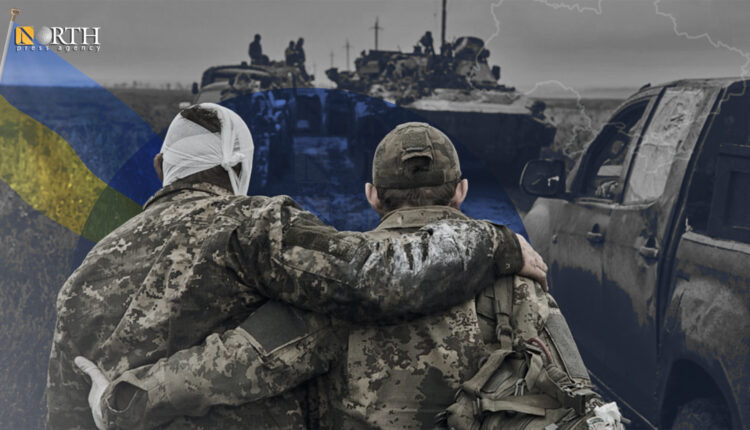
QAMISHLI, Syria (North Press) – The Ukrainian war did in a year what the Syrian civil war took a decade to achieve. Up to 300.000 soldiers on both sides have been killed and wounded. An additional 40.000 civilians are dead or injured. 7.5 million Ukrainians have been internally displaced, and an estimated four million have fled the country, being welcomed with open arms by European nations. Already, the US has sent Ukraine around $76 billion in aid – or around five times as much as it has sent in humanitarian aid to Syria in the past 12 years.
In many ways, the two conflicts are different beasts. In Ukraine, the West has unexpectedly found itself entangled in Cold War dynamics and amid trench-based warfare in Europe. In comparison, Syria was always a sideshow in which regional powers backed local insurgent groups.
How did it come to this?
Ukraine’s independence has been a Western interest since the Soviet Union disintegrated in the early 1990s. A number of former Eastern Bloc countries – Poland, Hungary, and the Czech Republic – joined the North Atlantic Treaty Organization (NATO). In 2004, it was expanded by most of the remaining eastern European nations, including the Baltic states, which had formed part of the Soviet Union, like Ukraine. The move followed Russian aggression in Chechnya and Abkhazia, in the Caucasus.
In April 2008, Ukraine and Georgia expressed interest in joining the alliance. Later that year, Russian troops marched into South Ossetia – sovereign Georgian territory. They have been there ever since.
Voices pushing for NATO accession only grew in Ukraine. In 2013, its pro-Russian President, Viktor Yanukovich, chose Moscow over closer ties with the European Union, inciting pro-Western protests in the country, which deposed Yanukovich in 2014.
That year, predominantly ethnic Russian regions in eastern Ukraine revolted against Kiev and Russian forces took control of the Crimea Peninsula – a Russian-speaking part of Ukraine. A sham election annexed Crimea to Russia that same year.
War in Ukraine’s east flared up periodically until 2021. Both sides accused the other of war crimes. After a number of failed peace mechanisms, Russia began to build up troops on its border with Ukraine in the spring of 2021. By early 2022, around 150.000 Russian troops were amassed at the border.
The Ukraine War
On Feb. 24, 2022, Russian troops invaded Ukraine in what Russian President Vladimir Putin called a “limited military operation”. Russian forces made quick advances before being stopped at the gates of Kiev. By April, Ukrainian forces began a successful counterattack. Later that month, Western powers held their first meeting to discuss providing the Ukrainian government with economic and military support.
The Ukrainian forces launched another counterattack in the autumn, repelling the Russian forces from the region of Kharkiv (in the east) and the city of Kherson (in the south). Since November 2022, the fronts have been mostly frozen in place.
In September 2022, Putin called for a referendum in the occupied Ukrainian oblasts of Luhansk, Donetsk, Zaporizhzhia and Kherson, annexing them shortly after.
Russian forces have been accused of gross human rights violations and war crimes, such as the wilful killing of dozens of Ukrainian civilians in the city of Bucha. The Russian forces have repeatedly targeted nuclear installations in Ukraine; Putin has also threatened Western countries with nuclear war over support for Ukraine.
What will the Ukraine War look like in 2023?
The war in Ukraine has rapidly grown beyond anything Syria’s war has offered in the past decade. While great powers were careful to delineate their spheres of influence in Syria, they are set to clash head-on in Ukraine – with serious consequences.
Western aid to Ukraine, particularly in weaponry, is unprecedented. Nearly two-thirds of US help sent to Ukraine is of a military nature. Yet the current conflict is not sustainable in the long run. Experts say it may not even last another year at the current levels.
According to one report by The Economist, Ukraine is firing roughly as many shells in a month as the US can produce in a year. Even putting together all international munitions flowing into Ukraine, it hardly suffices for three month-worth of barrages. The situation is likely no different – or even worse – on the Russian side.
In an effort to give its David-on-the-Dnieper the upper hand over the Russian Goliath, Western states have upped not only the number, but also the type of weaponry it is sending to Kiev. In January, Germany promised to send tanks to Ukraine. It was a major step for the otherwise war-averse nation.
Yet Western states still draw a line at sending jets to the country, which has been asking for them for a long time. Giving Ukraine the capabilities of striking deep inside Russian territory may escalate the conflict with Russia, risking turning a regional war into a nuclear disaster, say military experts. Yet not providing Ukraine with these weapons could mean their defeat. A number of countries, such as the Netherlands and Poland are considering shipping planes to Kiev. It may likely define the outcome of the war in 2023.
The Middle Eastern Angle
The war in Ukraine has made ripples in the Middle East. A large number of Middle Eastern states have leveraged the war to play peace-broker. Saudi Arabia and the UAE have abstained from imposing sanctions on Russia, but have instead mediated a number of prisoner swaps between Moscow and Western states.
Israel has attempted to remain neutral, as the current administration under Prime Minister Benjamin Netanyahu has had a cozy relationship with President Putin. Both countries have coordinated airstrikes in Syria. Despite being a staunchly Western ally, Israel has so far not sent any weapons to Ukraine – though that may be about to change.
Europe’s decoupling of Russian energy has had favourable impacts on Algeria, a gas-rich country, and come at the expense of its western neighbour, Morocco. Both countries have had a tense relationship for decades. Italy, Spain and France have all deepened ties with Algiers in the past year.
Similarly, European politicians have happily been photographed at events in Baku, Azerbaijan’s capital, even as the country has imposed a crippling encirclement of the Armenian region of Arstakh. Azerbaijan, too, is a major gas exporter.
Iran, on the other hand, has provided Moscow with hundreds of drones, which Russia has employed in Ukraine. Western analysts say the Ukrainian battlefield is turning into a testing ground for Iran’s drone warfare in the Middle East. As a result of Iran’s involvement in the war and of Russia’s departure from talks, the international deal to curb Iran’s nuclear program is all but dead.
Ankara’s calculation
However, by far the largest war profiteer in the Middle East has been Turkey. Though nominally a NATO member, Turkey has played off both sides against one another. It used its powers over the Bosporus Strait in order to keep out some Russian military ships. It also provided Ukraine with a number of Bayraktar drones in the years before the war.
However, more times than not, Ankara has veered away from the Western consensus on Russia. It has acted a peace-broker at times, negotiating an agreement for the export of Ukrainian wheat.
At other times, it has provided a safe haven for Russian capital. Turkey has profited handsomely off of the war in Ukraine, becoming a hub for Russia’s elite to park their rubbles and avoid Western sanctions. Trade between the two countries is booming – Turkish exports to Russia are up 86%; imports from Russia grew by over 100%.
At a time when the rest of Europe has waned itself off of the Russian energy, Turkey has invested heavily in Russian gas and is set to open a Russian-run nuclear plant this year.
More importantly, Turkey’s President, Recep Tayyip Erdogan, has kept the NATO accession bids from Finland and Sweden hostage, putting the Nordic countries in peril. He demands the two countries – especially Sweden – expel Turkish “terrorists” before he considers their bids.
And in Syria?
The Syrian government has been one of Russia’s only staunch allies – a testament to the importance of Moscow in propping up the government of Bashar al-Assad. Besides North Korea, Syria has been the only country to recognize Russia’s annexation of the four Ukrainian oblasts. According to some reports, the government has sent a limited number of troops to fight in Ukraine.
Opposition-held areas have openly declared their solidarity with Ukraine and their disdain for Russia’s air force, which bombed many of their homes. Yet reports that opposition fighters travelled to Ukraine to fight there have so far not been corroborated.
Overall, Russia’s influence in the country has waned to the benefit of Iran, which has made its presence felt across government-controlled territory. US forces, too, were spotted in the city of Raqqa for the first time since 2019. The region west of the Hasakah Governorate had been in Russia’s sphere of influence since then. Yet despite its weakening position, Moscow still carries weight in Syria. According to some reports, it was Russia which prevented a Turkish invasion of northeast Syria last autumn, not the US.
The main effect of the Ukraine’s War on Syria has been to shift the Western gaze from the latter to the former. This has has given Israel a freer rein in conducting airstrikes against Iranian-linked targets and Turkey a window to launch attacks on Kurds in northern Syria with impunity. The meager funds which flow into the region have been redirected to the cataclysmic conflict in Ukraine. This state of affairs was only crystalized, not changed, by the deadly earthquakes which struck northeast Syria in February.