
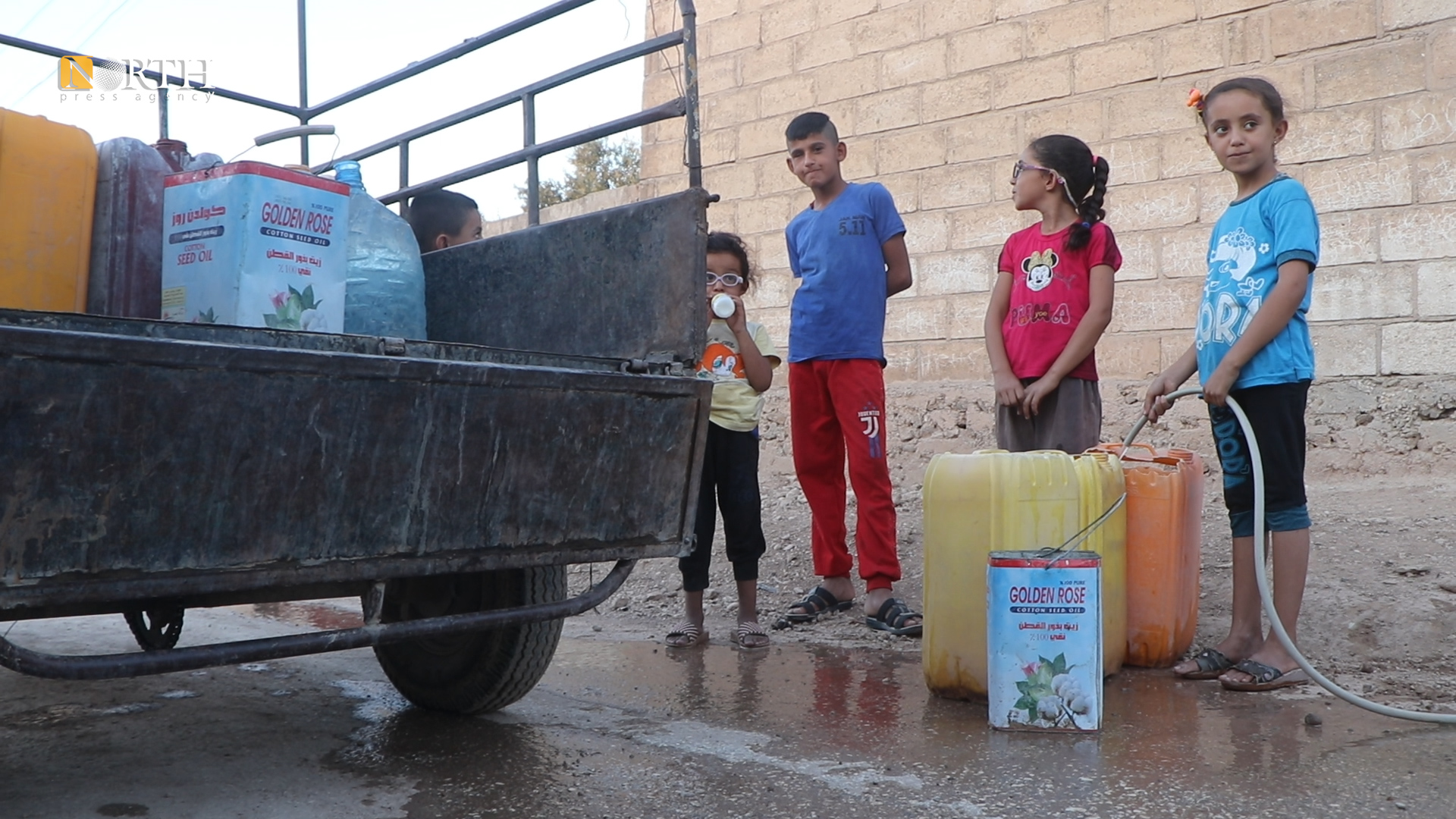
HASAKAH, Syria (North Press) – 30-year-old Yasser al-Khalaf, a resident of al-Ghazl neighborhood in Hasakah city, northeast Syria, is losing hope that he will be able to secure drinking water for his family, since the water of the project of drawing Euphrates River water to Hasakah has not reached the neighborhoods of Hasakah.
Following nine months of work on the project, water has still not reached houses, increasing burdens of residents in search of water resources.
Early in 2021, the Autonomous Administration of North and East Syria (AANES) began a project to draw the Euphrates River water from al-Suwar station in the countryside of Deir ez-Zor to Hasakah, to which the Turkish forces have cut off water by stopping the operation of Alouk station in the countryside of Sere Kaniye (Ras al-Ain) 20 times, since its control over the area in mid-October 2019.
Continuous sufferings
On August 31, the water of the Euphrates River reached the reservoirs of the water station of al-Aziziyah, but did not reach houses.
“The 130-km pipes and the lifting stations, which have recently entered into service, are still under testing, with the arrival of quantities of water to the tanks of the Aziziyah Water Station,” Salwa Saleh, co-chair of the General Directorate of Drinking Water in Hasakah, northeast Syria, told North Press.
Saleh pointed out that she cannot make any statement about the quantities of incoming water, the pumping system and its times until the works are fully completed and the investment system and its stability are checked, adding that the pumping mechanism will be determined later by the Directorate.
The project, which consisted of four phases, was scheduled to be completed within three months, in addition to the maintenance of al-Aziziyah water station, at cost of one and a half million dollars, according to a previous statement of the Autonomous Administration.
However, the emergence of many problems such as farmers and residents in the southern countryside drawing water illegally from the lines towards their homes or agricultural lands, in addition to the presence of blockages in the line, prevented the project from being completed within the specified time period.
“This project is not an alternative to Alouk water station; rather, it is an emergency case to secure only about 15 percent of the water needs of the residents of Hasakah,” the co-chair of the Municipalities and Environment Committee in Hasakah region Aldar Muhammad had previously told North Press.
al-Khalaf will continue bringing his empty reservoir by car, driving to al-Hemma well 20 kilometers west of Hasakah, in order to secure water for his house.
Exploitation
Residents accuse tanker owners of exploiting the water crisis and the need for water, especially during summer in order to increase its price.
Ibrahim Suleiman, a tanker owner selling water, does not deny peoples’ comments on the exploitation, justifying it by saying, “We have many expenses that burden us; maintenance costs are high. Every week we have to change the oil at about 80,000 Syrian pounds (SYP, about 23,52 US dollars), as each couple of wheels costs more than 200 US dollars.”
This is taking place because Turkish forces and Turkish-backed armed Syrian factions have cut water flow from Alouk station since June 24.
“The Turkish forces ask for 25 megawatts of electricity from Tishreen Dam six hours a day, and eight megawatts from Derbasiya station 24 hours a day,” according to officials of the Autonomous Administration of North and East Syria (AANES).
Following Russian-brokered agreements between the two parties, areas held by Turkish forces in Sere Kaniye (Ras al-Ain) were provided with electricity in order to operate Alouk wells, but two weeks later, little quantities of water reached reservoirs of al-Hemma station and then pumping stopped again.
40-year-old Mohammad Sulieman, a resident of al-Nashwa neighborhood in Hasakah, drives his three-wheeled motorcycle, bringing empty pots in order to fill them with drinkable water from wells in other neighborhoods in the city.
As for tankers’ water, he said, “We sometimes come down and beg tanker owners in order to come to houses.”