
Greece trapped in NATO alliance with its sole rival as tensions grow in eastern Mediterranean – Greek legal expert
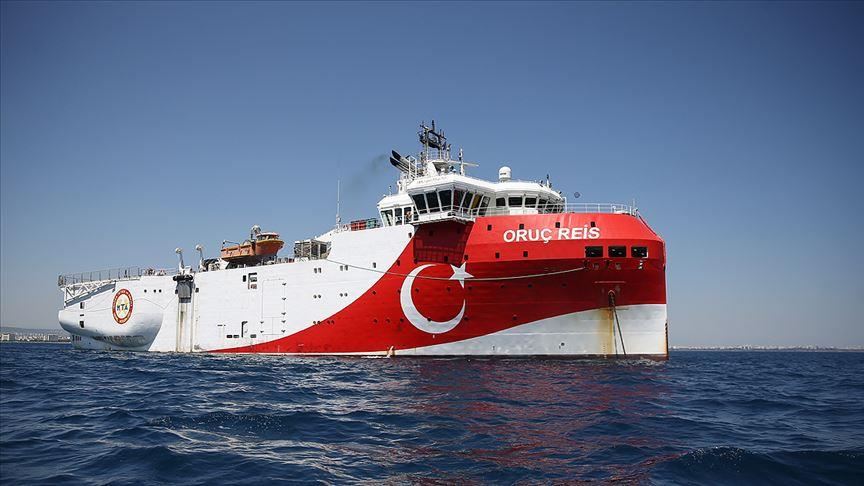
(North Press) – Since August, tensions have run high in the eastern Mediterranean Sea, particularly between Greece and Turkey, with Greece conducting military maneuvers in the area and Turkey expanding its operations to explore for marine resources.
Themis Tzimas, a Greek lawyer and expert in international law, spoke to North Press about the current tensions in the highly disputed and sought-after area.
However, the issue is quite complicated, and according to Tzimas, it appears that Greece largely stands in alone in defending its maritime territory from incursions by Turkey, as it is trapped in an alliance with its rival, whom the US favors in international disputes.
International maritime agreements
Tzimas explained that Turkey believes that the Greek islands have no exclusive economic zone (EEZ, or a sea zone in which a country has exclusive rights over exploration and marine resources), and considers the Greek islands as a kind of separate entity from the Greek mainland, even though “they are part of Greece and of its coastline.”
Both Greece and Turkey have signed EEZ agreements allowing them to explore and utilize the resources of the eastern Mediterranean – Greece with the government of Egypt and Turkey with the UN-recognized, Tripoli-based Government of National Accord (GNA), led by Prime Minister Fayez al-Sarraj.
However, Tzimas noted that the maritime agreement has never been finalized in Libyan parliament and that Libya is a state currently witnessing disputed authority, whereas the authority behind the Egyptian government is not a subject of debate.
“If we were to compare between the two, the Egyptian-Greek agreement is stronger. The truth is that probably international justice and the international community – unless we experience a dramatic turn of events in any of these states – will try to achieve balance between the two agreements. Turkey will be probably the main ‘loser’ in front of international justice,” Tzimas explained.
Trapped in an alliance with its enemy
Further complicating the issue is the fact that both Turkey and Greece are members of NATO.
During the 1980s, Greece was “the friendliest among NATO members towards the USSR and therefore less obedient to the US, whereas now it is Turkey that plays this role,” Tzimas said. “The real actor behind NATO is the US. The US will exercise pressure to a limited extent only on Turkey… Turkey takes advantage of this, in order to maximize its profit.”
“Therefore, while NATO and the US seem to be working in order to prevail peace among the two countries, in fact they do that while partially favoring Turkey,” Tzimas explained, adding that in this manner, Greece is entrapped in NATO, in that it belongs to the same alliance as its nearly sole military and political rival.
Unfortunately for Greece, Turkey cannot and will not be expelled from NATO, according to Tzimas. NATO and the US, he elaborated, will not abandon Turkey, and Turkey’s relations with EU member states “are not deteriorating as rapidly as it seems. Germany and several other EU member states will tolerate the Turkish behavior towards Greece, and not only towards Greece. Turkey will keep finding support from within the EU and NATO, as was the case with the intervention in Syria and Libya,” Tzimas affirmed.
He added that the main problem is that many of Greece’s alliances are still under US auspices or control, and the latter still largely favors Turkey in the international arena. He further added that “almost no Arab state sees positively the Neo-Ottoman aspirations of Turkey,” and that “Greece must acquire a significant, autonomous Arab policy, which at this point it does not have.”
Future of the Eastern Mediterranean
Legally speaking, there are some actions Greece could take to punish Turkey for its incursions into areas of the Mediterranean claimed by Greece. “The primary thing could be to block EU decisions until significant sanctions would be imposed upon Turkey. In addition, it could bring the issue to the UN [Security Council],” Tzimas stated.
Tzimas concluded that the eastern Mediterranean will continue to be an area of territorial dispute, particularly as long as “neo-Ottoman Turkey constitutes a pioneering actor.” He explained that the only thing preventing all-out war in the area is the balance of military force between the two nations, and that the tension will continue for years to come until “a new, fair global order is achieved.”