
Olive Presses in Raqqa cover production and provide job opportunities
Raqqa – North-Press Agency
Ahmed al-Hassan
The olive tree is considered as one of the newly fruitful trees in the governorate of Raqqa, compared to other Syrian regions, where it began to grow in abundance since the start of irrigation projects, and the increase in the agricultural awareness among local farmers, to reach more than 3 millions of trees since 2000 until the present day, which has become as one of the main crops in the region.
As local olive production increased, some olive oil presses opened in the city's countryside, which reduced the hardship of the peasants of moving their production to other cities in order to press the olive, such as Manbij, Afrin and other cities, as they used to do in the past. The 5 olive presses located in the city of Raqqa and its countryside accommodate local olive production.
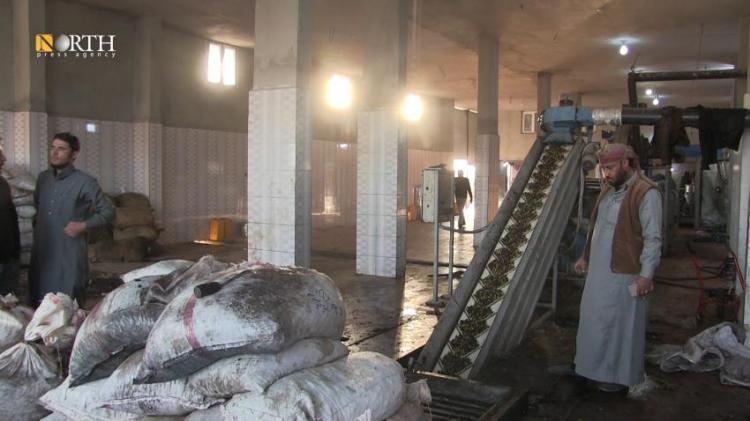
In this context, Mizwed al-Jasem, a technician in Maysaloon press, 15 km west of Raqqa, told North-Press that opening olive presses have facilitated the difficulties of moving olive to other cities for pressing. He also said that Maysaloon press operates 24 hours with a productivity of 20 tons of olives per day.
Al-Jassim noted that there are some problems and difficulties facing them, saying: "One of the difficulties we face is that our project isn’t supported with fuel, and the press is not provided with a power line, which burden us with heavy costs.”
Ahmed al-Bander, a farmer in the eastern countryside of Raqqa, pointed out that the opening of olive oil presses have reduced their efforts and saved money for pressing olives.
The opening of the presses in Raqqa, in addition to covering the city's production of olives, provided job opportunities for many young people, as Yahya al-Turki, a displaced person from Hama countryside said that he works in one of the olive presses in Raqqa. “I learned a new profession through my work in the olive press, as I have no other job," al-Turki said.
Muhammad al-Ramadan also explained about his work in one of the olive presses, "I work as a porter in the press, and I provide the burners with olive remains with a daily wage of 2,500 Syrian pounds.”
These projects are considered as one of the main local economy sources, through providing job opportunities for young people, covering local olive production and providing olive oil for the local market.