
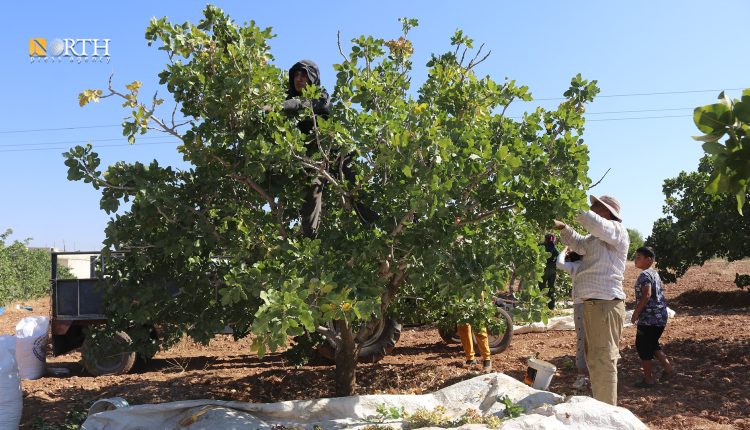
KOBANI, Syria (North Press) – Pistachio farmers in the western countryside of Kobani, northern Syria, are reporting a sharp decline in production for the second consecutive year, as prolonged drought and rising farming costs continue to affect one of the region’s key agricultural crops.
Despite the lower yields, farmers say prices have improved following the reopening of trade routes and the arrival of merchants from other Syrian cities and regions.
Mohammed Sheikh, a farmer from the western countryside of Kobani, walks among his pistachio trees with deep disappointment as this year’s harvest has once again fallen short of expectations.
“The yield of a single tree used to reach at least 10 kilograms, but this year it does not exceed three kilograms because of the drought,” Sheikh told North Press.
He said production on his land fell from around 10 tons last season to only three or four tons this year.
Prices improve
Sheikh said the price per kilogram has increased significantly, reaching $4.50 compared with $3 last year.
He attributed the improvement to the arrival of traders from Hama, Morek, al-Bab and Jarablus following the reopening of roads, contrasting the current situation with the period under the former Syrian government, when taxes and road closures restricted trade.
Pistachio trees in the Kobani region are mainly divided into two varieties, known locally as Ashouri and Turkish pistachios, according to Sheikh.
The Turkish variety is mainly used in ice cream and sells at a higher price, although it takes longer to produce. The Ashouri variety, meanwhile, has a more balanced yield and is commonly used as a salted snack.
However, Sheikh added that the rising cost of diesel has placed an additional burden on farmers, forcing them to reduce the number of times they plow their land from five times to only two.
The high fuel prices have also limited irrigation, with some farmers watering their trees only once or not at all.
Sheikh called on the relevant authorities to provide subsidized agricultural fuel to support farmers.
Farmer Abdullah Hussein said that most villages in the west of Kobani, including Seftek, Boban, Khorkhori, Qaran, Bayadiya, Jabneh and Ashma, depend heavily on pistachio cultivation for their livelihoods.
Production declines
Hussein said the production of his 100 pistachio trees has fallen from around one ton in previous years to between 300 and 350 kilograms during the past two years.
He attributed the decline to insufficient rainfall and persistent drought.
At the same time, Hussein said that the reopening of commercial routes and greater access to traders from Aleppo and Manbij helped break market monopolies and improve selling prices.
He expressed hope that next season would compensate farmers for their losses, particularly following rainfall recorded last year.
Hussein indicated that the price of diesel, which stands at 12,000 Syrian pounds per liter, remains the biggest obstacle to properly irrigating and caring for the trees.
Farmer Hussein Mukhtar described the decline in production for two consecutive years as an exceptional situation caused by drought and rising fertilizer and fuel prices.
He said that the selling price reached $4.40 per kilogram this year due to the arrival of traders, adding that the crop is exported to Gulf countries and Europe.
Trade improves
Mukhtar said pistachio exports bring foreign currency into the region and could contribute to its reconstruction after years of war and destruction.
He added that the current trading environment is significantly better than under the former Syrian government, which he said monopolized economic activity and restricted people’s ability to work and trade freely.
Mukhtar called for allocating agricultural diesel at reduced prices and lowering fertilizer costs by issuing multiple licenses for fertilizer sales to prevent monopolies.
“Supporting these trees is real support for the region’s economy and its reconstruction after the destruction it has suffered,” he said.
By Fattah Issa