
Alouk Water Station resumes supplying water to Hasakah after years
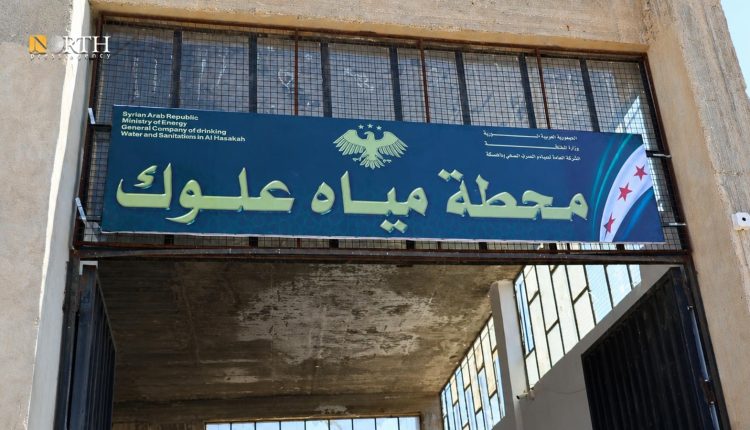
QAMISHLI, Syria (North Press) – Alouk Water Station officially resumed operations on Wednesday, restoring drinking water supplies to Hasakah city and its countryside after rehabilitation and maintenance work brought the facility back into service following nearly seven years of repeated disruptions.
The reopening ceremony was attended by Syrian Minister of Energy Mohammad al-Bashir, Hasakah Governor Noureddine Ahmad, members of the presidential delegation, the director of Hasakah Water Directorate, and several members of the Syrian People’s Assembly representing the governorate.
According to the official announcement, the station will initially operate 19 of its 34 wells to provide drinking water to Hasakah city, its countryside, and al-Hawl district. The remaining wells will be rehabilitated gradually in subsequent phases.
Located in Ras al-Ain (Serê Kaniyê), Alouk Water Station is the primary source of drinking water for Hasakah governorate. According to official Syrian figures, it supplies water to Hasakah city, its countryside, Tal Tamr, and the al-Hawl area, serving around 500,000 people.
Beyond its role as a public utility, Alouk Station became one of the most contentious issues in northeast Syria during recent years because of its strategic location and security sensitivity, making it a recurring point of dispute between the parties controlling the area.
From public utility to conflict issue
The station’s crisis intensified following military developments associated with Operation Peace Spring. The rights organization Syrians for Truth and Justice linked the complete shutdown of Alouk to electricity cuts affecting areas of the operation on Aug. 13, 2020, after which the station experienced repeated cycles of temporary operation and suspension.
Throughout the following years, residents of Hasakah and surrounding areas endured frequent water shortages caused by technical, security, and political disruptions affecting the station. Many households increasingly relied on water trucks and local desalination plants to meet their daily needs.
Years of repeated interruptions
Alouk Station passed through several operational phases, including complete shutdowns, partial operation, temporary restoration of pumping, and renewed interruptions.
Archives published by the Syrian Arab News Agency (SANA) document repeated announcements regarding the suspension and resumption of water pumping, illustrating the instability of the station’s operation despite multiple restoration efforts.
Local authorities also operated alternative desalination plants inside Hasakah city during several periods to mitigate the impact of the station’s shutdown.
UN warnings over humanitarian impact
The United Nations and humanitarian organizations repeatedly highlighted the humanitarian consequences of interruptions at Alouk Station due to the large number of civilians and displaced people dependent on its water supply.
In March 2020, UNICEF said Alouk Station served as the primary water source for approximately 460,000 people in Hasakah, Tal Tamr, and the al-Arisha and al-Hawl camps, warning that prolonged disruptions could increase public health risks.
In July 2021, the United Nations called for the restoration of water and electricity services and urged all parties to ensure civilians’ access to water and sanitation. The organization said severe interruptions at Alouk had placed nearly one million people at risk.
A UN statement at the time noted that the station had experienced at least 24 interruptions since November 2019, while the complete shutdown that began on June 23, 2021, was also linked to difficulties in accessing the site for technical teams and shortages in electricity supply.
Previous efforts fell short
Several attempts were made over the years to restore the station, but none resulted in stable long-term operations.
In September 2024, reports spoke of an international understanding aimed at restarting Alouk, coinciding with visits by delegations from UNICEF and the International Committee of the Red Cross (ICRC) accompanied by technical and field teams. However, those efforts did not produce a lasting solution due to continuing security and political complications.
In June 2025, a delegation from the United Nations and the Syrian Arab Red Crescent visited the station to assess its technical condition and the possibility of restarting operations. The visit remained limited to evaluation and planning as field obstacles persisted.
The main obstacles preventing sustainable operation included control over the station and its surroundings, difficulties ensuring safe technical access, securing a stable electricity supply, and repairing damaged transmission lines and infrastructure that affected regular water pumping.
UN agencies and technical teams also had to navigate complex political and security arrangements during each phase, leaving most previous restart attempts temporary or partial.
The final phase toward reopening
New efforts to restore the station accelerated in 2026, focusing on technical assessments, securing the facility, and repairing damaged infrastructure.
On April 7, 2026, Syria’s Ministry of Energy announced that it had taken over Alouk Station and begun technical evaluations in preparation for restarting operations, with government and local officials overseeing implementation of the Jan. 29 agreement.
On June 30, 2026, Hasakah’s deputy governor and spokesperson for the presidential team said a joint meeting involving the ministerial committee and the General Water Company reviewed the station’s status and the reasons behind delays in resuming pumping. He said mine clearance and the removal of encroachments along the transmission line were among the key measures undertaken before trial operations.
On July 15, 2026, the Ministry of Energy announced the launch of trial pumping after nine months of rehabilitation and maintenance carried out in cooperation with the International Committee of the Red Cross, while coordination with UNICEF continued to reach full operational capacity.
The latest preparations also included installing a mobile power station in Darbasiyah to provide a stable electricity supply to Alouk, highlighting that the challenges facing the station extended beyond technical issues to include logistical and security concerns.