
Students fearing new quakes miss school in Syria
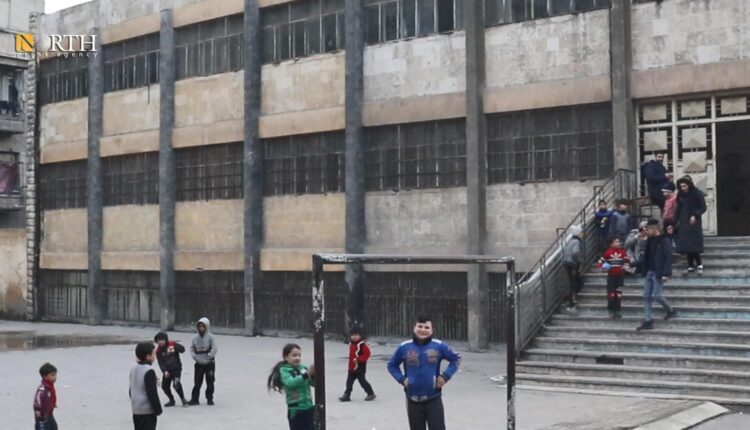
ALEPPO, Syria (North Press) – Parents in the Syrian government-held areas, especially those most devastated by the earthquake – Aleppo, Hama, Latakia, and Tartus – are abstaining from sending their children to schools.
Maryam Bathenjki, the principal of an elementary school in the Sayf al-Dawla neighborhood of Aleppo, said on Thursday that her school had 24 classes, each of which used to teach 30 students before the earthquake. Now, only seven or eight pupils attend each class.
At dawn on February 6, a 7.8 magnitude earthquake hit southern Turkey and Syria, killing 44.000 individuals. It also caused the destruction of hundreds of buildings, leaving many homeless.
Bathenjki noted that the absence of students is visible in all schools of Aleppo, including the western neighborhoods that were not affected by the quake.
The Syrian Ministry of Education announced on February 6 that schools would be suspended for several days as they reopened in all governorates except in the quake-devastated areas.
However, schooling resumed gradually in schools not damaged in the affected areas and which were not serving as shelters for affected people.
The Directorate of Education in Aleppo said on February 18 that it had suspended classes in 80 schools due to damage sustained by the earthquake, while some shifted to serving as shelters for earthquake victims.
On February 22, the Syrian Minister of Education, Darem Tabbaa, told a local radio station that only three percent of students were attending classes in Latakia schools, ten percent in Aleppo, 20 percent in Idlib, 30 percent in Tartus, 80 percent in Hama, and 100 percent in remaining governorates.
“We cannot suspend schooling in all areas in order to not negatively affect other students,” he said, commenting on demands by families to suspend all schools until the situation is better and all schools are inspected.
According to the Syrian Minister of Education, there are 3.7 million students in the government-held areas.