
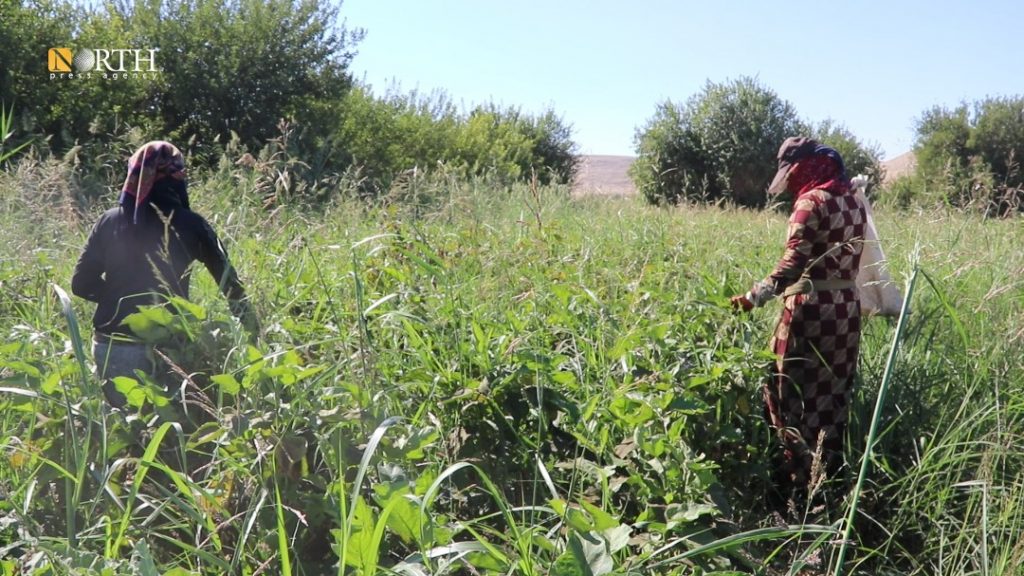
DERIK, Syria (North Press) – Adjacent to the Syrian-Turkish border in the village of Ain Diwar in the far northeast Syria, Manal Ibrahim, 27, a displaced woman from the city of Sere Kaniye (Ras Al-Ain) who resides in Newroz camp in Derik countryside, works with other women to harvest eggplant crops.
Displaced women from Newroz camp have to work as agricultural workers to secure their needs and improve their living conditions amid lack of aid provided by NGOs.
Despite the total lockdown measures and fears of being infected, the high cost of living pushes them to work under difficult conditions of displacement, the worker women said.
On September 25, the Crisis Management Team of the Autonomous Administration of North and East Syria (AANES) imposed a seven-day total lockdown in the Jazira region.
However, the total lockdown has been extended for another seven days due to the increase in deaths of coronavirus.
Currently, Newroz camp houses displaced families from the areas of Sere Kaniye (Ras al-Ain), Tel Abyad and Afrin. The total number of families that arrived in the camp reached 790 families, a total of 3,986 individuals, according to Nadim Omar, official of Relations Office at the camp.
Low wages
The camp was established in 2014 with the aim of housing refugees from the Yezidi district of Sinjar (Shingal), northern Iraq, due the attacks of the Islamic State (ISIS). After ISIS was expelled, the refugees returned to their areas or joined their families in other areas where they preferred to live.
In October 2019, families ,who fled the attacks of Turkey and its affiliated armed opposition factions, on Sere Kaniye and Tel Abyad, headed to the camp which was reopened.
Manal Ibrahim, who has been residing in the camp for 6 months, complains about the low income she gets compared to the working hours she does. She works five hours a day and sometimes up to seven hours in exchange for only 4,000 SYP (about one dollar).
Despite her fears of being infected with coronavirus, which has spread in the camp, Ibrahim has to leave her children alone in the camp and work in picking different types of agricultural crops.
The displaced woman added that when she started working in the agricultural fields, her wage was 3,000 SYP, but later it became 4,000.
“Despite the increase in my wage, it remains low in light of the high cost of living, especially since I am the only breadwinner for my family of six,” she noted.
Abdulrahman Abdullah, a farmer from Ain Diwar village, justified the low wages they pay for women working in his field by the low selling price of eggplant, which amounts to 400 SYP per kilo.
Abdullah has planted four hectares with summer vegetables this year, three of which are planted with eggplant, and he employs about 14 female workers, half of whom are displaced who reside in Newroz camp.
He pays each worker 4,000 SYP for 5 hours of work per day.
Two work shifts
According to displaced people in the camp, imposing the total lockdown has negatively affected the agricultural workers, as the farmers have not got them the work permission, and this has affected their living in the camp.
The decision of the lockdown allows the farmers to work on their farms provided that official permission are obtained from the agriculture committees in the area.
Although the camp’s displaced people receive some humanitarian aid, the quantities, according to them, “are not enough”, especially medical aid such as medicines.
The displaced people in the camp face difficulty in following the preventive measures against the virus because they share health facilities and kitchens, and the whole family members live in the same tent due to the increase in the number of the displaced coming to the camp in the past period.
Aysha al-Ali, 27, an IDP from Sere Kaniye, has to work two shifts during the day, harvesting eggplant in the morning and picking cotton in the evening.
She said that she earns 3,500 SYP per day for five hours of work in harvesting eggplant, while she earns 150 SYP for picking one kilo of cotton, which is “a low wage that is not enough for buying one meal.”
“We are nine people in the tent (..) How will a kilogram of tomatoes be enough for us?”