
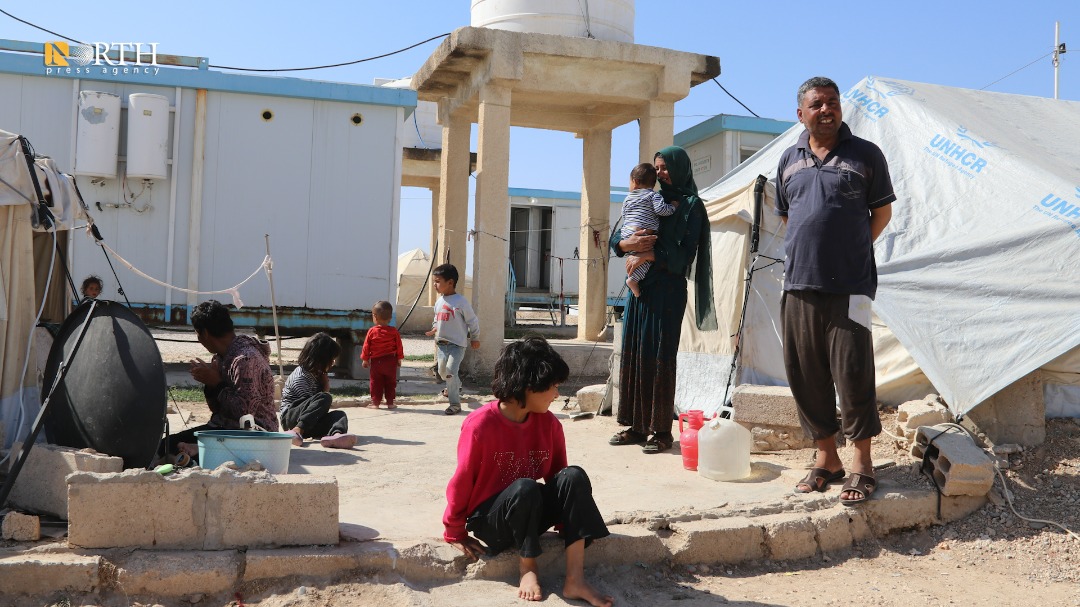
DERIK, Syria (North Press) – the 47-year-old Abdul-aziz al-Muhammad, father of a displaced family living in Newroz camp in Derik, northeastern Syria, is almost losing hope of securing adequate conditions for his three disabled daughters a year after he arrived at the camp, where he received promises of care.
He told North Press that he did not get any help not even with a penny except for the food basket that is provided to all families in the camp.
About a year ago, the man went to Newroz camp in Derik countryside because he had not been able to find housing and work elsewhere after the Turkish invasion of areas in the countryside of Hasakah and Raqqa.
The Turkish forces and the Turkish-backed factions have been running Sere Kaniye (Ras al-Ain) and Tel Abyad since late 2019 following an invasion displacing hundreds of thousands of people.
No aids for the girls
The family of nine lives in a tent on the outskirts of the camp.
The three sisters, the 15-year-old Hamda, the 10-year-old Hiyam, and the 6-year-old Sarah suffer from a congenital brain disability.
Al-Muhammad pointed out that Hamida and Hiyam have no cure, according to what the doctors told him, but he had been treating his young daughter Sarah for two years in Damascus, and the doctors told him that she might get better one day.
However, displacement and the deterioration of living conditions prevented the father from continuing her treatment, so that he is unable to remember the name of the medicine he was buying for her.
The organizations working in the camp treat the family of al-Mohammed like others, although it includes the three girls who need special circumstances and necessities.
The father added that his daughters do not receive any financial, health, or in-kind support, but rather relies on his work to pack hay, if available, to secure some of their needs.
Newroz camp, which was reopened during the Turkish invasion on Sere Kaniye (Ras al-Ain) and Tel Abyad in 2019, includes 715 families, in total of 3,420 persons.
Local organizations provide insufficient aid to the newly arrived families due to the continued closure of al-Ya’roubiyah/Tel Kocher humanitarian crossing.
Last month, Martin Griffiths, the UN Under-Secretary-General for Humanitarian Affairs, warned that “humanitarian needs in Syria are greater than they have ever been since the start of the crisis in 2011.”
Last week, the International Red Cross said that 100,000 IDPs fleeing the areas affected by the fighting are living with Iraqi refugees in camps in northeast Syria, amid extremely difficult living conditions.
Coronavirus exacerbates suffering
The father said he praises God and is aware that his daughters’ condition is fate. “But I despair of life when someone points to them with pity and tells me that your condition is difficult and you have disabled girls.”
“We used to own a house with several rooms, and when there were guests, we kept them in another room, but now we only have this tent,” he noted.
Abdul-aziz believes that, as a result of his daughters’ situation, he was supposed to have priority in a job in the camp in order to secure some supplies for them, but that did not happen.
The lockdown imposed by the Autonomous Administration to limit the outbreak of coronavirus, prevented the father from work so that he cannot earn money with his 13-year-old son.
Yesterday on Sunday, the second week of the complete lockdown began in the Jazira regions to limit the spread of the pandemic.
In September, the camp recorded new coronavirus infections, amid poor health capabilities in it, as the infections recorded since the beginning of the pandemic amounted to nearly 50.
The medical care is handled by a the Kurdish Red Crescent organization comprising a pediatrician, internist, midwife, pharmacist, nurses and paramedics.
The organization relies on imposing medical quarantine on one tent, and does not own any ambulance in the camp.
last week, the head of the Kurdish Red Crescent team in the camp, Ahmad al-Mustafa, told North Press that the number of people infected with seasonal diseases is increasing, as the number of child patients has increased from 30 to 50 cases.
Al-Mustafa called on international organizations to provide support to the Kurdish Red Crescent organization due to its weak capabilities in light of the increasing number of displaced people in the camp and the lack of medicines available in the only medical point in Newroz camp.
Confused mother
In front of the tent, the housewife Amina al-Muhammad moves between her three daughters and their brothers.
She treats her three daughters as she treats her six-month-old baby, feeding them with her hands, changing clothes for them and cleaning them in a tent.
She said that she has to divide the diapers she gets for her baby son among the girls as well. “We were safe at home, but what do we have here?”
“We came to the camp in the hope that the organizations would take care of our daughters… but they treated us like everyone else. Their father goes out at dawn to work to secure their needs,” she added.
She recalled that when she was at home, she could leave the girls in a room or in the yard without worrying too much.
But the tent here does not provide any privacy for the family, and the promises to provide special necessities, such as a toilet for girls near the tent, have not been fulfilled, according to the father.
Meanwhile, the middle daughter, Hiyam, is trying to get on her feet to get out of the tent, but the mother is confused about how to satisfy her, her eyes and her hands are busy with the baby and her remaining children.