
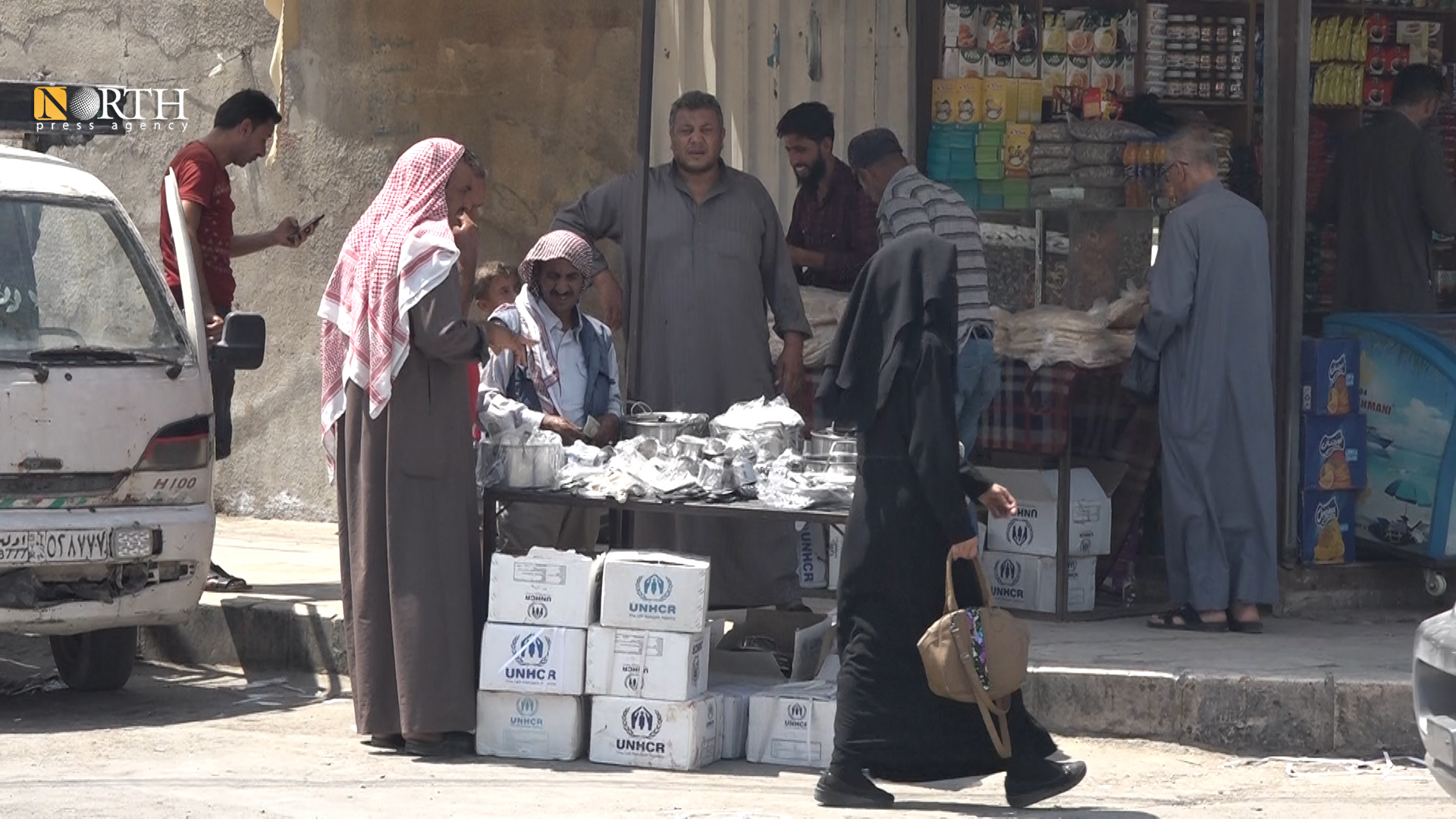
MANBIJ, Syria (North Press) – Juma’ Hamdan, a resident of the Jurat al-Arayis neighborhood in the northern part of Manbij city, north Syria, says that relief aid that aid organizations distribute has not reached their neighborhood, though many families there have no breadwinner.
Residents of neighborhoods of the city complain that the mechanism of distributing the aid is “unfair.”
“Local organizations distribute the aid, prioritizing some over others, and the one who has contacts with an employee of the organization receives relief aid. Most of those who receive it are not in need,” Hamdan added.
Manbij has about 30 neighborhoods. The organizations working in the city target some neighborhoods, whether through the distribution of relief aid, holding of training workshops, or taking care of patients, according to employees working in those organizations.
Jurat al-Arayis neighborhood is home to about 150 families, most of which have limited to no income, according to the residents of the neighborhood.
Hamdan pointed out that only al-Afya organization, specializing in cancer treatment, came to the neighborhood. “It only registered the names of about 15 cancer patients to provide them with chemical treatment and psychological support, but it has not provided them with anything for four months.”
Favoritism and sales
Hamdan and others suggest controlling the work of organizations working in the city and providing statistics of the deserving families in each neighborhood to avoid favoritism.
Asa’d al-Hamid, an IDP residing in Manbij, cannot afford to meet his family’s needs by depending on what he makes from selling vegetables from a stall, as he needs another source of income to sustain his family.
Al-Hazawneh neighborhood is one of the biggest neighborhoods of the city, with about 500 families residing in it, according to residents of the neighborhood.
Well-off families receive food aid sold in stalls in the markets. “We buy this aid because it is cheap, as the seller did not pay anything to obtain it,” Hamid added.
“I know some people who have cars and real estate and receive aid from the organizations because they know an employee or a member of the commune,” he referred.
Hamid attributes the reasons of the failure of this aid to reach the beneficiaries to the lack of control by administrative authorities supervising the distribution process.
Mutual accusations
An administrator in an organization working in Manbij who preferred to remain anonymous said that they do not deny that there are some mistakes in the distribution process.
“We follow new methods to evaluate the needy by going to the beneficiary’s house to avoid delivering aid to those who do not deserve it,” the administrator said.
There are eight organizations working in Manbij that distribute relief aid or prepaid cards amounting to $100, which are used to buy food and other products in stores designated by the organization.
Humanitarian organizations like Concern, al-Baraka, People in Need, DCI, ACTED, Noor al-Mustaqbal, Sawsan, and al-Afiya provide food aid, prepaid cards, and vocational training in Manbij, and take care of IDPs and the disabled. Moreover, they provide health education and health services for cancer patients.
The administrator stated that it is possible to reject some of the registered names, and “as for those accepted, they will receive aid equally.”
He attributed part of the mistakes in defining the beneficiaries to “manipulation of data sometimes, and the registration of names of those who are not needy by relying on the commune statistics.”
However, Ramadan Obeida, the head of the Jurat al-Arayis neighborhood commune, said that his work in this regard is limited to providing the organization with data for all residents of the neighborhood. “The organization that requests the data is the one that determines the beneficiaries.”
Obaida stressed that he oversees the distribution, “and we cannot allow the delivery of the aid to one person outside the list that they agreed upon.”