
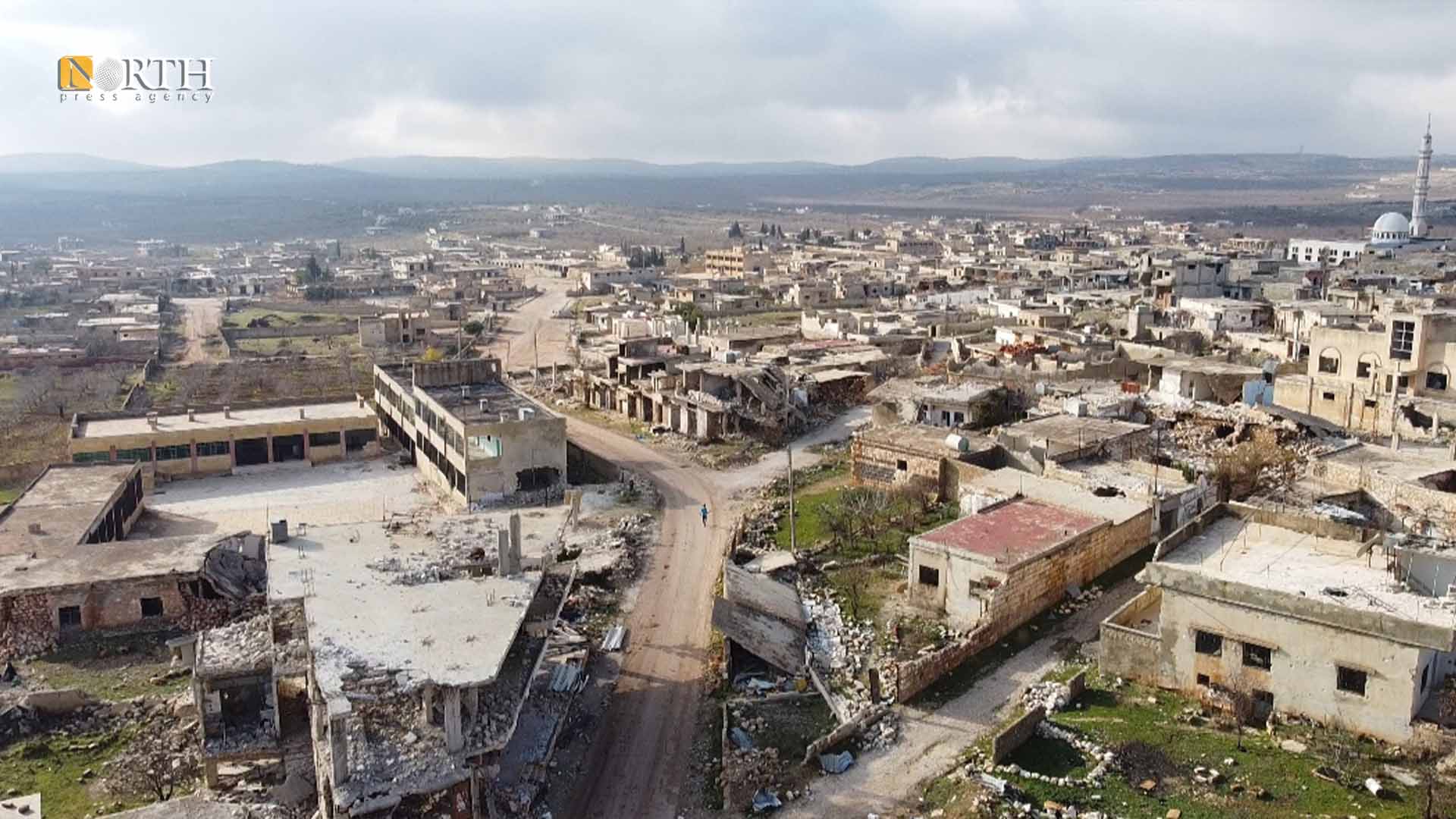
IDLIB, Syria (North Press) – Abdulatif al-Assad, an IDP from Rif-Dimashq residing in the Aqrabat Camps on the Syrian-Turkish borders, north of Idlib, northwest Syria, did not know that his travel to Zawiya Mountain, south of Idlib, to find work would change his life entirely and worsen his financial condition.
After he failed to find a job in the camps to sustain his family and secure his father’s medication, al-Assad went to a village in the Zawiya Mountain to work in cherry picking.
During May, he worked for three days for 30 Turkish lira per day (3.42 USD). On the fourth day of work, as he was heading to his work with his friends on a motorcycle, a cluster bomb exploded the moment the motorcycle passed over it.
The bomb resulted in the amputation of one of his feet. Shrapnel left wounds in different parts of his body. “I am almost helpless and cannot sustain my children after I lost a limb,” he adds.
Dozens of young men, especially IDPs in camps on the Syrian-Turkish border north of Idlib, are forced to go to Zawiya Mountain and Ghab Plain, west of Hama, to work in the agricultural lands near the frontlines.
“Forced to work”
Those who take risks and go to these areas say that deteriorating living conditions and the lack of job opportunities force them to do so.
War remnants such as missiles, shells, and cluster bombs are widely spread in the areas near the frontlines with government forces south of Idlib and west of Hama.
War remnants still threaten the lives of farmers and workers in those areas amid the lack of education or knowledge on how to deal with him, and no party has taken any responsibility to remove them.
On June 21, Mare’ Hassan al-Fayoumi, a resident of al-Hamdaniya village east of Idlib, was killed by a land mine while he was grazing his sheep in the agricultural lands near al-Khawin village in Khan Sheikhoun, south of Idlib.
Halima al-Sinjari lost her 37-year-old husband to a land mine while he was working in harvesting olive last year in Kansafra region alongside the areas under government forces’ control in the city of Kafr Nabl, south of Idlib.
Al-Sinjari’s husband was selling beans from a stall in the camps of Ma’arat Masrin, north of Idlib. However, this job did not meet his family’s needs, so he was forced to go to Zawiya Mountain for work in order to improve his living condition.
After her husband died, al-Sinjari was forced to work at a sewing workshop in Ma’arat Masrin for wages not exceeding 15 Turkish lira per day.
“Excellent wages”
Al-Sinjari explained that her children were forced to leave school to help her, as her 14-year-old son goes daily to Idlib to work in a restaurant for more than 12 hours a day.
“I am not satisfied with my child’s work all these hours long; I fear that something bad may happen to him while he goes and comes back at night, but we have no choice,” she added.
During the harvest, Samih al-Mahmoud, an IDP from the northern countryside of Hama residing in the Atma Camps on the Syrian-Turkish border, goes to Ghab Plain with one of his relatives to work on the harvester for daily wages that exceed 100 Turkish lira.
The wages of working in the agricultural lands near government forces’ areas are better than other regions, as they are considered battle zones.
Despite being exposed to the risks of targeting or exploding mines, al-Mahmoud believes that his wages are “excellent compared to the wages of some jobs we used to receive in the camps.”
Due to the lack of job opportunities and the deteriorating living and economic conditions, “I was forced to work in dangerous areas; I never expected things to get this bad,” he added.
“I am forced to work to gain the required amount for my child’s surgery before he loses his sight,” he pointed out.