
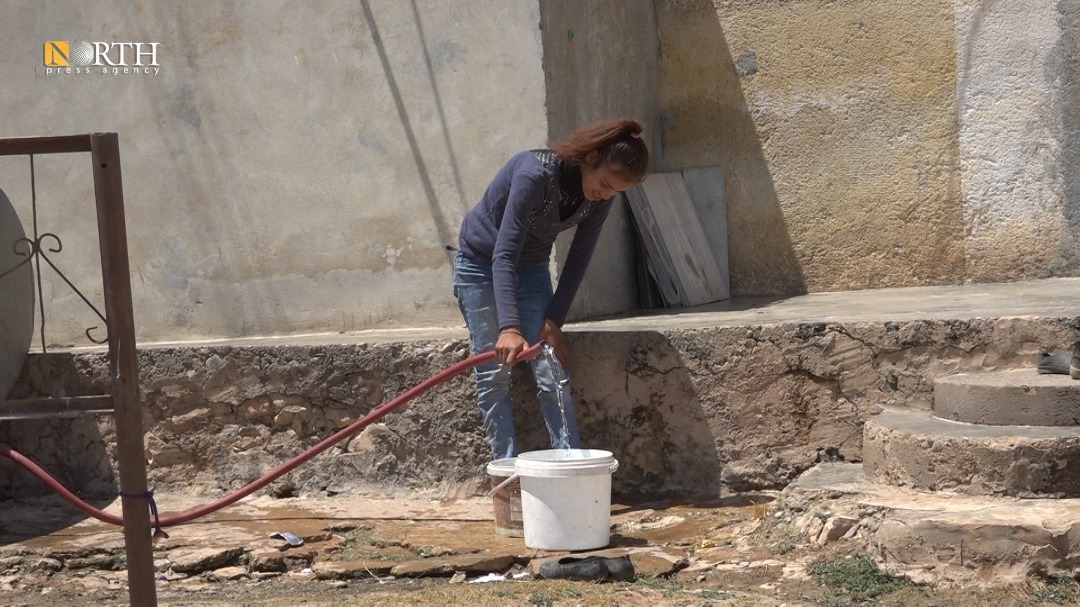
KOBANI, Syria (North Press) – 60-year-old Qadriya Muslim, a resident of Gulmed village four kilometers south of Syria’s Kobani, is forced to bring water from other villagers who buy their water supply from tankers, because water does not reach to her house and cannot tolerate the high expenses of digging a well.
As a result of having no water network or having some that have not been put into service yet, residents of the village of Gulmed and 40 other ones buy water from tanks.
It is worth mentioning that Kobani city is surrounded by 370 villages most of which are suffering of water shortage in light of Turkish seizure of Euphrates River.
For more than three months, Turkey has limited the flow of the Euphrates into Syria, depriving large numbers of people of usable water. Turkey reduced the flow of water from the Euphrates River into northeast Syria’s dam gradually, reducing the amount of water received to unprecedented lows.
Turkey keeps water in six dams, the largest of which is Ataturk Dam, the second largest in the Middle East, with a storage capacity of 48 billion m³, violating the international agreement they signed with Syria in 1987 which stated that Syria’s share of water coming from Turkey is 500 m³ per second.
The water flow to the Euphrates River is now limited to less than 200 cubic meters, according to the General Administration of Dams in Northeastern Syria
Network out of service
“We were able to arrange our water before, but for about nine years and after we were displaced due to the Islamic State (ISIS) attack and after we returned in 2015, the wells were destroyed and had no water,” Muslim said.
Though each tank costs about 15,000 Syrian pounds (SYP) (each barrel is 1,000 SYP), she is forced to buy tanker water that does not last for more than three days.
When household tank gets empty, housekeepers resort to bring some water from other people, according to her.
“Nine years ago, when the Syrian regime was in power, a water network was extended, but no water was pumped into it,” and that may distribute to solve the problem.
It seems that it is easier for families that have small tanks, which are filled from fountains in the city, while other families suffering more in securing water and its expenses.
In Gulmed village, there are about 300 families most of which work in cultivation and breading livestock; however, water shortage obstacles their works.
Future projects to provide solutions
Though villagers need dairies of their livestock, but they face difficulty in raising them in light of the water shortage, according to the housekeeper Altun Birkl.
Birkl pointed out that some limited income families are facing difficulty in securing the expenses of water from tanks.
“We call for the digging of a well,” she added.
“They have to provide us with water, since wells do not contain water and digging a deep well costs between three and four million SYP,” according to Birkl.
“There are many villages that are suffering from the same problem as Gulmed,” official of Kobani Water Directorate Muhammad Mahmud said.
“Meanwhile, now, we are busy providing the city with water after Turkey cut off our water supply,” according to Mahmud.
In August of 2020, “in the first phase, we provided about 20 western villages with water,” he added.
The Water Directorate, which is repairing the reservoirs of the radio tower area, will provide Gulmed and other southern villages with water in coming projects, according to the official.
Gulmed and about 40 villages will receive water from the radio tower reservoirs that are being repaired now, Mahmud elaborated.