
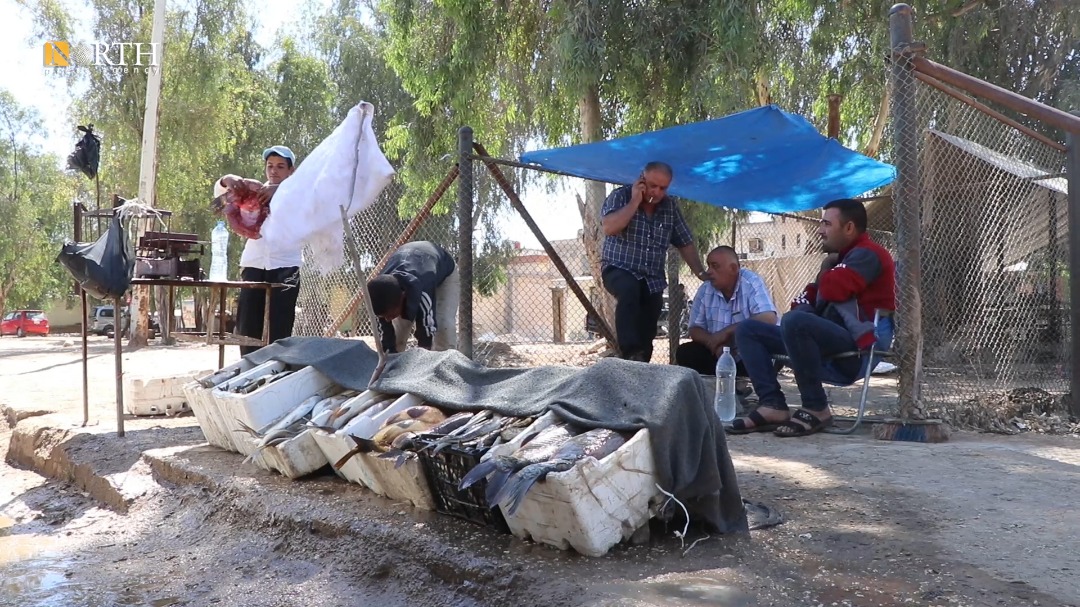
TEL TAMR, Syria (North Press) – On the side of the M4 Highway in the center of the town of Tel Tamr, north of Hasakah, northeastern Syria, Hajem al-Ali, a resident of the village of Dashisha, buys fish from a fishmonger amid fears of losing it due to the low water level of the Euphrates River.
Al-Ali, a day laborer, finds the price of fish cheap compared to other meats, and acceptable for people with low incomes.
Al-Ali, the breadwinner of a family of seven, pointed out that instead of buying chicken or sheep meat for 20,000 SYP, he takes fish for 10,000 SYP, and the amount is sufficient for his whole family.
In light of the high price of mutton and chicken in Tel Tamr, which is affected by the high dollar and the high cost of fodder, many residents of the region resort to buying fish, especially those with limited incomes.
The fish stalls in the town have witnessed a remarkable activity in recent times due to the stability of their prices compared to other meats.
The price of one kilogram of fish in Tel Tamr ranges between 2,500 and 4,500 SYP, depending on its type and quality, while one kilogram of chicken is sold at 5,200 SYP and mutton for 12,000 SYP.
Good demand for fish
The Euphrates River, despite the low water level due to its seizure by Turkey, is the main source of fish in the markets of the Hasakah region, which comes through fishermen and merchants from the city of Raqqa.
Before his displacement from his city of Sere Kaniye (Ras al-Ain) after the Turkish invasion in October 2019, Rustem Khalaf settled in the town of Tel Tamr and started working selling fish.
Khalaf sells fish that are caught from the Euphrates and brought to the city of Tel Tamr by merchants.
The turnout of residents, especially those with low incomes, to buy fish is good because its prices are adequate with their daily income, Khalaf added.
Like the hundreds, and perhaps thousands, of those working in fisheries in the northeastern regions of Syria, Khalaf’s source of livelihood is threatened due to Turkey’s seizure of water from the Euphrates.
For more than three months, Turkey has limited the flow of the Euphrates into Syria, depriving large numbers of people of usable water. Turkey reduced the flow of water from the Euphrates River into northeast Syria’s dam gradually, reducing the amount of water received to unprecedented lows.
Turkey keeps water in six dams, the largest of which is Ataturk Dam, the second largest in the Middle East, with a storage capacity of 48 billion m³, violating the international agreement they signed with Syria in 1987 which stated that Syria’s share of water coming from Turkey should be no less than 500 m³ per second on average.
The water flow to the Euphrates River is now limited to less than 200 cubic meters, according to the General Administration of Dams in Northeastern Syria.
Fears of losing our livelihood
Khalaf says that in the event that the Euphrates dries up and the fish die, he will again have to change his job and look for another job like other people working in this field. “If there is no water or fish left, I have to look for another job. I will lose my job, as well as the fishermen and the merchants.”
The Turkish seizure of the Euphrates water has caused problems, the most prominent of which is the shortage of drinking water, power outages, and impacts on cultivation and the environment in most areas of northeastern Syria.
Since the outbreak of the Syrian war, Turkey has cut off water from the Khabur River, which flows from its territory towards Hasakah and reaches Deir ez-Zor in eastern Syria.
The cutting off of water from the Khabur, a tributary of the Euphrates, has forced many fishermen to give up their profession after many years.
64-year-old Saif al-Din Khader, from the countryside of Tel Tamr, spent 35 years fishing on the banks of the Khabur River.
Khader said: “I worked as a fisherman for a long time, from 1986 until the beginning of the Syrian crisis. The Khabur river water was cut off; the Turks systematically blocked it, which affected my work, and for several years I have been self-employed.”
The former fisherman considers the Turkish seizure of water from the Euphrates as a crime against the region’s residents, especially as it threatens the livelihood of fishermen and fish sellers.
“This is another kind of war besides the economic war; there is the water war…it is a very dangerous war for the Syrian people. I consider it the greatest crime against humanity,” he added.