
Israel bombs Hamas leader’s home, international pressure to end conflict increases
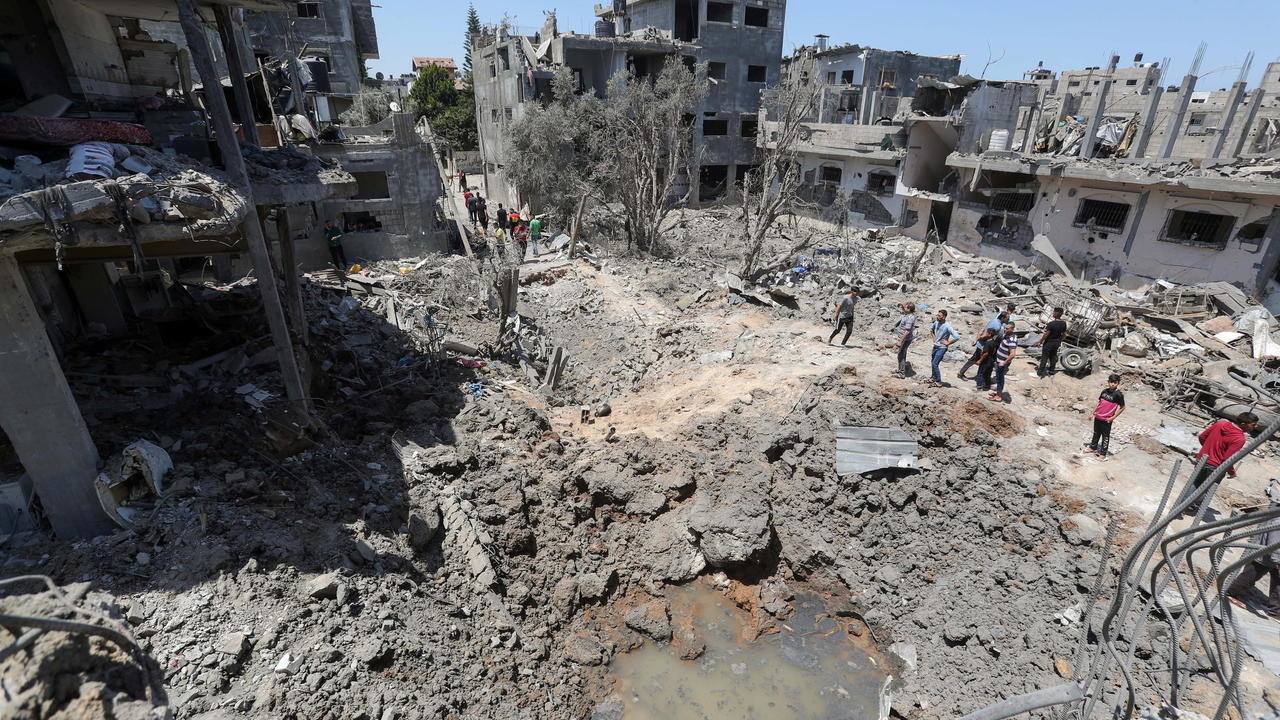
RAMALLAH, Palestine (North Press) – The Israeli army continues its military operation against the Gaza Strip, and last night the house of Hamas leader Yahya Sinwar and that of his brother Muhammad Sinwar were targeted.
Sources in Gaza Strip said that the two homes had been left empty since the escalation began. The Israeli army announced that it had bombed a bank used to pay the salaries of Hamas militants.
The Ministry of Health in the Gaza Strip stated that the death toll from the Israeli operation has reached 181, including 52 children and 31 women, while 1,225 people have been injured.
The Civil Defense in Gaza reported today that Israel targeted 5 homes on al-Wehda Street without prior notice, and there are many families under the rubble of the houses as teams continue to attempt their rescue.
Israeli aircraft also launched dozens of raids on agricultural lands in various areas of Gaza, and bombed the National Bank in Rimal neighborhood in the city.
The Izz ad-Din al-Qassam Brigades, the military wing of Hamas, announced that it launched a new missile attack on the settlement of Netivot and the Hatzor air base in southern Israel in response to “the enemy’s targeting of civilians.”
In conjunction with this announcement that was made on the al-Qassam Brigades’ Telegram channel on Sunday, Israeli police confirmed that two rockets had landed on Netivot, without reporting any casualties so far.
More than 40 rockets were fired from Gaza towards central Israel and Beersheba last night, and dozens of them were intercepted.
Most of them landed in open spaces, and about ten Israelis were wounded while running to shelters; some of the shells resulted in material damage.
Sirens went off in Israeli border cities after dawn on Sunday.
On Sunday, the United Nations Security Council will hold a meeting to discuss the worst outbreak of violence between Israel and the Palestinians in years.
UN spokesman Stephane Dujarric said in a statement Saturday that Secretary-General of the United Nations Antonio Guterres reminded all parties that any indiscriminate targeting of civilian and media buildings violates international law and must be avoided at all costs.
The Israeli State Security Cabinet (SSC) is meeting today, and the official Israeli radio Makan stated that on the political level they are preparing for several more days of fighting and that international pressure has begun to be exerted on it to reach a ceasefire.
Palestinian sources said that these pressures come from Egypt and other international parties, but Israel rejects them because they want additional time to hit more targets, while Hamas says that “the ball is in the Israeli court.”
Meanwhile, eyewitnesses stressed to North Press that all the main streets in Gaza were destroyed by the Israeli bombing, so that they could not be used on foot in light of the rubble and large potholes in the roads.
Khader Mahfouz, a political analyst living in Gaza, told North Press that the expects coming hours will bring new news of a ceasefire. He believes that if the Israeli prime minister had achieved military objectives in Gaza, he would have ended the war by now.
Late Saturday, Israeli Prime Minister Benjamin Netanyahu said, “We are still in the middle of this process, and it is not over yet, and will continue as long as necessary.
Hamas launched the missile attack on Monday, after weeks of continuous tension due to a lawsuit to expel a number of Palestinian families in East Jerusalem, and in response to the Israeli police clashes with Palestinians near al-Aqsa Mosque during the month of Ramadan.
Israel has launched thousands of strikes in Gaza, claiming it is targeting Hamas, which has tied to the Muslim Brotherhood, and the Islamic Jihad Movement in Palestine, which is based in Damascus and funded by Syria and Israel.
Hamas leader Ismail Haniyeh, speaking to crowds of protesters in the Qatari capital Doha, said on Saturday that the fighting was mainly around Jerusalem. He added that the “Zionists believe that they can demolish al-Aqsa Mosque,” and warned Netanyahu not to “play with fire.”
Israel considers all of Jerusalem as its capital, though claim is not universally recognized at the international level.
The United States launched a series of diplomatic efforts in recent days to try to stop the violence.
Hadi Amr, deputy assistant secretary of state for Israel and Palestinians and President Joe Biden’s envoy, arrived in Israel on Friday for talks.
The White House said Biden spoke with both Netanyahu and Palestinian President Mahmoud Abbas late on Saturday, and briefed them on US diplomatic efforts.
The diplomatic efforts are complicated by the failure of the United States and most Western powers to communicate with Hamas, which these states consider a terrorist organization.
Abbas, whose power base is concentrated in the West Bank, reportedly has no influence over Hamas in Gaza.