
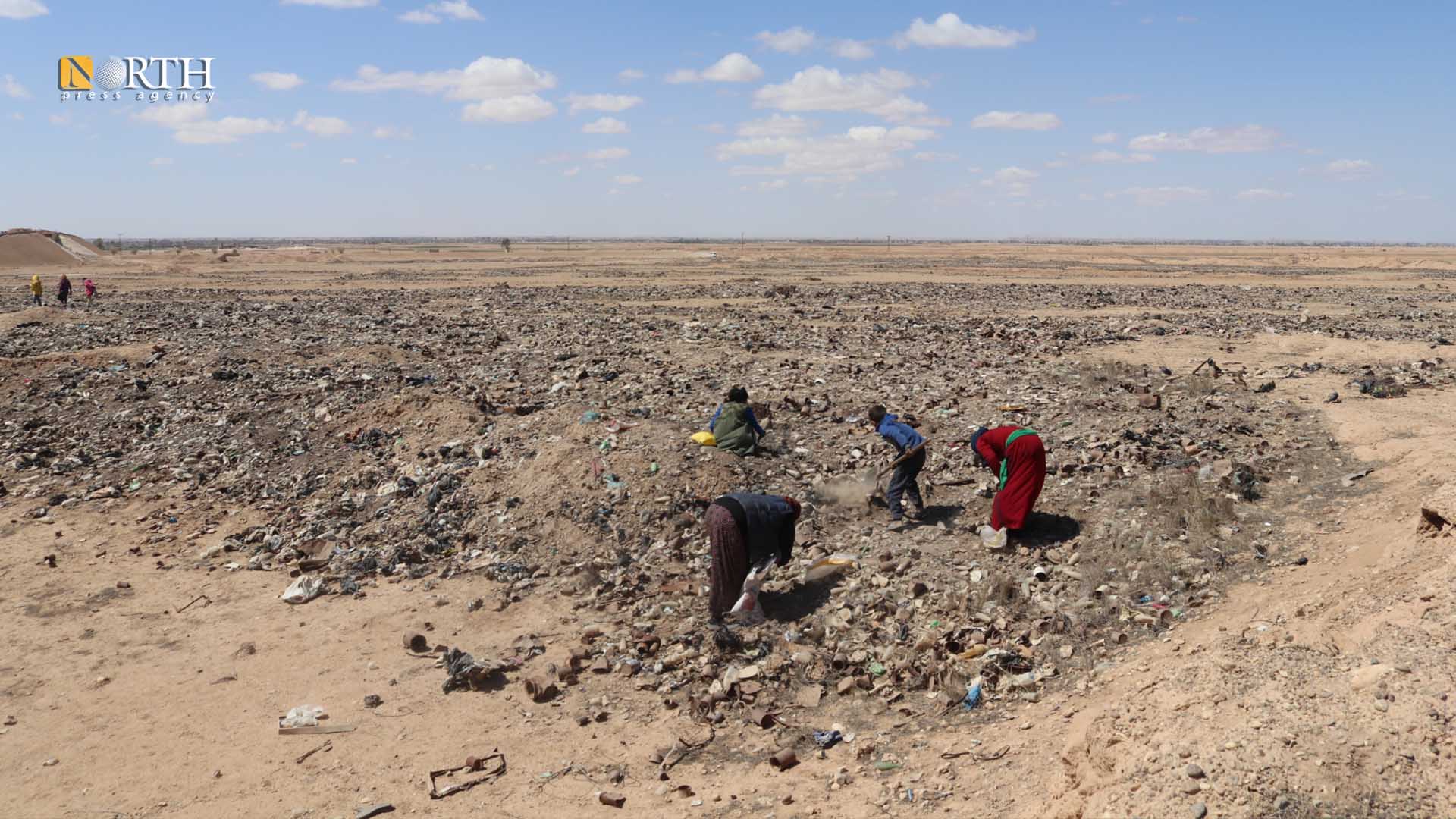
DEIR EZ-ZOR, Syria (North Press) – Early every morning, Khawla Hamid (a pseudonym), 29-year-old woman living in the eastern countryside of Deir ez-Zor with her children, heads to the garbage dumps in order to secure their daily sustenance, regardless of the danger of the place.
The garbage dump is four kilometers away from the family’s residence, where they go either on foot or with passing cars.
Khawla, her three daughters, and her son are forced to live with dirt accumulating under their nails, along with itchiness and redness throughout the night. The minimum livelihood is the maximum that the family can wish for, and everything else does not matter, including the health risks.
Scavenging the garbage in search of plastic and copper throughout the day has become one of the sources of income for dozens of families in Hajin, 100 km east of Deir ez-Zor.
Amidst the unpleasant odors, Hamid and her children search for pieces of copper, plastic, and iron, to collect and sell or trade for food and detergents.
“We have no other job to let us stop scavenging the trash,” she says with a sigh.
Waste and all the unpleasant odors emanating from it, not to mention the diseases it causes, does not prevent these women and children from working in order to earn their daily bread, after they lost all hope of finding another source.
Helpless
The work of searching through garbage existed even before the war in Syria, but it was restricted to specific people, who were often men.
As the war began in the country over a decade ago, the phenomenon has increased, becoming a profession for many different families.
The daily income of the family ranges from five thousand to seven thousand Syrian pounds, “not enough for anything, we can’t get by on this amount of money. Is it enough for food, medicine or drinking water or what?” says Khawla.
The price of a kilo of copper in the eastern countryside of Deir ez-Zor is about 12,000 SYP, a kilo of plastic is sold for 35 SYP, and a kilo of iron is 300 SYP, according to the owners of scrap shops.
Hamda al-Obaid (a pseudonym), a 48-year-old displaced woman in the city of Hajin, walks a distance of five kilometers, carrying on her back what she has collected from the landfill to sell it for an amount not exceeding 2,000 Syrian pounds – less than a dollar.
“Because of the deterioration of the living conditions, my children and I have to search for trash amid diseases and dirt,” she says.
Near Hamda, 45-year-old Subha Abdulwahid says: “We come to the landfill five kilometers away to work from six in the morning until midday.”
She adds, “Everything we sell per week reaches 12,000 SYP,” and stresses that the work is hard and disgusting, but more honorable than begging.
Abdulwahid sometimes finds some clothes in the dump, and uses them for her children. When the family collects things, it returns and sells them to the dealer, who in turn takes them to recycling plants.
Looming dangers
Doctors in Hajin city cautions these children and women against going to dumpsites because of the dangers that affect their lives, not to mention the danger of the remnants of battles.
Many epidemics and dangerous diseases that threaten workers there, such as leishmaniasis, are spread in landfill areas, and they may also be a cause of hepatitis, “according to doctors.”
Salah al-Salman, co-chair of the Hajin Civil Council, says, “Through the discussions and meetings, we have not reached tangible results regarding these children.”
“We aspire to see organizations that teach those children professions and industrial crafts or establish charities that guarantee a decent life for them so that they do not return to such places,” he added.
Until solutions to this problem are found, these families will continue to search through the piles of garbage to survive.