
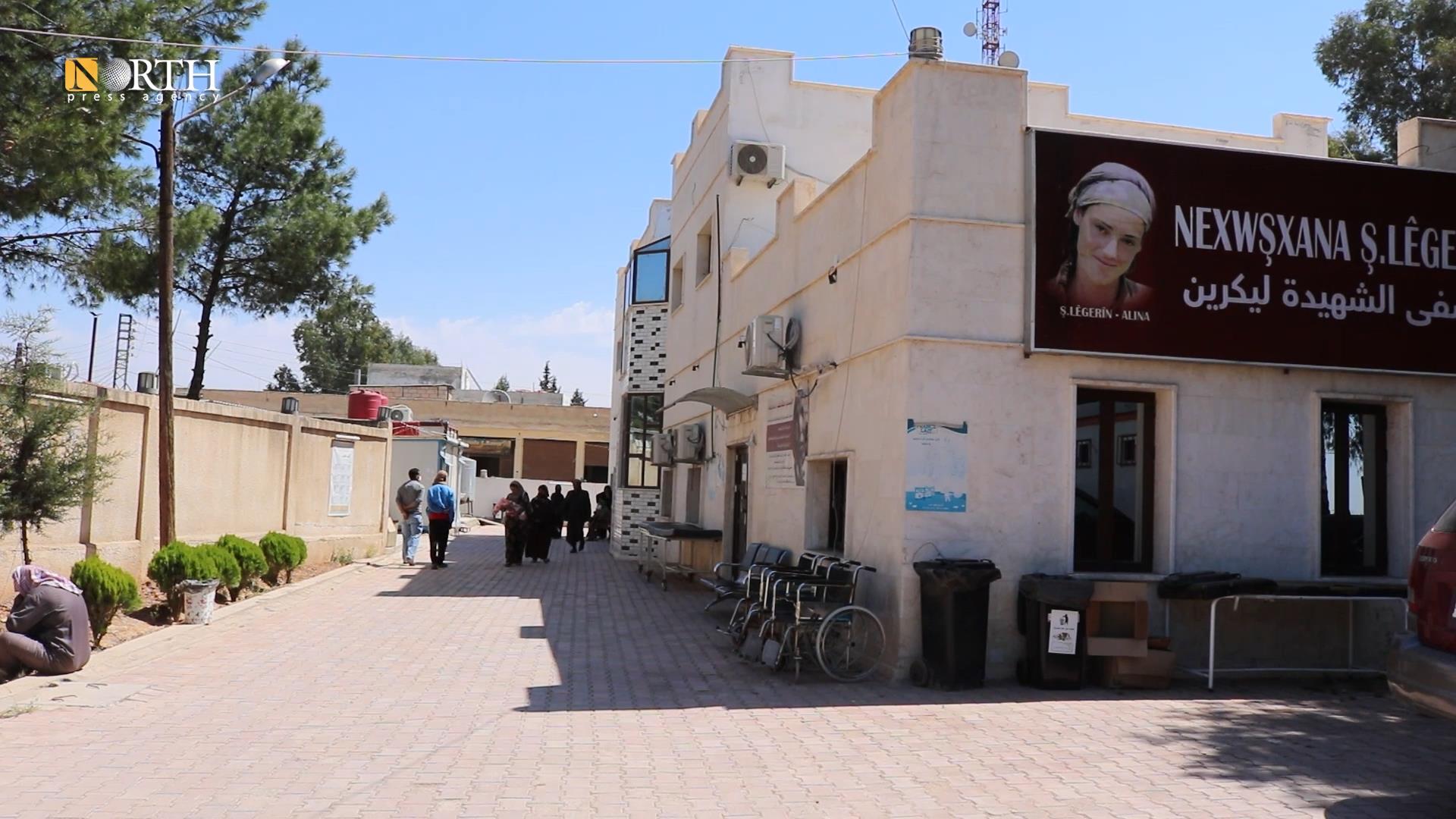
HASAKAH, Syria (North Press) – In the small Syrian town of Tel Tamr, a hospital has sat on the front lines serving local people for years, through attacks by terrorists, a massive army, and now through the coronavirus pandemic.
Early beginnings
In 2013, after the Syrian government withdrew from the areas around Sere Kaniye during al-Nusra Front’s attacks on the region, the Kurdish Red Crescent (KRC) medical organization stepped in to serve the medical needs of the people of Tel Tamr after its small hospital was left empty.
Dr. Hessen Amin, administrator of the Martyr Legerin Hospital and a member of the Kurdish Red Crescent in Tel Tamr, says that the KRC opened a small medical center in the town to provide free care to patients.
However, the clinic was not enough to satisfy the growing needs of the population.
“In 2014, we needed a hospital, and the capacity of Autonomous Administration was weak at that time. We met as doctors of Tel Tamr and decided to open a hospital for the residents of Tel Tamr.” Payments were merely symbolic; a visit to the hospital cost only 200 Syrian pounds and went to the hospital and the volunteer medical staff.
Tragedy
Tragedy struck the war-torn Tel Tamr area again when yet another terror group – ISIS – attacked the region.
Dr. Amin recalls that ISIS blew up the hospital, killing countless numbers of civilians and many medical workers.
With deteriorating economic and health conditions and large numbers of displaced people flooding the area, the KRC decided to establish a new hospital, “with the help of some foreign allies, especially the Italian UPP organization,” according to Dr. Amin.
The former government hospital was chosen as the site for the new, modern hospital, which eventually grew to have surgical, inpatient, internal medicine, pediatric, and gynecological care available, and opened in April 2017.
Always on the front
Medical staff at Martyr Legerin Hospital have witnessed war countless times – first with al-Nusra in 2013, then with ISIS in 2015, and finally, with the Turkish army and their affiliated Syrian armed groups during their attack on Sere Kaniye and Tel Abyad in late 2019.
“Our hospital was on the front line, and because of this, we treated and operated on all wounded, especially civilians, who were injured by Turkish planes and bombardments,” Dr. Amin recalls.
The massive waves of injured people from the war in the villages around Tel Tamr put pressure on the already fragile healthcare system, straining the capabilities of the KRC and the hospital building itself, which Dr. Amin says is over 55 years old.
Uncertain future
After years of serving the local populace through pandemics and invasions, the hospital is in dire need of maintenance and updating.
However, Dr. Amin states that engineers working on the hospital say they cannot work in the building, and so some departments are closed until a decision from the Autonomous Administration is made regarding a new hospital site.
Dr. Amin explained Tel Tamr’s unique demographics, calling the area “a little Syria” which is diverse and home to all communities; Syriacs, Chaldeans, Assyrians, Arabs, Circassians, and Kurds.
“We can help all communities in Tel Tamr and its surroundings,” he stated.
“We call on all international health and humanitarian organizations to help us restore our hospital to what it was before.”