
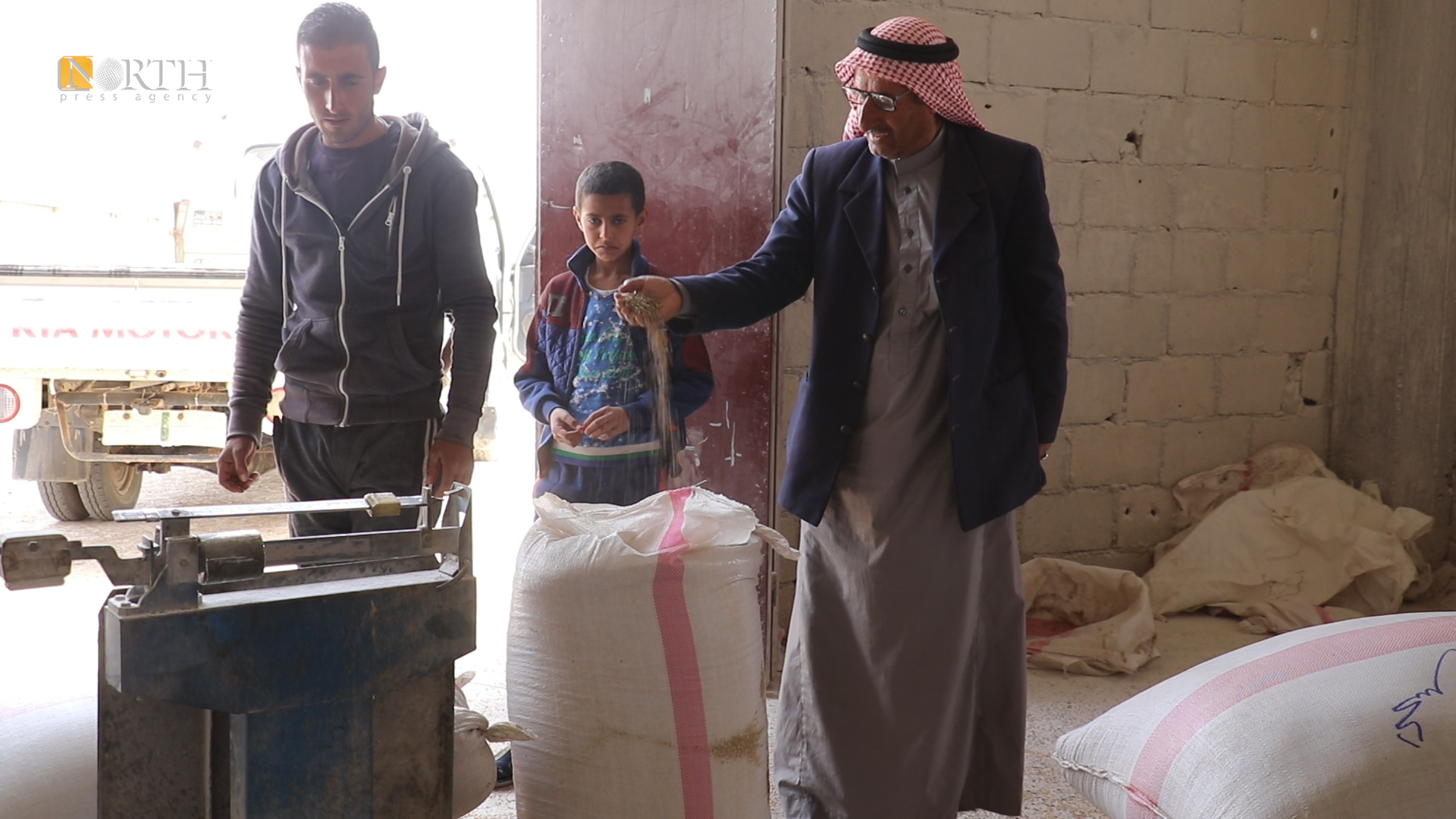
JIL AGHA, Syria (North Press) – Residents of more than 30 villages near the town of Tel Kocher, in the countryside of northeast Syria’s Qamishli, suffer from a lack of bread, and families are forced to grind sterilized agricultural wheat and barley to make bread at home.
According to the residents of those villages, which are known as the “political line” or the southern villages of Tel Kocher, the bread shortage is nearly five months old.
Barley bread
Residents’ fears are increasing that the bread shortage will worsen due to deterioration of large areas of wheat and barley crops due to the lack of rainfall this year.
“We used to hear about barley bread from our ancestors, until we saw it and ate it,” said Saleh al-Ali, a resident of the village of Krivati in the Tel Kocher countryside.
Al-Ali pointed out that since November 2020; they have been witnessing a bread crisis. “The amount of allocations that the authorized person brings does not cover the needs of the village. 500 bundles, how will it suffice for 300 houses?”
The lack of allocations to villages has led, in many cases, to problems between the residents “and the authorized person, who has nothing to do with the problem,” according to al-Ali.
A doctor in the town warned that grinding agricultural wheat may harm residents, as “it is sterilized with chemical preservatives to prevent mice from approaching it and thus are toxic substances.”
Agricultural wheat is not considered suitable for human use and causes severe intestinal inflammation and many digestive problems, according to the doctor.
Fadel Gharib, resident of the village of Manjur in the countryside of Tel Kocher, complained about the high prices of wheat and barley, explaining that ”there are mills and bakeries, but the basic material, even if it is available, is expensive.”
The price of a kilogram of wheat is 1,300 Syrian pounds (SYP), while a kilogram of barley is 1,100 SYP and red wheat is 1,200 SYP.
Hakim al-Afar also complained about the high cost of wheat and the loss of flour, “a bag of flour is sold for 70,000 SYP.”
Every day, dozens of families from the “political line” villages go to the village of Aqab, which is home to a mill.
Ahmed Okab, owner of the mill, said that the demand for grinding wheat, barley, and agricultural wheat has increased recently, as nearly five tons of wheat, barley, and agricultural wheat are grinded daily there.
He mentioned that there are families who grind barley to make bread, as 2 tons of barley are grinded daily, and the quantity may exceed that, according to him.
Okab pointed out that the real bread crisis has intensified in light of the reduction in the allocations for bakeries. “Families used to bake, buy, and receive their allowances through the authorized person, but today there is no bread, no flour,” he added.
However, Muhammad al-Ahmed, an administrator and financial official in the bakery in the town, told North Press that the bakery’s allocations only cover the town in most cases and the military forces.
He pointed out that the bakery allocations five months ago were 12 tons, “but now we bake nine tons as daily allocations.”
The reason for the shortage of flour allocations in Tel Kocher’s bakery is due to the lack of mills and their inability to secure sufficient quantities for supply bakeries, member of Tel Kocher’s Economic Committee Muhammad al-Farhan said.
He pointed out that the lack of stone and semi-automatic bakeries throughout the southern region, amid the high price of wheat and drought this year, constitutes a real crisis for the residents.
Al-Farhan said that they are about to develop plans to restore the Tel Kocher bakery, open a mill, and establish a new economic feasibility for bread that includes the villages of the south, so that bread can be distributed through authorized agents according to the family register to contain the crisis.