
Ilham Ahmad says SDF integration does not resolve all outstanding issues
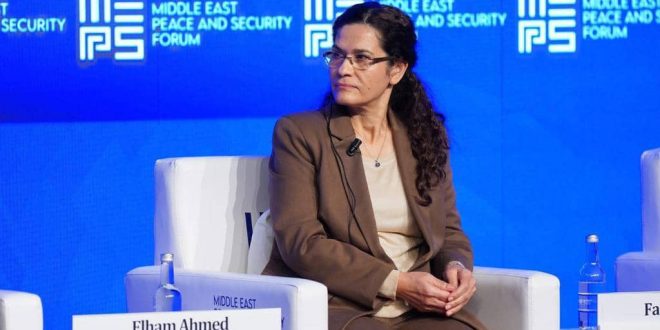
QAMISHLI, Syria (North Press) – Ilham Ahmad, Co-Chair of the AANES’ Foreign Relations Department, said on Sunday that the completion of the SDF’s integration into Syrian state institutions would not mean that all outstanding issues had been resolved.
Speaking to Rojava Local TV, Ahmad said that discussions with Damascus had primarily focused on education in the mother tongue, stressing that Kurdish sentiments over the issue were justified.
“Our greatest struggle will be to protect the language and the rights of the Kurds in the constitution,” Ahmad added.
She pointed out that the issue of prisoners remained a constant part of the discussions and had “never been forgotten,” without providing further details.
Ahmad indicated that the possible change of the name of the Syrian Republic would be addressed during constitutional discussions.
On military integration, she said talks over incorporating the Women’s Protection Units (YPJ) into the Syrian military had not yet concluded.
The YPJ, a predominantly Kurdish women’s military force that operates alongside the SDF, played a major role in the fight against the Islamic State (ISIS) in northeastern Syria.
The Kurdish official also said that the return of people displaced from Sere Kaniye (Ras al-Ain) to their homes would take place in an organized manner.
Turkey and Syrian opposition factions took control of Serekaniye and the nearby town of Tel Abyad in October 2019 following a Turkish military operation against the SDF. The offensive displaced tens of thousands of residents, including Kurdish civilians.
Ahmad added that the current period was “sensitive” and called for the protection of the gains and achievements made in northeastern Syria.
“We will remain committed to the pledge we made to our martyrs,” she said.
Her remarks come amid ongoing discussions between Damascus and the SDF over implementing an agreement to integrate the Kurdish-led force and institutions in northeastern Syria into the Syrian state.
The agreement has also raised questions over constitutional guarantees for Kurdish rights, language and political participation, as well as the status of displaced people and the future structure of the region’s security forces.