
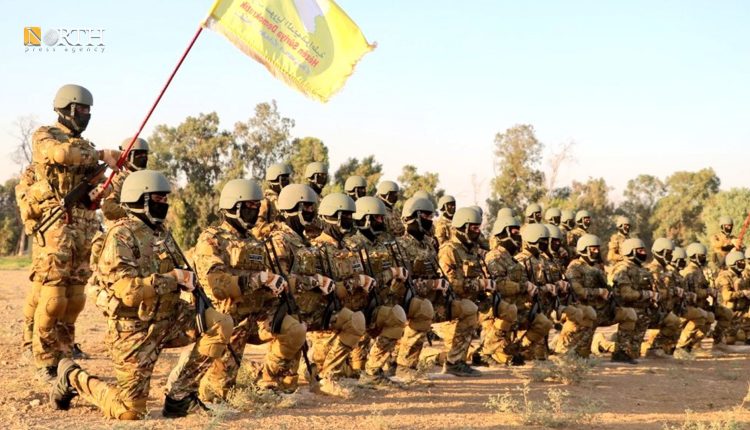
QAMISHLI, Syria (North Press) – Over more than a decade, the Syrian Democratic Forces (SDF) have evolved from a multi-ethnic military alliance formed in late 2015 into a leading ground force in the fight against ISIS, with direct backing from the U.S.-led international coalition. In August 2026, the SDF ended its existence as an independent military force after completing its integration into Syrian state institutions and formally announcing its dissolution.
Formation: A Kurdish-led, multi-ethnic alliance
The SDF was established on Oct. 10, 2015, in Derik in Hasakah governorate as an alliance bringing together Kurdish, Arab, Syriac, Assyrian and Turkmen forces. In its founding statement, the alliance described itself as “a unified national military force for all Syrians.” In practice, however, the YPG and YPJ remained at the core of its military and organizational structure.
The alliance emerged as ISIS expanded its control across northern and eastern Syria, particularly after the 2014 Battle of Kobani. Before the SDF was formally established, the YPG and YPJ had worked with Arab factions of the Free Syrian Army through the Euphrates Volcano operations room. U.S. air support during the Battle of Kobani further strengthened Washington’s ties with local forces fighting ISIS.
As Washington sought a local ground partner that could extend beyond a solely Kurdish framework, it backed a broader, multi-ethnic formation. The arrangement also helped Washington limit the political cost of openly supporting the YPG, which Turkey opposed.
Who made up the SDF?
The SDF brought together a well-organized Kurdish core with local military factions and councils, many of them predominantly Arab, across areas including Raqqa, Deir ez-Zor, Manbij and Tabqa. Syriac and Assyrian formations also joined, alongside smaller Turkmen, Armenian and other units.
The YPG and YPJ were the most cohesive and experienced formations within the alliance. They provided much of its military backbone, command structure and combat capabilities. Other groups included the Syriac Military Council, the Sanadid Forces linked to the Shammar tribe, and Arab factions that joined the alliance at its formation or expanded their participation later.
Regional military councils were established in Manbij, Tabqa, Raqqa, Deir ez-Zor and Kobani. They brought together local fighters and took part in operations to drive ISIS out of territory it controlled.
The Asayish, meanwhile, operated as an internal security force separate from the combat formations, while remaining linked to the security structure of the Autonomous Administration in areas under SDF influence.
The SDF’s strength was not simply a matter of numbers. Its military effectiveness rested largely on the cohesion, discipline, command structure and battlefield experience of the YPG and YPJ, combined with their ability to coordinate closely with the international coalition.
The Pentagon estimated in March 2017 that Arabs made up about 60% of the force, compared with 40% Kurds.
War against ISIS: From Kobani to Baghouz
The SDF’s rise was closely tied to the war against ISIS, although the military partnership that eventually produced the force began before its formal establishment.
The Battle of Kobani in 2014-2015 marked a turning point in relations between the international coalition and the YPG and YPJ, which later formed the core of the SDF.
U.S. support initially centered on airstrikes against ISIS positions. It expanded in October 2014 to include airdrops of military supplies and ammunition. The support weakened ISIS’ ability to reinforce and resupply its forces and helped local fighters move from defending Kobani to retaking surrounding areas.
The experience of Kobani underscored the need for a broader force that could include Arab and Syriac formations. That process culminated in the creation of the SDF in October 2015. U.S. support subsequently expanded beyond air cover to include training, planning and battlefield coordination.
In 2015 and 2016, the SDF launched operations against ISIS in Hasakah countryside, Tel-Abyad and the area around Tishrin Dam, with support from coalition airstrikes, surveillance and intelligence.
Capturing Tel-Abyad was strategically important because it severed one of ISIS’ key supply and communication routes along the border and helped connect the northeastern Syria and Kobani areas, which were then under Kurdish administration.
During the battle for Tishrin Dam in late 2015, coalition forces helped support the advance across the Euphrates and the capture of the area around the dam and its supply routes. Coalition aircraft provided surveillance and struck fixed and mobile targets, while local forces carried out assaults, clearing operations and ground control.
The operation helped open the way toward Manbij, Tabqa and Raqqa.
Manbij
In the summer of 2016, Manbij became a major focus of the campaign against ISIS. The city served as a key transit point between Raqqa and the Turkish border and was used as a route for fighters, supplies and smuggling.
The offensive began in June under the leadership of the Manbij Military Council and Arab forces within the SDF, with wider SDF involvement in the siege and fighting.
The coalition provided heavy air support. More than 105 strikes were carried out during the early stages, targeting fighting positions, vehicles, heavy weapons, arms depots and car bombs. By early August, the coalition said it had conducted 602 strikes in support of the operation.
Airpower was only part of the support. Coalition surveillance and intelligence helped isolate the city and guide the advance, while coalition forces also supported mine and explosive clearance and the establishment of defensive positions against ISIS counterattacks.
Raqqa
Before the assault on Raqqa, the SDF and the coalition focused on cutting the city off from ISIS supply routes, particularly those leading toward Deir ez-Zor and the area around Lake Assad
Surveillance and airstrikes targeted ISIS defenses and helped facilitate operations in the countryside, while military advisers assisted with planning and coordination.
In Tabqa and around the Euphrates Dam, coalition strikes targeted ISIS positions and fortifications threatening the advancing forces.
On June 6, 2017, the SDF launched its assault on Raqqa city. The coalition provided air cover, artillery support, intelligence, planning and military advice.
The SDF carried out the ground assault, urban fighting, clearing operations and territorial control. Coalition forces focused on ISIS snipers, fortifications, headquarters, mortar positions and vehicle-borne explosives.
By the 53rd day of the operation, the SDF had captured about 45% of the city, according to a coalition spokesman. The SDF announced the capture of Raqqa on Oct. 20, 2017, dealing a major blow to ISIS, which had treated the city as the “capital” of its project in Syria.
Deir ez-Zor, Baghouz: The final battle
After Raqqa, the campaign moved into the eastern Euphrates Valley, where the SDF fought ISIS in towns and villages across Deir ez-Zor governorate before pushing toward the group’s final enclave between Hajin and Baghouz near the Iraqi border.
The coalition provided equipment, training, intelligence, logistical support, precision strikes and military advice. During the campaign in the Deir ez-Zor countryside, coalition aircraft and artillery supported the SDF advance, striking tunnels, fortifications and fighting positions while ground forces fought to capture towns.
From August 2018, coalition airstrikes and artillery supported the offensive against the remaining ISIS-held territory around Hajin and eastern Deir ez-Zor, extending toward the Syrian-Iraqi border.
The final battle for the Baghouz enclave began in February 2019. Fighting was complicated by tunnels, improvised explosive devices and suicide attackers, as well as the use of civilians as human shields by ISIS. At the same time, waves of displaced civilians, fighters and their families left the enclave.
On March 23, 2019, the SDF announced the end of ISIS’ territorial control in Syria following the fall of Baghouz.
The defeat ended ISIS’ territorial rule but did not mark the end of the group as an armed organization. ISIS shifted toward a campaign of insurgency, relying on cells, attacks, assassinations, explosives and attempts to target detention facilities.
After 2019, the nature of the SDF’s partnership with the coalition changed. Large-scale campaigns to capture cities and towns gave way to operations aimed at containing the ISIS insurgency and preventing the group from rebuilding.
U.S. support included training SDF personnel, sharing intelligence and accompanying forces during raids targeting ISIS cells, leaders and financing and weapons networks. In Deir ez-Zor and Hasakah, coalition forces accompanied SDF commando units during repeated security operations.
The partnership also continued to protect sensitive facilities from ISIS attacks, pursue smuggling, financing and recruitment networks, and manage the al-Hawl Camp and detention facilities holding ISIS members.
Broadly, the SDF provided the ground force for sieges, assaults, urban combat, clearing operations, territorial control, arrests and local security. The coalition supplied airstrikes, surveillance, artillery fire on some fronts, training, weapons, logistical and medical support, intelligence, targeting and limited accompaniment during some operations.
Together, the two sides sustained a military campaign stretching from Manbij and Raqqa through the Euphrates Valley to Baghouz.
From military force to settlement with Damascus
After years of military and security administration in northeastern Syria, relations between the SDF and the Syrian government under President Ahmad al-Sharaa entered a new phase with the March 10, 2025 agreement signed in Damascus by al-Sharaa and SDF Commander Mazloum Abdi.
The agreement established a broad political framework for relations between northeastern Syria and the state, with the end of 2025 set as a deadline for the work of executive committees.
It called for guarantees of Syrian representation and participation in the political process and state institutions, recognition of Kurds as an integral part of Syria and guarantees for their rights, a ceasefire, and the integration of civilian and military institutions in northeastern Syria into state structures.
The agreement also covered border crossings, the airport and oil and gas fields, the return of displaced people, state support in confronting remnants of the former regime and threats to Syria’s security and unity, and the rejection of partition, hate speech and incitement.
Implementation initially stalled over disagreements about how integration would take place, the structure of the new military formation, the powers of local administration, and arrangements concerning oil and borders. Reports in early 2026 said Damascus talks had yet to make tangible progress toward accelerating implementation.
January 2026 agreement
On Jan. 29, 2026, the sides reached a more detailed agreement following renewed tensions and an understanding on a ceasefire and phased integration.
The agreement provided for a permanent ceasefire, the withdrawal of forces from points of contact, the deployment of Interior Ministry security forces in Hasakah and Qamishli, and the transfer of civilian and government institutions and border crossings to state control.
It also called for the integration of Autonomous Administration institutions while retaining civilian employees, the settlement of civil and educational rights for Kurds, and guarantees for the return of displaced people.
On the military side, the agreement provided for the formation of brigades from the SDF, along with a brigade for the Kobani/ Ayn al-Arab/ forces within a division affiliated with Aleppo governorate. The arrangement marked a shift from the SDF’s independent military structure toward the formal chain of command of the Syrian state.
August 2026: Integration completed, dissolution announced
The process of dismantling the SDF’s independent structure entered its final stage in August 2026.
On Aug. 20, Mazloum Abdi announced that the integration of the SDF’s military, security and administrative institutions into Syrian state institutions had been completed. He described the move as the end of the integration phase and the beginning of a new phase focused, according to statements attributed to him, on securing Kurdish rights in the constitution and operating within Syrian law.
Five days later, on Aug. 25, Abdi announced from the presidential palace in Damascus that the SDF’s mission had ended and that the force was being dissolved as an independent military organization.
The announcement also covered the dissolution of the Autonomous Administration and its affiliated military and civilian formations and their integration into state institutions.
The two announcements marked separate stages of the same process: the Aug. 20 statement described the completion of integration, while the Aug. 25 announcement formally ended the SDF’s existence as an independent military organization.
What happens to the SDF leadership?
Sources have said that Mazloum Abdi could take an advisory position within the Syrian state and that Ilham Ahmed could join the Syrian People’s Assembly. However, no final decree or official announcement has established their positions, powers or responsibilities.
The end of the SDF as an independent military force therefore does not necessarily mean that all of its senior figures have left the political scene. Rather, based on the available information, it marks the transfer of the military and institutional structures that operated under the SDF umbrella into the framework of the Syrian state.