
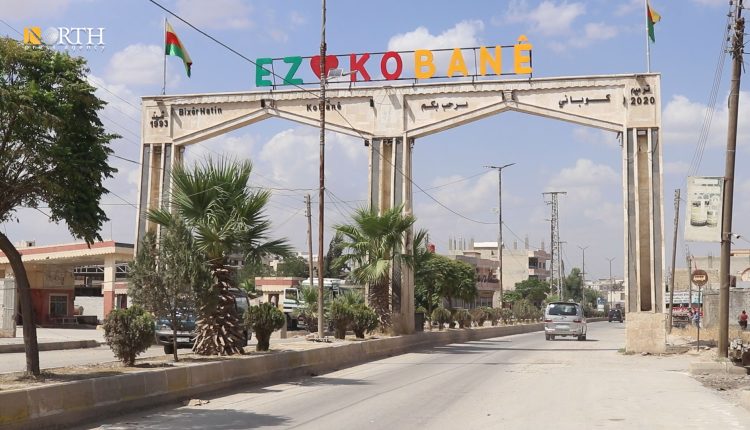
QAMISHLI/KOBANI, Syria (North Press) – In Syria, the names of cities, towns and villages are more than geographical labels on maps or entries in official records. They carry deep memories shaped by decades of political change.
In predominantly Kurdish areas, particularly in northeastern Syria, the issue of place names has been linked to a broader struggle over language and identity.
Most of these areas were assigned Arabic names officially recognized by the state and used in government records, while their Kurdish names were disregarded and remained in use only among Kurds.
However, Kurdish rights activists and researchers have documented the names of hundreds of villages and towns, arguing that these areas were arabized through discriminative policies, particularly during the rule of Hafez al-Assad and his son Bashar.
Kobani, history of a name
The city of Kobani has been one of the most prominent cases raised in recent years because of its dual name, and is among the clearest examples cited in discussions of Arabization.
Writer and poet Hussein Mohammed Ali, a resident of the city and one of its longtime teachers, discusses the history of the name and how the story of the city began nearly a century ago.
Ali told North Press that the name Kobani is linked to the circumstances of World War I, when the Ottoman Empire and its ally Germany decided to build a railway in the area.
He added that the name was derived from the word “Company,” as the project site developed into a settlement because of its large scale. Due to the ease of pronunciation, local residents referred to it as “Kobani” instead of “Company.”
The writer’s account partly overlaps with another explanation that suggests the name “Kobani” was derived from the German word “Bahn,” meaning “road” or “railway,” referring to the German name for the railway passing through the area.
Another explanation, however, traces the name “Kobani” to “Kom Bani,” a Kurdish term meaning “upper union,” which was used for a Kurdish tribal alliance in the area.
As for the name “Ain al-Arab,” the writer links it to a geographic context involving a spring east of the city. Shepherds who came to the area for grazing used the spring as a landmark, giving rise to the name “Ain al-Arab,” or “Kaniya Araban” in Kurdish. He noted that the name was coined by Kurds themselves.
The writer stressed that the presence of the word “Arab” in the name is not, in itself, a problem for him. Rather, he said, the issue lies in the way official names became part of a broader policy aimed at demographic change.
Dual names
Like Kobani, many Kurdish cities and towns in northeastern Syria also have dual names, including Qamishli/Qamishlo, Tirbe Spiyeh (al-Qahtaniya), and Sere Kaniye (Ras al-Ain).
Gorgin Issa, a member of the Kurdish Language Education and Protection Foundation, gives several examples of Kurdish names that were subjected to Arabization.
According to Issa, the name Qamishli/Qamishlo is linked to the Kurdish root “qamish,” meaning reeds. He adds that the current form of the name was later subjected to linguistic changes associated with Arabization.
As for Tirbe Spiyeh (al-Qahtaniya), Issa told North Press that the name was associated with graves in the area with white tombstones. The Arabic name therefore became “Qibur Bid” [White graves], translated into Kurdish as “Tirbe Spiyeh” The name was later replaced with al-Qahtaniya, referring to the Qahtan tribe [Arab tribe in Arabian Peninsula].
Issa links the change to an attempt to eliminate a name that was viewed as a translation of the original Kurdish name.
Other examples he cites include Chel Agha (al-Jawadiyah), Girke Lege (Maabadeh), and Derik (al-Malikiyah), in addition to dozens of other Kurdish villages.
Issa estimates that around 150 Kurdish villages have Arabized names, based on the information available to him, while he believes the number could reach at least 240 villages.
He traces the beginnings of Arabization policies in Syria to the early stages of the modern state, saying it emerged during the post-Ottoman period.
He said the policy became more entrenched during administrative changes in border areas in the 1920s before the demographic change took clearer forms in later periods.
Arabization
The issue of arabizing city and village names in Syria reveals challenges that go beyond differences between two names on a map. It involves an intersection of politics, language, identity and collective memory.
According to rights reports, the Arabization of place names was part of demographic change policies implemented by consecutive Syrian regimes, most notably the exceptional census and the Arab Belt, two discriminative projects against the original inhabitants of Kurds in northern and northeastern Syria
In 1962, the exceptional census stripped large numbers of Syrian Kurds of their citizenship. Human Rights Watch estimates that around 120,000 Kurds were affected.
Kurds stripped of citizenship were classified as “foreigners,” while others were placed in the category of “unregistered” people who were not recorded in citizen registries.
After the Baath Party came to power, the Arab Belt project was proposed in 1965 to change the demographic composition of Kurdish areas in Hasakah Governorate by resettling Arab families and relocating Kurds from villages within the project’s designated area, according to Human Rights Watch.
The Arabization of place names therefore came within a broader context of discriminative policies concerning identity and demographics. For many Kurds, changing a name consequently went beyond an administrative issue and became connected to historical memory and belonging to a place.
Restoring names
Shaheen al-Ali, a member of the administrative council of the Kobani Lawyers Union, is calling for the city’s name to be restored to Kobani, citing the major sacrifices made by Kurds, particularly during the battles against Islamic State (ISIS) in 2014.
From this perspective, the lawyer believes restoring the name should not be limited to popular usage but should also extend to official documents, including civil and real estate registries and all government records.
Al-Ali told North Press that residents could submit a petition through the local administration to request the name change. He added that it could also be carried out through a decision by the relevant government authority or by presidential decree, depending on the legal powers in place.
Al-Ali stressed that the issue concerns more than Kobani and applies to other cities and towns whose names were changed across Syria.
In this context, writer and poet Hussein Mohammed Ali is calling on the Syrian transitional government to reconsider the issue as a right of Kurds.
“This is the hope and demand of our people: that these names return to their historical names and that they be officially recognized, including in government registries and documents,” he said.
Kurds believe the state has a responsibility to reconsider them through a legal and official framework that guarantees the restoration of historical and cultural rights.
They stress that a name is not merely a description of a place, but part of identity, and that historical place names represent an essential part of Kurdish intangible heritage.