

QAMISHLI, Syria (North Press) – As Syria debates its future political and constitutional framework, longstanding demands for recognition of the country’s cultural and linguistic diversity have returned to the forefront. Among them is the call to officially recognize Syriac, one of the Middle East’s oldest living languages and a cornerstone of the identity of Syria’s Syriac community.
Despite centuries of continuous use – particularly in Hasakah Governorate and the city of Qamishli – Syriac remains absent from Syria’s official educational and administrative institutions, prompting growing calls from activists, educators and community leaders for legal safeguards to ensure its survival.
For many Syriac speakers, preserving the language is not only a cultural issue but also one of identity, historical continuity and equal citizenship.
Constitutional promises, limited implementation
As discussions continue over Syria’s transition and future governance, Syriac community representatives argue that existing legal frameworks fail to provide meaningful protection for their language despite constitutional references to cultural rights.
Malik Asmar, an administrator at the Olaf Taw Foundation for Syriac language, told North Press that significant efforts have been made in recent years to institutionalize Syriac education within schools across northeast Syria.
“The new phase Syria is entering should guarantee the rights of the Syriac people and recognize Syriac as one of the country’s historical languages,” he said.
Asmar pointed to Article 7 of Syria’s constitutional declaration, which guarantees cultural and linguistic rights for all Syrians, saying it provides a legal basis for legislation protecting local languages.
He called for a dedicated decree safeguarding Syria’s indigenous languages – particularly Syriac – to ensure equal educational and cultural rights for all communities.
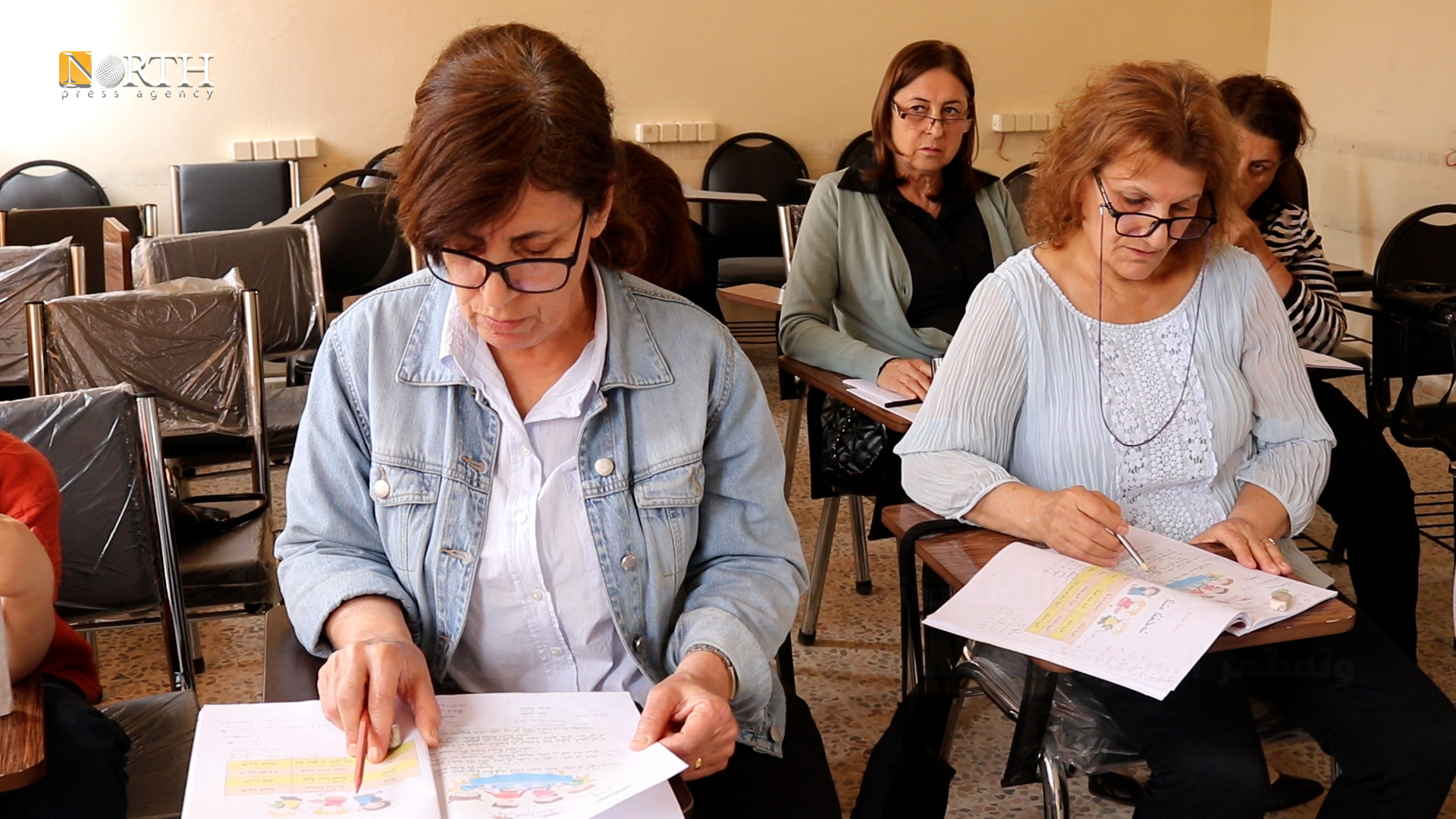
Without official recognition, he warned, preservation efforts will continue to depend largely on churches and individual initiatives, as they have for decades, rather than becoming part of national institutions.
His remarks come days after members of the Syriac community staged a protest outside the Hasakah governorate building, demanding recognition of their language and broader cultural rights. During the demonstration, Hasakah Deputy Governor Ahmad al-Hilali described their demands as legitimate and pledged to relay them to the relevant state authorities.
Education at the center of the struggle
Education remains one of the sectors most affected by the lack of official recognition.
Although Syriac continues to be taught in several specialized institutions and cultural centers, teachers say they face persistent challenges related to curriculum development, funding and institutional support.
Noura Malki told North Press that many members of the Syriac community were disappointed after Syriac was excluded from the list of officially recognized languages in schools and universities.
Still, she expressed hope that future discussions with the Syrian government could lead to formal recognition.
“Syriac is more than a means of communication,” she said. “It carries the history and heritage of the Syriac people.”
She added that Syriac families played a central role in establishing modern-day Qamishli after migrating from the Tur Abdin region, making the language an integral part of the area’s collective memory.
Malki stressed that preserving the language begins at home.
She encouraged families to speak Syriac in daily life while supporting educational institutions such as Olaf Taw that specialize in teaching and promoting the language.
Limited resources, ongoing efforts
Syriac language teacher Jacob Barsoum said the absence of official recognition has also affected students’ motivation to learn the language.
Nevertheless, he added that strong family ties to Syriac heritage continue to encourage younger generations to study it.
Barsoum identified financial constraints as one of the greatest obstacles facing Syriac education, explaining that no official budgets are allocated for language instruction.
As a result, churches, civil society organizations and cultural institutions continue to shoulder most of the financial burden.
He added that Syriac-language media outlets, cultural organizations and church schools remain essential in preventing the language from fading while expanding opportunities for learning.
More than a language
For many Syriacs, language is inseparable from identity.
Community members argue that any legal or constitutional marginalization of Syriac directly affects their sense of belonging within the Syrian state.
Malki described Syriac as a complete cultural identity encompassing the historical, religious and social memory of the Syriac people.
Preserving it, she said, requires cooperation between families, educational institutions and the state.
Young Syriacs face additional challenges as education and employment increasingly require Arabic or foreign languages.
Simon Jabro, a student at Damascus University, told North Press that studying in languages other than one’s mother tongue gradually reduces everyday use of Syriac, particularly because it remains absent from public schools, universities and official institutions.
He said young people must therefore make extra efforts to maintain fluency by speaking Syriac at home, listening to Syriac music and following Syriac-language media.
According to Jabro, official recognition would strengthen the language’s status and encourage younger generations to embrace it as an essential part of their cultural identity.
Keeping an ancient language alive
Despite legal and educational challenges, Syriac remains widely spoken by thousands of people across Hasakah, Qamishli and other towns in northeast Syria.
It continues to be used in homes, churches and community gatherings, while religious institutions, cultural organizations and Syriac-language media organize educational programs and cultural activities aimed at preserving the language.
Community leaders acknowledge that these efforts have helped sustain Syriac through decades of political change.
However, they argue that voluntary initiatives alone cannot guarantee its future without comprehensive public policies supporting language education and institutional use.
As debates over Syria’s future constitutional order continue, demands for official recognition of Syriac as a national or locally recognized language are gaining momentum.
Supporters say such recognition would help protect one of the region’s oldest living languages while reinforcing Syria’s cultural diversity.
For now, Syriac stands at a crossroads—caught between a rich historical legacy and an uncertain institutional future. Whether it remains largely confined to homes and churches or becomes an acknowledged part of Syria’s public life may ultimately depend on the country’s willingness to translate constitutional promises of diversity into lasting legal protections.