
AANES official expects breakthrough on SDF integration talks in early 2026
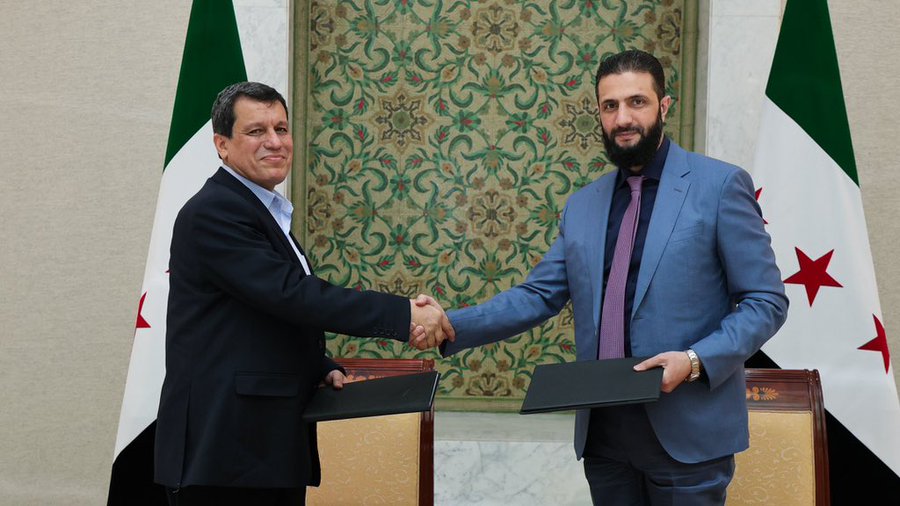
QAMISHLI, Syria (North Press) – Negotiations to integrate the Syrian Democratic Forces (SDF) into Syria’s national military structure are expected to reach a breakthrough in early 2026, a spokesperson for the Autonomous Administration of North and East Syria (AANES) delegation to Damascus said on Friday.
In an interview with the Erbil-based Rudaw Network, Maryam Ibrahim, spokesperson for AANES’ Negotiation Committee with Damascus, said relations with Syria’s transitional government remain “a bit weak,” but both sides are prioritizing the military file as the core issue in talks.
Although the end-of-year deadline set in the March 10 agreement between SDF Commander-in-Chief Mazloum Abdi and Syria’s Transitional President Ahmad al-Sharaa passed without a final deal, Ibrahim said progress is close.
“No timeframe has been determined, but there is hope it will be done in the coming days,” she said, adding that AANES expects a breakthrough “in the early days of 2026.”
Ibrahim indicated that a high-level meeting between Abdi and senior officials in Damascus is expected within the next 10 days. A similar meeting scheduled for late December 2025 was postponed for “technical reasons,” coinciding with renewed clashes in Aleppo between Damascus-affiliated factions and the Internal Security Forces (Asayish) in the Kurdish neighborhoods of Sheikh Maqsoud and Ashrafiyeh, which left casualties.
According to Ibrahim, the negotiations are focused first on military arrangements. “Importance is given to the military file,” she noted. “Before everything else, agreement will be made on the military points.”
Under the proposed framework, the SDF would become a component of the Syrian national army while maintaining its local presence in North and East Syria. Ibrahim pointed out that the deployment of Damascus forces to the region has not been discussed.
“SDF remains in North and East Syria, and Damascus forces do not go there, because SDF fundamentally becomes a component of the Syrian army and represents the army there,” she stated.
One of the main sticking points remains the form of integration. Damascus favors absorbing SDF fighters individually into existing units, while the SDF insists on remaining a unified force in its current areas. Ibrahim added that the SDF is expected to integrate as three military formations, including a separate brigade for the Women’s Protection Units (YPJ).
“We are trying to integrate women into the Syrian army as well, but for now they preserve their own military system in the North and East,” she said.
On governance, Ibrahim stressed that AANES is not seeking separation from Damascus. “We showed that we are not separatists and we do not want to create a separate government, but rather we want to be integrated with the Damascus government so that this becomes the foundation for building a democratic and decentralized Syria,” she said.
She added that Damascus has recently shown greater flexibility, noting growing acknowledgment that “the centralized system deepens the problems.”
Ibrahim pointed out that regional interference, particularly from Turkey, has previously slowed negotiations. Ankara has warned that SDF demands for decentralization threaten Syria’s territorial integrity, though Ibrahim said Turkey’s tone has recently softened.
“We see that Turkey has recently taken a somewhat softer position,” she said, expressing hope Ankara would play a “positive role.”
She added that talks are proceeding with “American guarantee” to finalize the military file. The SDF has been the main local partner of the U.S.-led Global Coalition to Defeat the Islamic State (ISIS) in Syria.
The March 10 agreement between Mazloum Abdi and Ahmad al-Sharaa laid out a framework for integrating the SDF and AANES institutions into state structures, amid efforts to stabilize the country after years of conflict.
The talks come against the backdrop of repeated security tensions, particularly in Aleppo’s Kurdish neighborhoods, and ongoing disputes over decentralization, governance, and military command. Kurdish, Druze, and Alawite communities have long called for decentralized governance, citing decades of marginalization under the former Baath regime.
Turkey, a key backer of Syria’s transitional government, has consistently opposed any arrangement it views as empowering the SDF, which it considers linked to the PKK. Meanwhile, the United States has sought to balance support for its SDF ally with engagement with Damascus, particularly following Syria’s recent inclusion in the anti-ISIS coalition.