

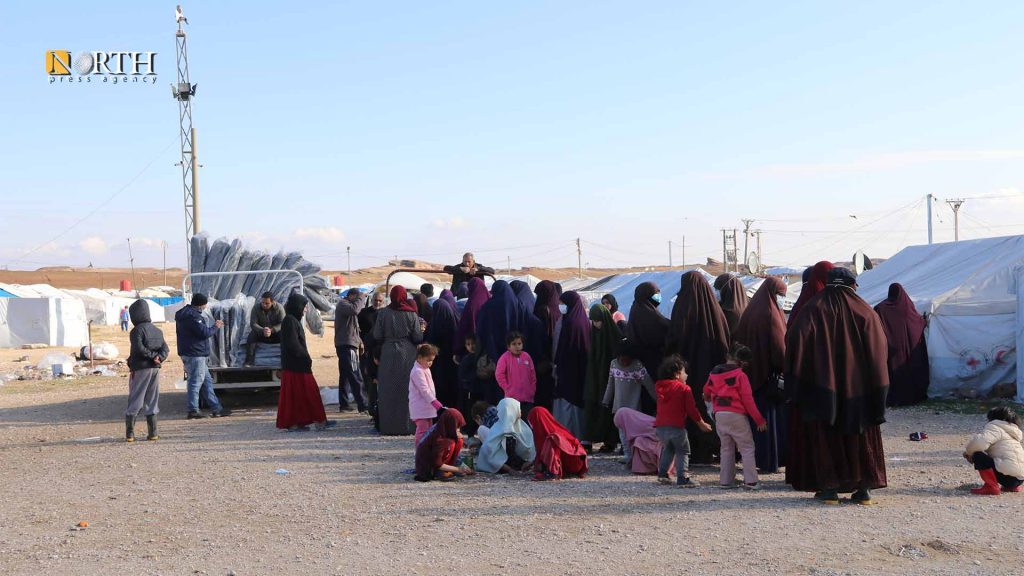
DERIK, Syria (North Press) – With temperatures below freezing, the Canadian 29-year-old refugee, Asma’ al-Beri, who is residing in Roj Camp near Derik city in the far northeast Syria, says she and her family have not received winter supplies including clothes and covers to warm themselves.
Refugees in the Roj Camp are complaining about the lack of winter requirements such as covers, mattresses, clothes and blankets in addition to the need to replace the old outworn tents that can hardly protect them against cold wind.
Residents of the camp are suffering in light of the weak response by humanitarian organizations in a time when they urgently need winter clothes and thick fabric covers to reinforce tents, “We have only six blankets that cannot protect us during this cold weather,” Beri added.
“My child and I need jackets and winter clothes. My child had flu in this cold weather,” she noted.
During 2020, the Autonomous Administration of North and East Syria (AANES) started the process of moving families of the Islamic State Organization (ISIS) from the Hawl Camp, east of Hasakah, to Roj Camp.
The AANES conducted this process with the aim of relieving the immense pressure on Hawl Camp and keep the families away from influence of extremists in foreigners or immigrants section for women in the camp, according to statements by officials of the AANES.
The Roj Camp is a house for about 806 families numbering 2,800 persons of Arab and foreign nationalities including wives and children of ISIS that hail from 62 counties, according to the Camp’s management.
No winter clothes
Roj Camp Director, Nora Abdo, said they were promised to receive winter clothes by UNICEF, “but they have not implemented their promises so far in light the decreasing temperatures.”
UNICEF offered electric heaters to those with asthma and allergy, “but the power is not always available which is a problem witnessed throughout areas in northeast Syria,” Abdo told North Press.
Although the services provided by organizations in the Camp are better than those in the camps shelter IDPs fled Turkish attacks against northeast Syria, the closure of al-Ya’rubiyah border crossing with Iraq has a great effect on the amounts of humanitarian aid designated to the refugees in Roj Camp.
The number of covers and mattresses designated for distribution, according to the camp’s administration, do not match with the number of those residing in one tent.
In January 2020, the UN Security Council canceled the mandate granted to the UN for using al-Ya’rubiyah crossing for humanitarian aid entry.
The UN Security Council’s decision has reduced the ability of relief organizations to support the ravaged health care system there and respond to the COVID-19 pandemic, according to Human Rights Watch.
Despite calls by organizations and member states of the United Nations for re-authorization of the crossing, the repeated Russian-Chinese veto led to rejection of the proposal, even before voting.
The 32-year-old Egyptian refugee, Amira Mohidin Sadeq, who is residing with her two children in the camp, said the clothes they received last year “did not suite my children’s sizes and inadequate.”
“My children wear about four jumpers and pants all at once in order to stay warm, but they hardly move,” she added.
Outworn tents
“Tents are not of good quality and they have become old and should be replaced with others or supported with thick fabric covers and waterproofs in order to keep them warm during winter,” Sadeq noted.
A number of organizations are operating in Roj Camp including Blumont, responsible for services, Save the Children, responsible for educating those under 18, the Kurdish Red Crescent, for health condition, International Committee of the Red Cross (ICRC), provide tents to foreign refugees, and United Nations High Commissioner for Refugees (UNHCR), provides the tents to the Arab refugees.
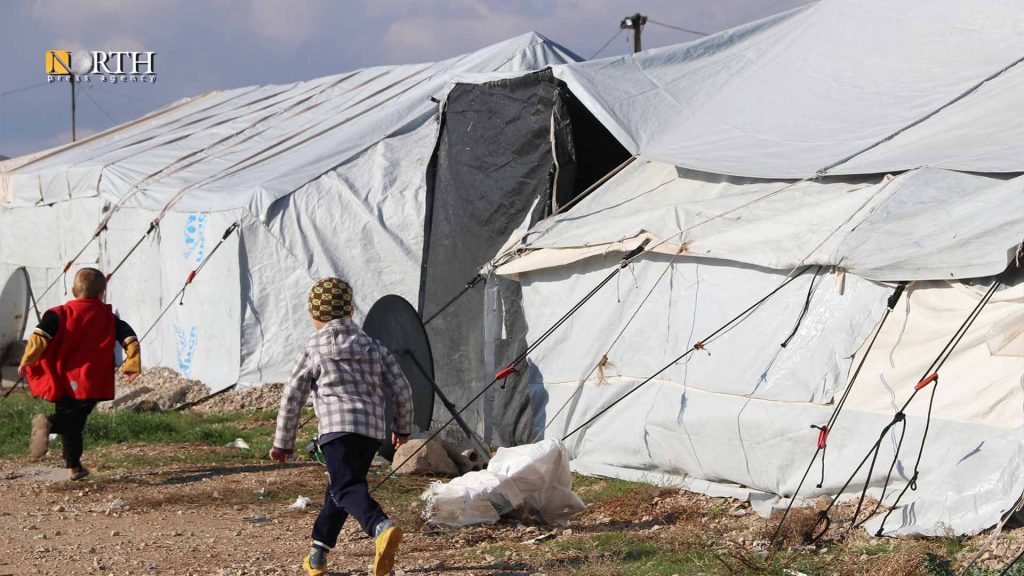
The camp needs more tents in addition to replacing 400 old tents with other new ones, according to the camp’s administration.
With the onset of winter, Blumont provided the camp’s residents with heaters and between 25 and 50 liters of kerosene, according to the number of family members.
However, the heaters were not good some of them were broken down and let alone their risk, according to refugees.
“When I lit the heater I sit next to it and keep watching it because my children suffer from asthma and allergy,” Sadeq said.