
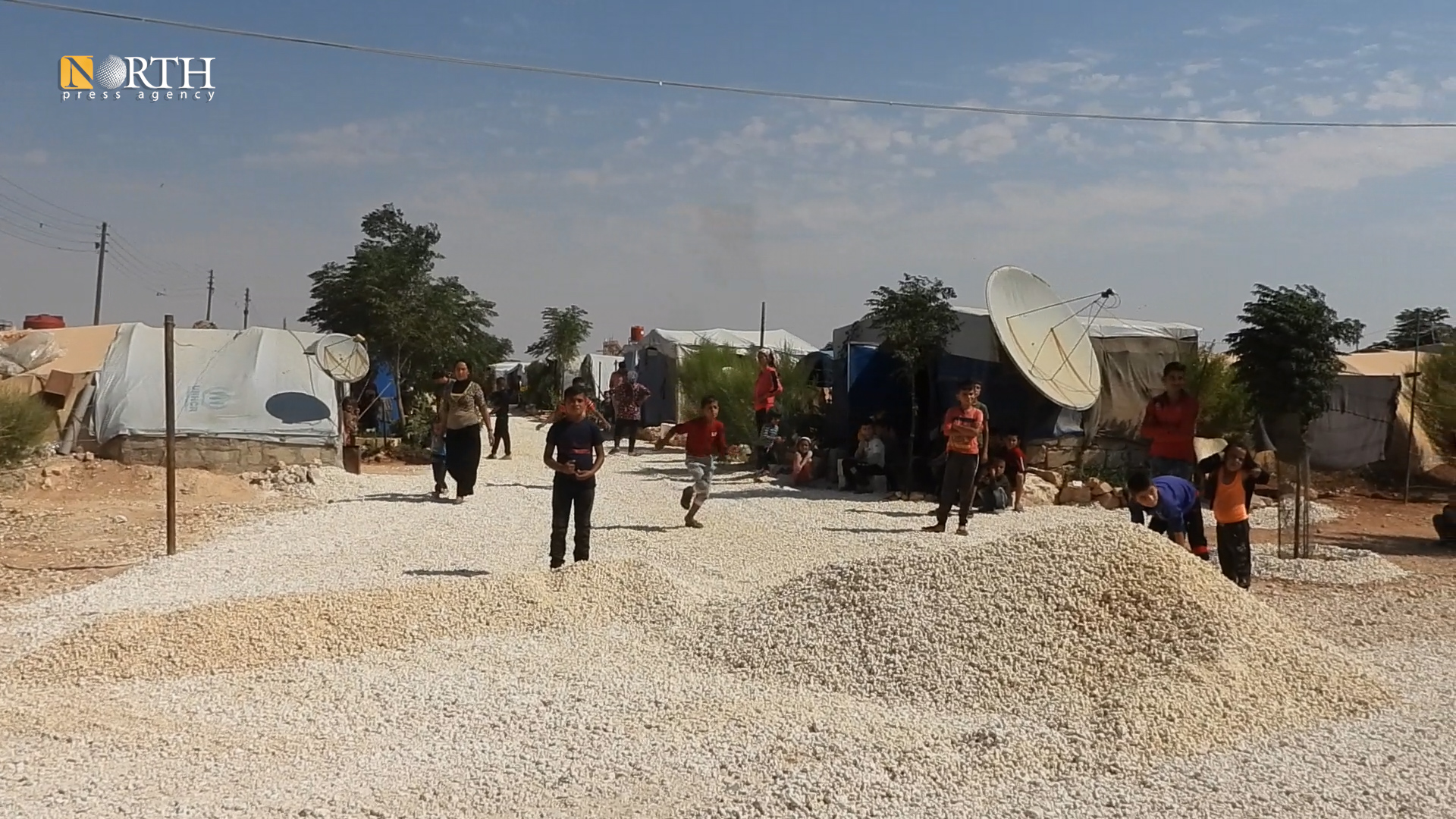
ALEPPO NORTHERN COUNTRYSIDE, Syria (North Press) – With the advent of winter, Shadya Najjar, 51, a displaced woman from the city of Afrin, northwest Syria, fears that she and her family may face the same problems they had last winter.
Najjar, who resides in the Barkhodan IDP camp in the northern countryside of Aleppo after displacing from Afrin following the Turkish invasion, did not get fuel for heating and other necessities needed in winter like clothes, carpets and others last year.
“We face difficult situations, as there is no fuel for heating or even rug or carpet to sit on, and winter is coming soon,” she said.
With the advent of winter, Afrin IDPs fear more, as they have not secured fuel and other means of heating due to the siege imposed on the region by the Syrian government.
In 2018, following the Turkish invasion, along with Turkish-backed opposition factions, about 300,000 displaced people from Afrin sought shelter in the camps of al-Awda, Afrin, Barkhodan, Sardam and Shahba, while others were distributed among 42 villages and towns in the northern countryside of Aleppo.
According to statistics conducted by the Social Affairs Labour Board in Afrin, which works currently in the northern countryside of Aleppo, about 2,000 displaced families from Afrin reside in the five camps, and about 140,000 persons reside in the villages and towns.
Since November 2020, the Syrian government has prevented the entry of enough quantities of fuel, gas, foodstuff, medicine and flour to the areas in the northern countryside of Aleppo.
Last winter, the government checkpoints near the city of Manbij prevented fuel from the Jazira region to enter the northern countryside of Aleppo. It only allowed the first batch of fuel to enter, which was not enough for the displaced families.
Afrin IDPs face real trouble
According to statistics of the Fuel Committee of the Autonomous Administration in the northern countryside of Aleppo, the displaced families and the residents of the region, need about 660,000 liters of fuel per day to meet their needs in order to operate generators, bakeries, health centers and internal transport vehicles.
“The quantities of fuel entering the region only meets 30% of these needs, amid continuation of the siege of the area,” Muhammad Mustafa, a former committee official, told North press.
The missing materials, due to the siege, include gas and gasoline, which do not enter the region regularly. Rather, residents get them in the black market at very high prices.
The official then warned of a disaster that would happen to the IDPs if the government continued to politicize the matter of their needs.
In a house without windows and doors in the village of Babennis in the northern countryside of Aleppo, Firyal Suleiman, 45, a displaced woman from Afrin, lives with her family.
Suleiman expresses her fears of facing the same problem she had last winter saying: “We have many concerns. Last winter, a kilogram of firewood was between 250 and 300 SYP, but this year it is sold at 500 SYP, and we do not get salaries to buy them or fuel.”
Last winter, displaced people had to collect dry tree branches and nylon bags to keep themselves warm, as most of them cannot afford to buy diesel or firewood from the black market.
Double suffering in the tents
According to Abid Hannan Ma’mo, co-chair of the Social Affairs and Labor Board in Afrin, they are preparing to distribute new heaters to the IDPs in the camps and distribute children’s clothes to the “needy” families.
However, Ma’mo told North Press that they have no solutions if the siege on the area continues.
He pointed out that the aid provided by organizations to the IDPs “only covers 20% of the needs of them. At the beginning of last winter, organizations distributed blankets and sponges, but not all families got them.”
Sitting in front of her tent, Nayla Muhammad, 58, a displaced woman from Afrin and resides in Barkhodan camp, talks about her difficult life in the camp.
“My tent is worn out, so I occasionally patch it,” she said.
“When it rains, the water comes in the tent, and when I light the fire, the tent is full with steam and moisture, so that our things get wet,” she added.