
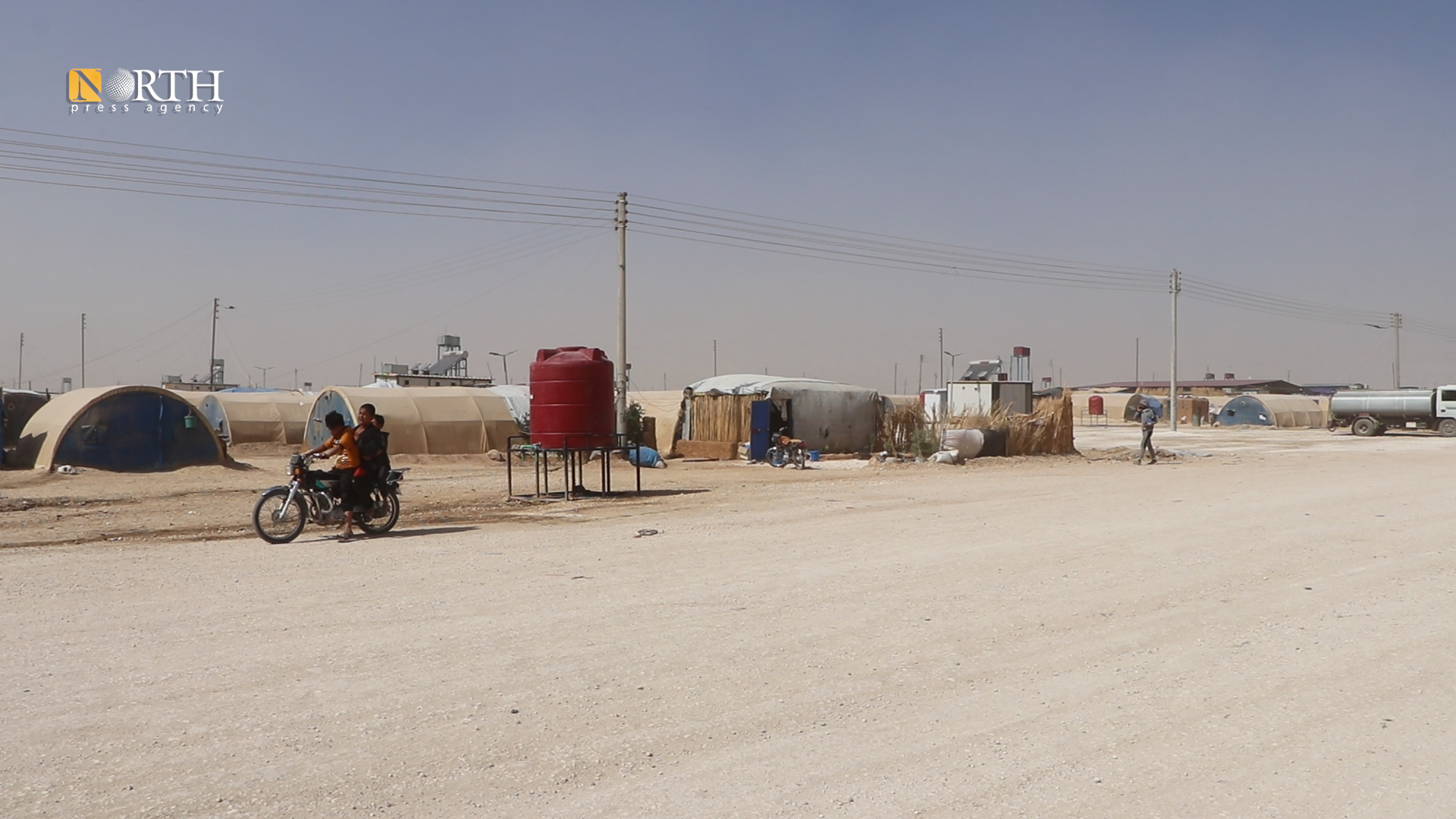
HASAKAH, Syria (north Press) – Two years of displacement from her hometown, Anoud al-Jassem, 69, an IDP from the countryside of Sere Kaniye (Ras al-Ain), who resides with her family in Washokani camp near Hasakah city in northeast Syria, still remembers everything she left behind.
The displaced woman, sitting in front of her tent with her disabled daughter and other displaced women from her region, said that she left behind her warehouses of wheat, barley, cumin, electricity generators, tanks of water and diesel, and all its possessions, including a house, land, and others.
The old woman, who suffers from many diseases, the most noticeable are herniated disc, diabetes and blood pressure problem, added that “We just took our clothes we were wearing when we were displaced.”
On October 9, 2019, Turkey and its affiliated opposition factions invaded Sere Kaniye and Tel Abyad, causing the displacement of 300,000 indigenous people.
The people of the two cities are distributed among tents and shelters in northeast Syria. They live in harsh living conditions amid lack of humanitarian aid.
Washokani camp, which was established by the Autonomous Administration on October 24, 2019, on the outskirt of the town of al-Tweina, 13 km west of Hasakah, houses 2,317 families, a total of 15,158 people, distributed among 1,986 tents, according to the camp management.
“We want to go back home”
Summaya al-Azzawi, 49, an IDP woman from the countryside of Sere Kaniye who resides in the same camp, describes her situation now as a tragedy.
She lived for a few weeks with her children in a school which was turned into a shelter for the displaced people from Sere Kaniye and its countryside.
“My children slept on the tiles of the school yard for three days. We then moved to the camp. For a year, we have slept on nylon sheets because there were no sponges and blankets,” she added.
Al-Azzawi pointed out that in the summer, they suffer a lot from high temperatures amid the absence of means of cooling.
She fears the winter, and says that the displaced people in the camp have not yet received fuel for heating nor blankets or clothes, adding that the sponges they received last year have become worn out and unusable.
The displaced woman described her tent saying, “This tent is used as a bathroom, a kitchen, a bedroom and a living room.”
She finds in returning to her home a solution to end her suffering in the camp, “We do not want anything, we just want to go back to our homes, even if we have nothing to eat. We will grow crops and harvest them. It will be better than our situation now.”
Insufficient aid
The IDPs in the camp complain about the lack of food baskets distributed by the organizations, as families often receive one food basket every two months.
Riyad Mer’i, official of the Relations Office at Washokani camp, said that food baskets have not been distributed for the past two months, as “the organizations justified this by the lack of sufficient budgets.”
According to Mer’i, the provided aid does not meet 20% of the needs of the IDPs of drinking water and food.
Over the last period, organizations that were providing services in the camp, have stopped distributing these services and headed towards the areas of Deir ez-Zor and Raqqa, according to Mar’i.
“Three children lost their lives in the camp in the summer due to the high temperatures,” Meri’ told North Press.
Meri’ pointed out that many NGOs have evaded their “moral and humanitarian” responsibilities towards the IDPs of Sere Kaniye, “as a result of the Syrian government’s failure to recognize this camp and the failure of the UNHCR to provide aid to the displaced.”