
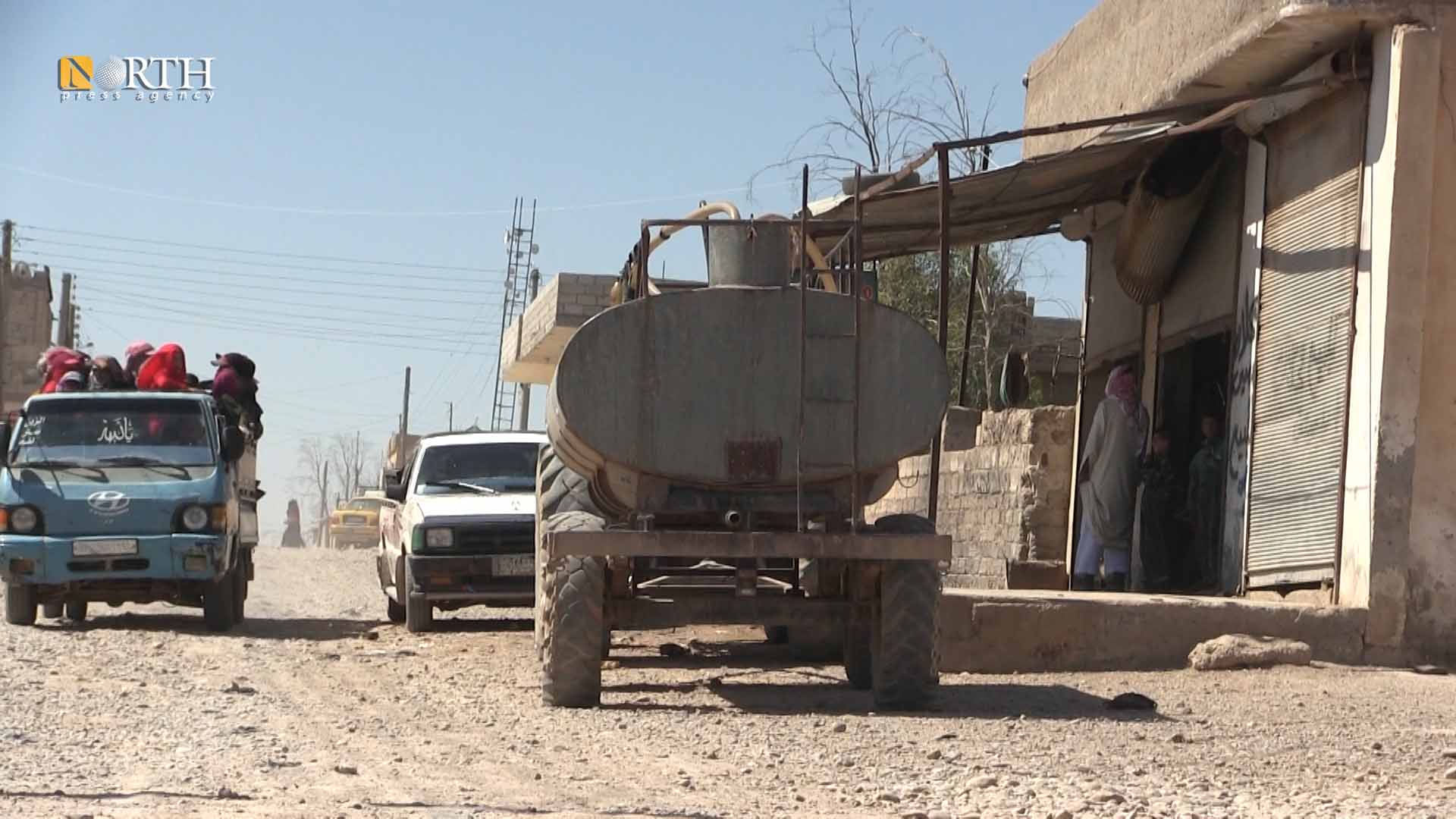
RAQQA, Syria (North Press) – Zahiba al-Issa, a resident from Mazra’at Tishrin, north Raqqa, north Syria, whose condition is worse than others, fills each water reservoir of five barrels at about 5,000 Syrian pounds (SYP) because water has not reached to her neighborhood for more than five months. .
“I swear, tankers’ water is full of parasites,” al-Issa said.
As a result of months of water cutoff in light of increasing temperatures and water consumption, sufferings of the residents in villages of the northern countryside of Raqqa are worsening.
Meanwhile, the northern neighborhoods of Raqqa and the villages in its northern countryside are the most affected as a result of the cutoff and drinking water shortage, where residents of about 30 villages buy each five barrels of water from mobile tankers at about 3,500 SYP.
The reason behind the water cutoff is attributed to the poor conditions of water lines, which are not prepared to cover the recent population expansion the area witnessed, according to water department of the Local Administration and Municipalities Committee of the Raqqa Civil Council.
Moreover, the increasing rationing electricity hours curbed the work of water stations in Raqqa which are operated only when electricity is available affecting the pumping process towards homes.
Al-Issa elaborated that drinking water cutoff and high expenses affected all aspects of her family’s life especially for personal hygiene, “I do not bathe my children because of the high cost of water.”
Difficulties and imposed conditions
The city of Raqqa, which includes main and subsidiary pumping stations for drinking water, has been more affected especially after Euphrates River water witnessed a record decrease in the water supply reaching sometimes to 181 m3 per second, according to the Energy Department of the Autonomous Administration of North and East Syria (AANES).
For more than three months, Turkey has limited the flow of the Euphrates into Syria, depriving large numbers of people of usable water. Turkey reduced the flow of water from the Euphrates River into northeast Syria’s dam gradually, reducing the amount of water received to unprecedented lows.
Turkey keeps water in six dams, the largest of which is Ataturk Dam, the second largest in the Middle East, with a storage capacity of 48 billion m³, violating the international agreement they signed with Syria in 1987 which stated that Syria’s share of water coming from Turkey is 500 m³ per second.
The water flow to the Euphrates River is now limited to less than 200 cubic meters, according to the General Administration of Dams in Northeastern Syria.
As other cities in north and east Syria, feeding hours of electricity has decreased reaching between five and six hours per day in the city of Raqqa and its villages.
Meanwhile, residents of Raqqa and other areas, which rely on the Euphrates River, have noticed a change in the color of water that is full of parasites.
Despite of releasing several public and official warnings from areas in north and east Syria regarding a massive health and environmental disaster awaiting the region, Turkey is continuing its seizure of the Euphrates River.
Under consideration project
Despite ten years of war that negatively affected most of the Syrian areas, Mazra’at Tishrin, whose population exceeds 25,000 after it was 7,000 pre-Syrian war, has been witnessing population growth and flourishing physically and commercially.
Head of Raqqa’s Water Office, Hussein al-Jarjab, stated, “We made several visits to these areas and villages in order to install additional pumping sets or new stations on the channel.”
“This issue is still under consideration and discussion with concerned authorities including either the Autonomous Administration or organizations,” he added.
They will start the project after finishing the study during the few coming months, according to al-Jarjab.
As for Fatima al-Awaid, who is an IDP residing in the village of Rewaiyan, north Raqqa, said that she is forced to fill a reservoir of five barrels with water at 3,500 Syrian pounds (SYP).
“Water has been cutoff for about two months,” she elaborated.
Additionally, al-Awaid, who takes care of ten orphaned children in light of her deteriorating material conditions, are tolerating extra burdens since she is forced to buy water every ten days.