
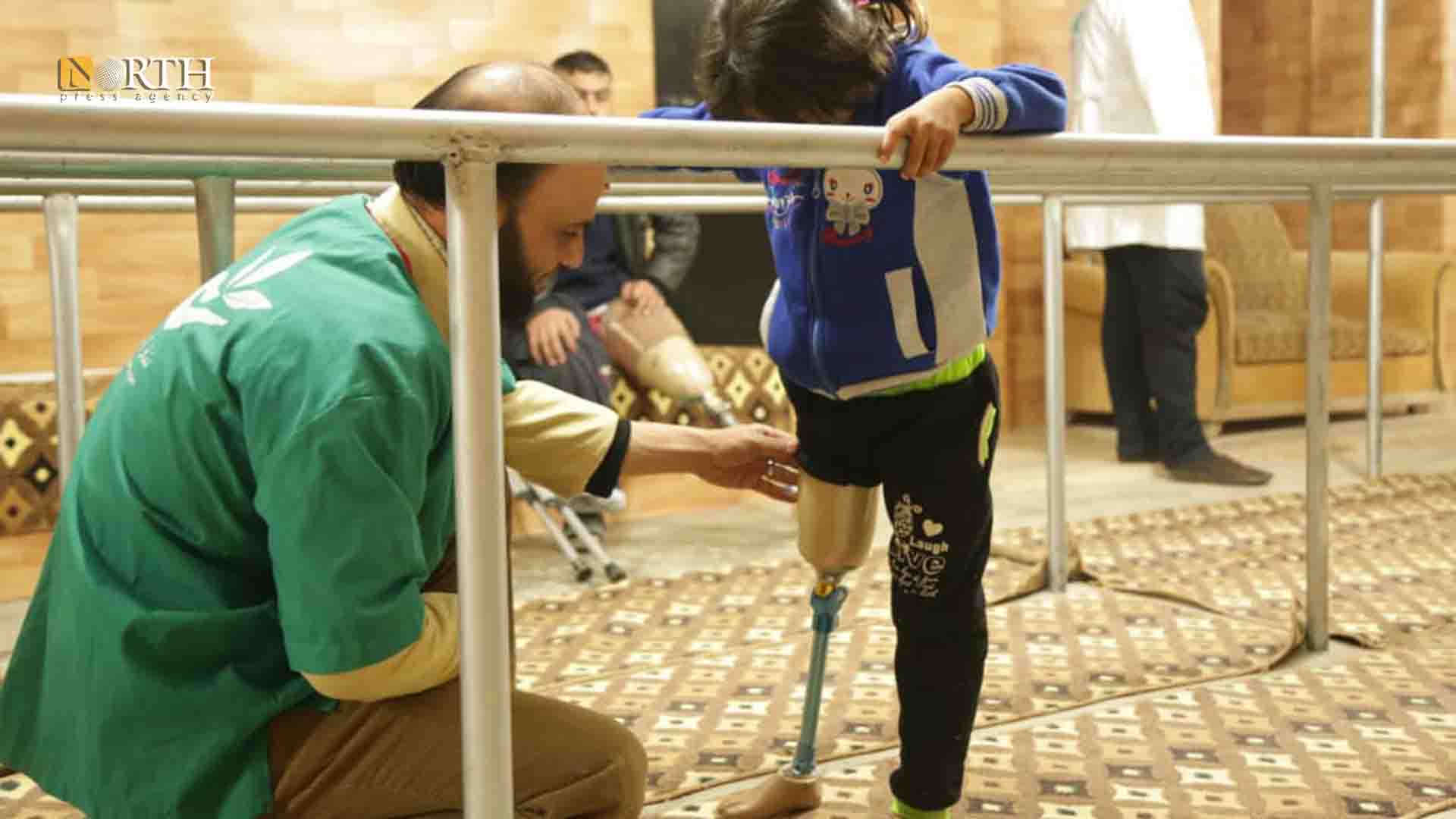
IDLIB, Syria (North Press) – With eyes full of sadness and heartbreak, the ten-year-old Ibrahim watches the children of the camp running in front of him, playing soccer, his favorite game, while he just looks at them.
Suddenly the ball is in front of him, and he is about to throw it, but he remembers that he is without feet. In his wheelchair, he turns toward his tent to escape from a world that has become cruel and scary for him.
Before his displacement from the city of Khan Shaykhun to a camp in the town of Kafr Lossin about two years ago, Ibrahim al-Berro lost his feet as a result of a military raid.
Six months ago, a well-off person donated prosthetic limbs to al-Berro, but he could not adapt to them, and was unable to walk with them, so he settled in his wheelchair.
Nevertheless, al-Berro’s chance remains better than the 14-year old Walid Ghazal, who uses crutches to move around, as he is still waiting for his turn to a charity to get a lower limb.
Ghazal has lost his right leg due to a shrapnel of a shell since the end of 2019, and what hurts him most is his feeling of being different, along with the look of pity in the eyes of others.
“I was on my way back from school when a shell fell on the street where I was walking, killing a person, and I lost my feet. So that I lost hope for life,” Ghazal, from the city of Sarmin, told North Press.
Like al-Berro and Ghazal , there are many children in Idlib who have had one of their limbs amputated, lost their ability to play and move, and all they dream of, is getting a prosthetic limb that helps them lead a semi-normal life.
Limited capabilities Centers
Samer Asa’ad (pseudonym), a prosthetic technician at a limb-fitting center in the city of al-Dana, links the scarcity of free prosthetics to their high costs, and the increase in the number of war-wounded who need such limbs.
According to World Health Organization (WHO) reports, 86,000 Syrians, most of whom are children, have had their limbs amputated since 2011, and are waiting for help.
Two years ago, the head of Alliance of International Doctors organization, Mevlit Yurtseven, estimated the rate of leg and arm amputations in Syria as the largest in the world since World War II.
“In Syria, we are facing the biggest crisis of leg injuries and arms amputations in the world since World War II,” he said.
The cost of a homemade prosthetic limb ranges between $700 and $1,500, while smart prosthetics cost more than $30,000, according to Asa’ad.
“Children need specialized treatment and services, and their needs as children differ from those of adults,” he added.
Psychological suffering
Nightmares hardly leave the child Talal Alwan from Zawiya Mountain, who lost his hands as a result of the explosion of a tank shell, which he found on their land near the government forces’ checkpoints.
“I was with my brothers on our farmland when I found an unexploded shell, I picked it up and walked with it, and when someone alerted me to the necessity not to touch it, I threw it on the ground and it exploded, then I found myself on a hospital without hands.”
Alwan pointed out that the passage of more than a year since the accident, did not reduce his sadness and isolation and his need for help and assistance in all the details of his life.
“Many children live permanent nightmares from the intensity of the horror they live in their daily lives, and some of them experience hysterical states and lose self-control,” Dalal Ahmado, a psychological counselor from Sarmada, told North Press.
Ahmado pointed out that amputee children feel inferior, helpless, negative, surrendered, insecure, and lack of confidence as a result of dependence on others in most of their life matters.
Ahmado calls for the need to pay attention to this category of people whom the war caused them permanent disabilities, to support their rights and enable them to exercise their role in society, to prepare specialized educational centers, and psychological and physical rehabilitation programs to reintegrate them into society, to overcome challenges and regain something of their lost childhood.