
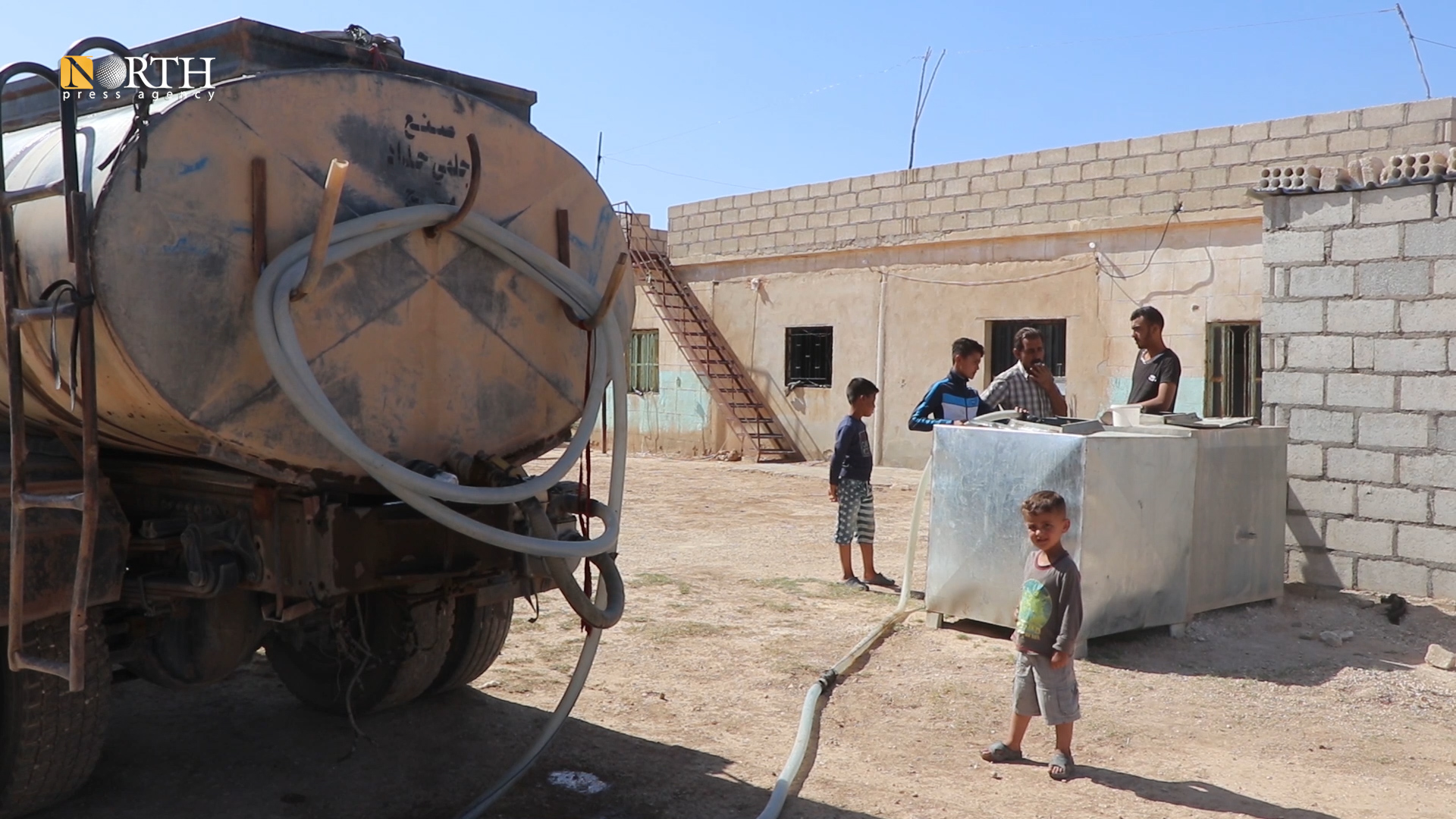
TEL TAMR, Syria (North Press) – After a week of waiting, Salman al-Ahmad, a resident of the village of al-Ghaybish in the countryside of Tel Tamr town, northeastern Syria, could fill his tank with water after his suffering in securing water amid water cuts.
Al-Ahmad and the residents of dozens of villages in Hasakah countryside suffer from various difficulties due to water cut off from the main lines because of the shortage of water from the Alouk station in the countryside of Sere Kaniye (Ras al-Ain).
Late in 2019, the Turkish forces and pro-Turkish armed groups took over the regions of Sere Kaniye (Ras al-Ain) and Tel Abyad after a military operation.
Alouk station is the main source of drinking water for the cities of Tel Tamr, Hasakah, Shaddadi, Hawl, their countryside and the affiliated camps.
Despite feeding Sere Kaniye (Ras al-Ain) with 20 megawatts of electricity to operate four pumps, “the weakness to pump water and the shortage of water unveil the falsehood of the Turkish allegations to fulfill its promises,” according to sources of the Autonomous Administration of North and East Syria (AANES).
Crisis exacerbated
However, Khaled Alo, an official at Water Department of the People’s Municipality in Tel Tamr, said, the Turkish forces controlling the station claim operating four pumps, “but they are actually operating two pumps that do not cover the need of the residents of Tel Tamr and Hasakah.”
Pro-Turkish groups are “looting electricity through operating generators to irrigate agricultural lands,” he added.
“We are wondering about the role of the international powers present in the region such as the Global Coalition and the Russian forces regarding a humanitarian disaster carried out by Turkey and its affiliated,” he referred.
However, negotiations with Turkey under Russian auspices have “failed,” he pointed out.
“Turkey asks for 25 megawatts of electricity in return for operating two pumps from 9:00 a.m. to 9:00 p.m., provided that four pumps should be operated from 9:00 p.m. to 9:00 a.m., at a rate of 16 wells.”
“Negotiations with Turkey have not succeeded but stopped along with violations and looting of the equipment of the station,” Alo stated.
What increased the water crisis is the high temperatures that reach more than 35 degrees Celsius in Hasakah while the AANES’s Health Board continues to record coronavirus infections.
Insufficient tankers
Tel Tamer residents depend on tankers to secure their household needs of water, which depend on a source in Tel Tamer and another source in the village of Ain al-Abed, east of the town.
The municipality of Tel Tamr pumps water to the town every other day and for 12 hours, “but due to the weak quantity of incoming water, 40% of the population receive water, while 60% suffer from water cut off,” according to Alo.
Due to his difficult living conditions in light of the failure of the agricultural season, al-Ahmad waits for municipal tankers to obtain water in light of the high prices of private ones.
The price of filling a five-barrel tank sometimes reaches 9,000 Syrian ponds (SYP), while the municipality fills it at only 1,000 SYP.
However, the municipality’s tankers, which are only four, cannot cover 142 villages affiliated with the town, which forces al-Ahmad and others to wait a week or more until they can fill the water tank.
Omar Sheikho, Sere kaniye IDP residing in the countryside of Tel Tamr, said that the water tank can hardly cover his family’s need for two or three days due to the high usage of water.
Like thousands of residents, Sheikho finds it difficult to constantly pay sums of money to fill a water tank every three days, “it is very expensive, but we are forced to buy.”