
SUWAYDA, Syria (North Press) – Nisrin Hammoud (pseudonym), one of the abused women in the city of Suwayda, southern Syria, failed to hide the wounds and bruises that left their traces on her bluish and pale face, and she also failed to hold back her tears as she told her story with her husband to North Press.
Hammoud is subjected to beatings and violence by her husband to the extent that she is afraid to leave the house or see her friends.
“My husband beats me for no reason. I spent long nights with my daughter afraid and restless in the living room after I was subjected to physical violence, severe beatings and verbal insults,” she said.
She considered that society and the law do not provide any support or any rights for battered women, for fear of scandal amid outdated local and societal norms.
Since she was exposed to violence three years ago, Hammoud has not submitted any complaint to any party, for social considerations.
On the May 18, a husband beat and killed his wife with an automatic rifle in the village of el-Sourah in the northern countryside of Suwayda for unknown reasons, as the husband fled without any prosecution or judicial warrant against him.
Increasing violence rate
In a statistic by the Center for Support and Empowerment of Women in Suwayda, conducted on fifty women in Suwayda this year, it was found that 20 women are subjected to violence by their partner every minute.
Before the Syrian war, and through a study of the same sample numbers conducted at the time, the statistics indicated that ten women were subjected to violence per minute.
Asma Rabi’a (a pseudonym), a social researcher working at the center, considered that the increase in the rate of violence is a dangerous indicator that requires attention.
She pointed out that the phenomenon of domestic violence is an existing societal situation that has never been interrupted, but it has increased during the war years, with the spread of security and legal chaos, economic deterioration and the spread of drugs in Suwayda.
While the effect of the spread of coronavirus, which obliged the majority to stay at home, was more deadlier economically and psychologically on the women, according to the researcher.
In 2015, feminist activists established the Women’s Support and Empowerment Center in the city of Suwayda, which is funded by United Nations organizations and includes dozens of specialists to support and empower women, and includes a center for statistics and evaluation.
Syrian families, especially in the government held areas, are facing a difficult living conditions represented by a severe shortage of bread and fuel and the high prices of other basic items.
Psychological disorders
Reports of the United Nations Office on Crime and Drugs Control indicate that since the spread of coronavirus epidemic, all types of violence against women and girls, especially domestic violence, have increased.
In November 2020, Ghada Wali, Director of the United Nations Office for Crime and Drug Control, said that coronavirus crisis had exacerbated violent crimes against women in many countries.
One out of three women experiences various forms of violence in her life and often in her home, according to Wali.
The complete lockdown in light of the global pandemic has increased the risks of violence and reduced women’s access to basic police and justice services, according to the director of the UN office.
The potential psychological disorders as a result of violence vary, as it may appear in the form of a loss of self-confidence, and it may double into a state of permanent anxiety or severe depression, according to social workers.
There are also differences in the ability to withstand psychological stresses resulting from violence.
Absent law
Rwaida Zahir (a pseudonym), a young woman from Shahba region in the countryside of Suwayda, could no longer bear hearing her mother’s screams as she was being beaten and verbally abused by her father.
She repeatedly tried to defend her mother “but I used to receive beatings along with her.”
Three years ago, the father began to practice violence against the family, when he lost his money in a construction undertakings and could no longer meet the family’s needs, the daughter told North Press.
But she refuses to use that as a reason to justify destroying and breaking her family.
Like her predecessor, her mother did not file a complaint with the competent authorities for the same reasons.
Zaher pointed out that the absence of laws that deter men from committing domestic violence crimes, the recklessness of the local community, and the inheritance of outdated customs and traditions make women not immune from violence.
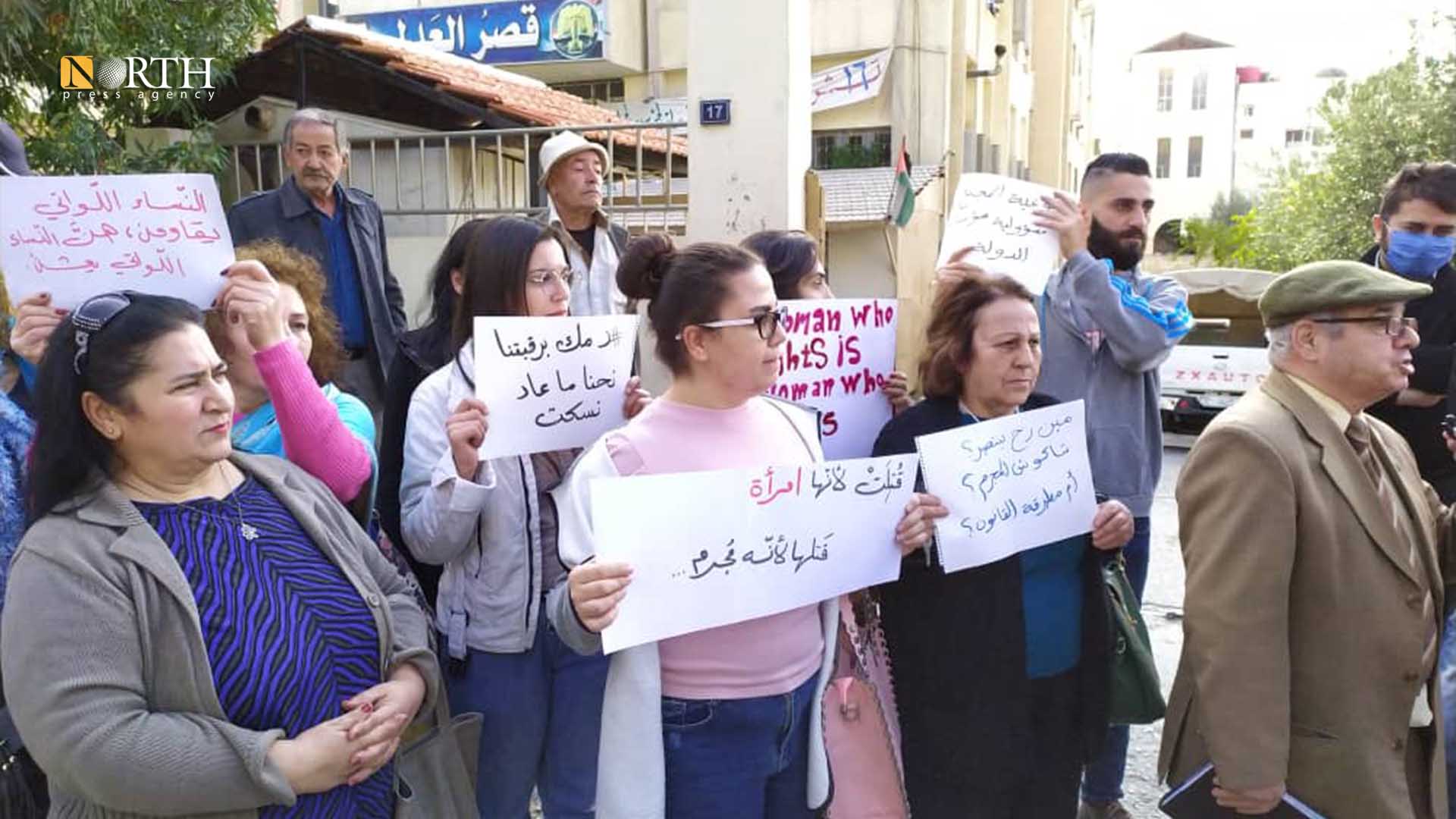
On November 19, 2020, dozens of young women and men protested in front of the Judicial Palace (Palace of Justice) building in Suwayda, denouncing judicial laxity and favoring clan solutions in domestic violence crimes, including honor killing.
In 2002, the Syrian government ratified the accession to CEDAW Convention of 1981, which is concerned with the elimination of all forms of discrimination against women.
The Syrian Penal Code does not include any clear article related to domestic violence, which was confirmed by Mahmoud Hazem (pseudonym), a lawyer and legal practitioner working in the judiciary in Suwayda.
The lawyer told North Press that the Syrian Penal Code contains legal loopholes that need new legislation that protects women and children from domestic violence.
“There are no articles in the Syrian Penal Code that criminalize sexual or domestic violence or rape within marital life and do not directly address them, but there are articles that touch on what is called criminal behavior, violence and harassment in general,” he added.