
No drinking water and empty promises in Syria’s Aleppo
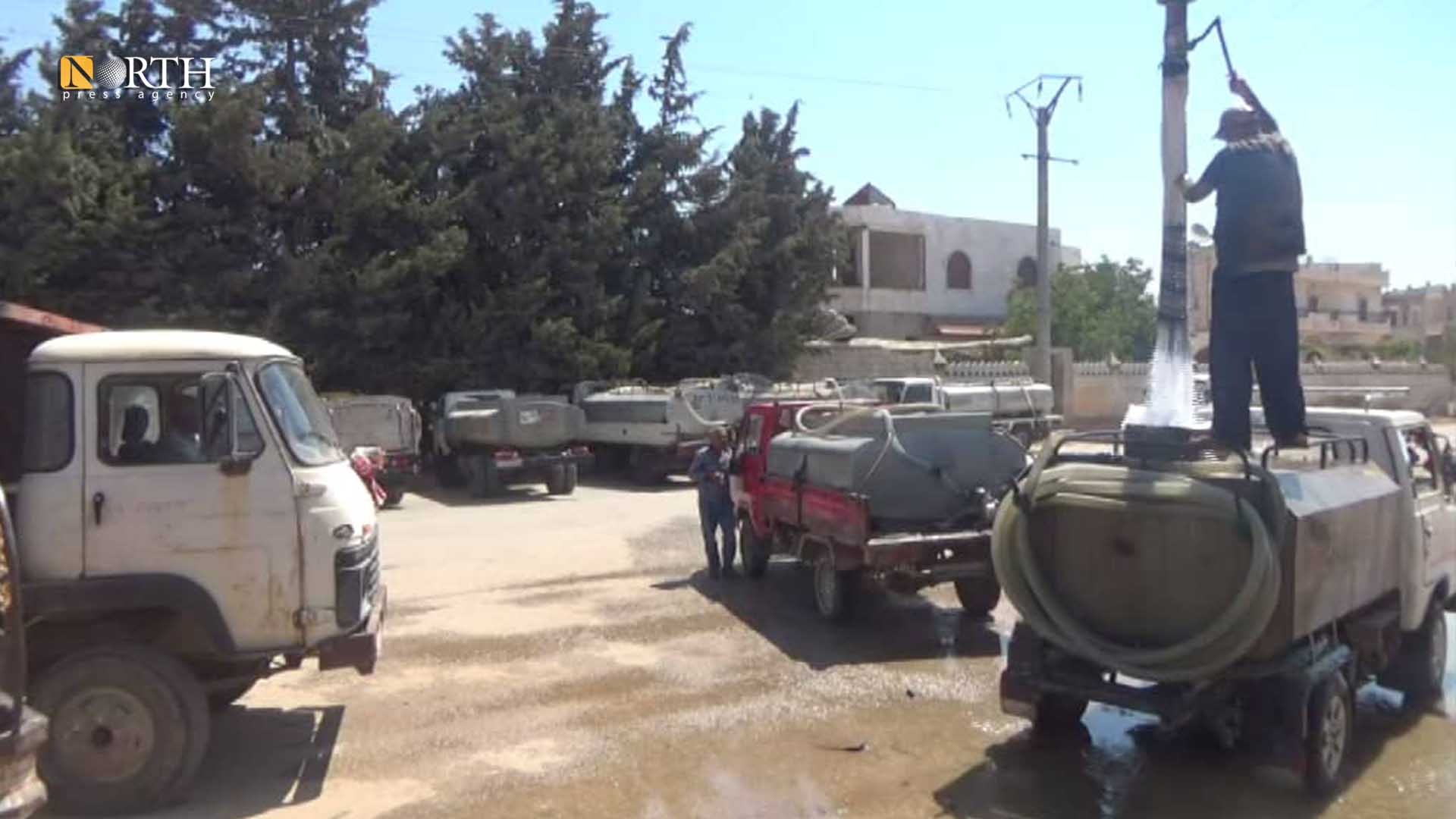
ALEPPO, Syria (North Press) – For several years now, Muhammad Sa’ed al-Baba, a resident of the town of Zahra in the northern countryside of Aleppo, has had to buy water from mobile tanks for sums he says are very expensive for him, especially in light of the deteriorating living situation. The price of a twenty-barrel water tank is 15,000 Syrian pounds, as al-Baba needs four tanks per month.
Before 2013, the residents of towns and villages in the northern countryside of Aleppo relied mainly on government artesian wells, as each village and town has an artesian well connected to main reservoirs that pump water and through networks to homes weekly.
As a result of the battles in the region during the past years between government forces and opposition groups that have alternated control over them since 2012, these networks, reservoirs, and wells were damaged, and large sections of them went out of service in the towns and villages of Kahyan, Bayanoun, Anadan, Nubul, Zahra, and others.
Currently, part of the population depends on tanks, while others collect rainwater in ponds and small wells that they have dug in their homes.
Frequent demands
In February 2020, government forces took control of the towns of Anadan, Huritan, and Kafr Hamrah in the northern countryside of Aleppo, coinciding with the withdrawal of the opposition groups.
The Iranian-backed Popular Committees in the Shi’ite towns of Nublu and Zahraa took control of the towns of Hayyan and Bayanoun and the village of Tel Musaybeen, located on the highway in the northwestern countryside of Aleppo.
Al-Baba said that despite their frequent requests to the Nubl Water Corporation to maintain the networks, the reservoir, and the well that supplies the town, no solution was offered.
The families held the concerned government authorities responsible for providing drinking water and the necessity to maintain water networks and tanks in light of their inability to dig wells at their own expense due to the high costs involved.
Samir Asma, a resident of Bayanoun town in the northern countryside of Aleppo, needs 50,000 Syrian pounds per month to secure drinking water for his family.
Asma accused the owners of water tankers of exploiting them. “They use the high price of diesel as an excuse to raise the price of transporting water without control or supervision,” she explained.
The water network in Bayanoun only needs maintenance of the damaged parts, as the government well and the main reservoir are not damaged and are capable of work and restoration, according to local residents.
Many families in Bayanoun and other towns have chosen to move to the city, as the water problem continues.
Asma said that they demanded the Nubul Water Corporation, the municipality, and even the governorate solve the problem in light of the worsening situation every year, especially with the advent of the summer season, “but none of the concerned government authorities have solved it.”
Government promises
According to local residents, the popular demands for drinking water and alleviating financial burdens have only resulted in more promises that have not yet been practically implemented.
At the beginning of May, Hussein Diab, the governor of Aleppo, visited the city of Nubul and met with activists from the northern countryside of Aleppo, and stressed at the time that he was in contact with the Drinking Water Corporation in Aleppo and that maintenance work and rehabilitation of the networks would start at the beginning of next June.
However, a source in the Nubl Water Corporation said that “maintaining and equipping the damaged networks requires a minimum of two billion Syrian pounds, while the corporation only got two million Syrian pounds to complete and equip the water infrastructure in the northern countryside of Aleppo.”
The source pointed out that “the water corporation is trying hard to maintain the main networks and provide water to areas with large population gatherings within the available capabilities.”