
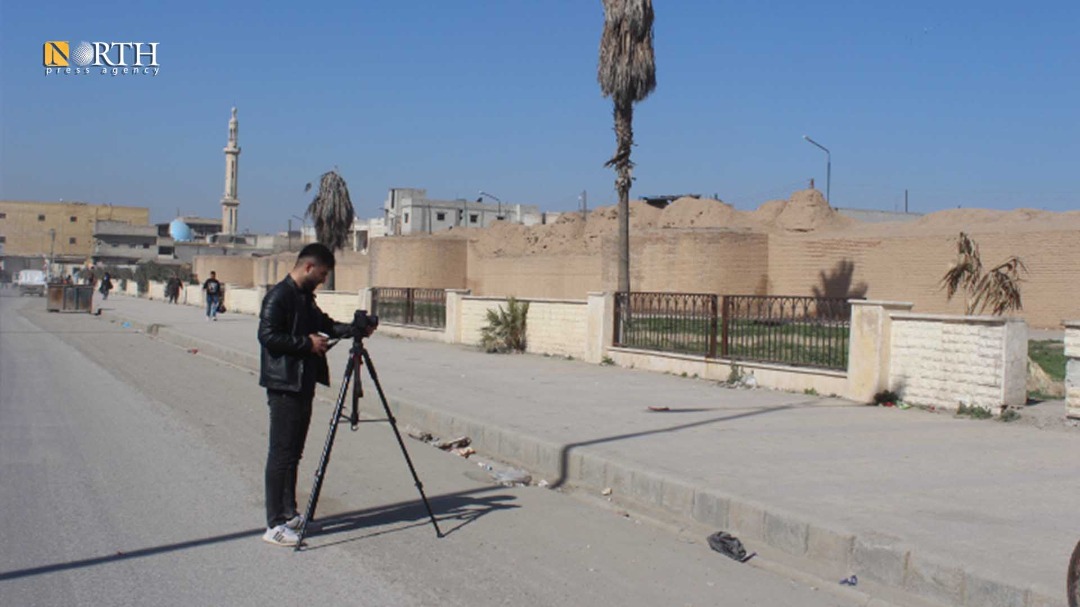
RAQQA, Syria (North Press) – Journalists in the city of Raqqa, northern Syria, believe that they face great difficulty and challenges at several levels to accomplish a material with some professional standards to influence their surroundings, even partially.
Difficulty and responsibility
Omar Muhammad, who has been working in the media field for three years, said that he does not take off his glasses because of two degrees of deviation in both eyes due to the long dealings with phones and computers.
He added that he, and other journalists, are often forced to stay away from their families because of work, which requires keeping up with new events and developments.
“Journalism is more than being a job, and journalists must not be seen as employees, otherwise they must immediately leave work and search for an institution that takes professionalism as a basis for media and journalistic work,” Muhammad said.
He pointed to the difficulties he faces in his work, “because the residents always evade the camera, and some officials in the Autonomous Administration evade press interviews because they consider themselves employees for the sake of salary and do not have a sense of responsibility for the tasks assigned to them.”
“However, belief in any project is supposed to be a motive for active participation and advocacy before media platforms, which is the case for other administration officials,” Muhammad added.
On World Press Freedom Day, which marks May 3, the journalist hopes that “the local press in Raqqa and northeast Syria to stand up to its real responsibilities and that the journalist will not be a tool for polishing or favoring anyone, in an era when some media has become a platform to convey people’s concerns and problems.”
Steps and hopes
Ayham Ismail, a journalist who worked during the battles to expel the militants of ISIS from the northeast regions of Syria, said that the press in northeast Syria “was able to take great steps within a few years compared to the journalistic work in other areas in Syria.”
“Being a journalist, this makes you a target for many parties and you become a person who is followed by people, and your personal life will no longer be yours, as your acquaintances, friends, and you have to be very careful with everything because you have become a well-known face,” he added.
Ismail believed that some officials of the Autonomous Administration remained short-minded regarding the importance of journalism, and did not realize what they should do for the challenges the administration faces.
For his part, the co-chair of the Media Office of the Autonomous Administration, Amer Murad, said that the most prominent right of the journalist is to obtain the information, which is subject to many obstacles, and these obstacles are a global problem and not specific to northeast region of Syria, while it remains one of the priorities of journalism’s work to continue searching for the information.
Murad considered that the Autonomous Administration secures the right to obtain information for journalists, “with the exception of information that harms the public interest and public security.”
The adoption of the Media Act in the coming period would “guarantee the right of the journalists to obtain the information and make it accessible to journalists, and require the officials the administration to facilitate and cooperate with the journalists.”
There are 104 media outlets and more than 1,100 journalists in the Autonomous Administration regions, according to the licenses granted by the Media Office of the Autonomous Administration.
May 3 marks the World Press Freedom Day, which dates back to a UNESCO conference in Windhoek on May 3, 1991, aimed at developing a free and pluralistic press.
In December 1993, the United Nations General Assembly declared World Press Freedom Day, which is celebrated annually around the world on the third of May.
The press in Syria has suffered for decades from challenges, most of which were linked to the censorship of the security authorities and the failure to allow the appearance of professional media.
According to a report by Reporters Without Borders for the year 2021, Syria ranked 173 and it is the next to last in the Arab world. The report said that journalists “are still extremely vulnerable.”