
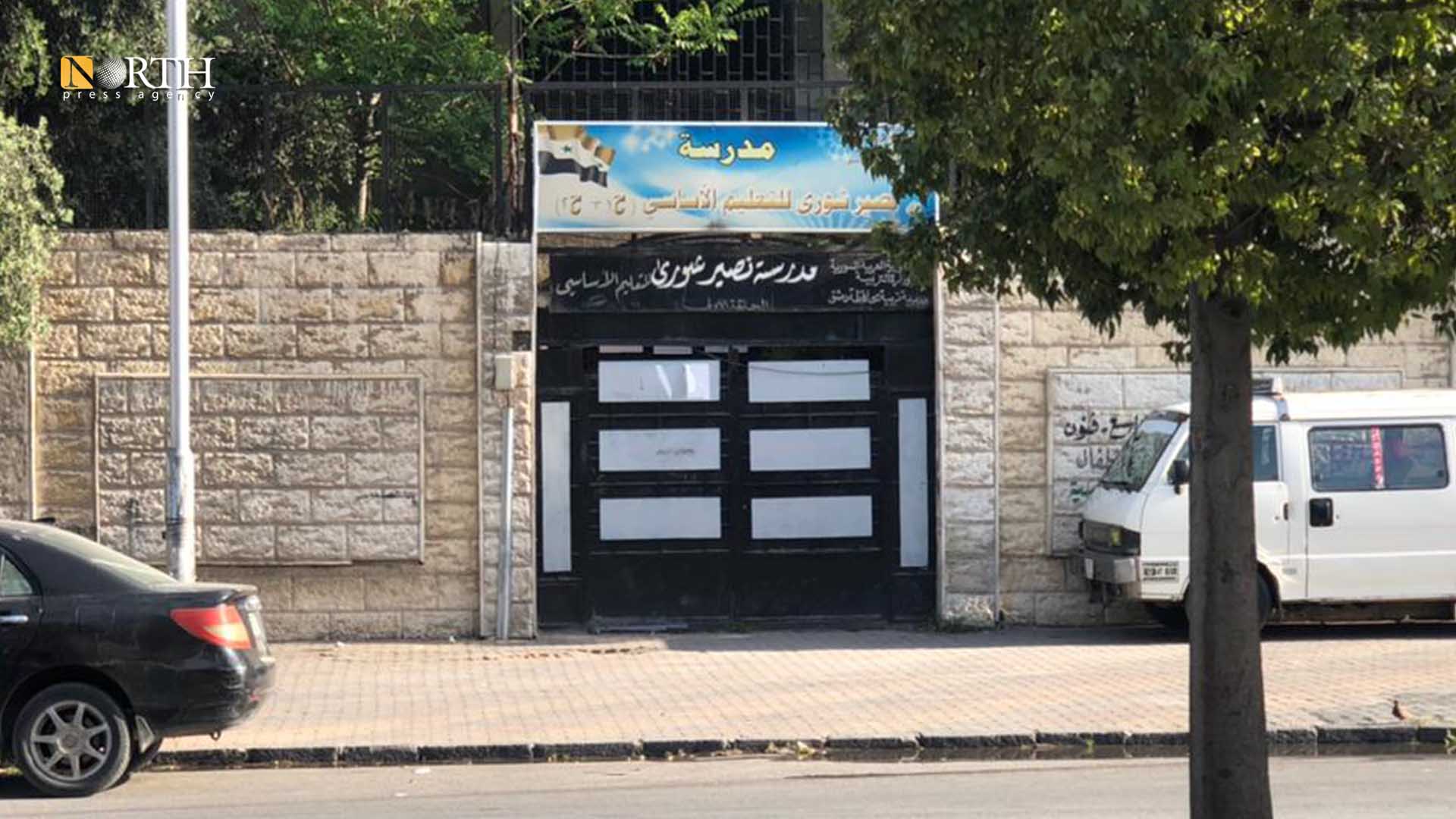
DAMASCUS, Syria (North Press) – The statements of an endowment official brought the suffering of teachers and education personnel in Syria back to the forefront, reminding observers of the situation of Syrians amid living crises.
On Wednesday, the Syrian Ministry of Religious Endowments denied the validity of a statement authorized to give zakat (alms) to government employees, attributed to the Mufti of Damascus and spread on social media.
The ministry, through a post on its official Facebook, said that the statement was forged, neither confirming nor denying the fatwa.
A few days ago, Khader Shahrour, the director of the endowments for the Damascus countryside, called through the Syrian government’s Sama Channel to distribute charity to government workers and teachers.
Islamic legal teachings do not prohibit charity for any needy person, regardless of his work. However, the TV program’s focus on teachers and government employees provoked sarcastic comments and resentment of endowments.
Pretty bad condition
In the television program “You Ask, and Islam Answers,” Sheikh Khader Shahrour said that teachers in Syria must be supported with charity.
In answer to a question to one of the callers, he said: “We must focus completely on teachers in schools because they are poor, needy, and have low salaries.”
Followers saw that the sheikh’s words are evidence of the miserable situation, since teachers, who are paid by the government, require charity from others.
Civil activist Basma Haj (a pseudonym) said that Shahrour’s words reflect the miserable condition of teachers who teach generations and who are supposed to be idealists.
“Amidst the officials’ bullying and corruption, teachers suffer from hunger and poverty silently…we are grateful to Sheikh Shahrour for shedding light on this forgotten segment of society,” Haj told North Press.
Haitham Ibrahim said mockingly in a comment on Facebook that donations and charity should be collected in the school, but not in front of people, “out of concern for our feelings, while the principal distributes them to teachers equally and according to their tenure.”
2020 witnessed multiple setbacks for the Syrian economy, starting with the collapse of the Syrian pound (SYP) to an exchange rate of nearly 3,000 SYP against the US dollar, the suspension of many production plants, price hikes, and the implementation of the US Caesar Act in mid-June.
The implementation of sanctions was followed by suffocating crises due to the lack of fuel, in addition to the ongoing bread crisis and increased hours of power cuts.
This economic crisis in government-held areas contributed to the further deterioration of the already low standard of living after a decade of war and has also forced young people to engage in various jobs and accept unsuitable working conditions.
Rasha Badie, a teacher in Syria, said in another comment on Facebook: “We as teachers were envied; we had a monthly salary and we were off in the summer. Now charity is allowed to be given to us.”
Low salaries
“More than 13 million people in Syria were in need of humanitarian aid,” UN coordinator for humanitarian affairs and emergency relief Mark Lowcock said in March.
The salary of a teacher in the Syrian government held areas is about 60,000 SYP, equivalent to less than $20 per month.
Teachers say that they immediately spend what they receive on transportation in light of the transportation crisis, and a large number of micro-buses have stopped service.
Damascus-based teacher Ihab Salameh (a pseudonym) was forced along with a number of his colleagues to rent a taxi to take them on a daily basis to the school where he teaches in the al-Tijaria district of Damascus.
He said, “Every day, each of us pays 2,000 SYP to drive us to school and bring us back home later, meaning that most of the salary we get is spent as travel fare.”
Salameh said that Shahrour’s statements, which sparked widespread controversy, emanate from reality. Teachers are in a miserable financial condition and it is necessary to help them, even if this matter is not consistent with educational and social values.
Extra works
Teachers staying in Damascus say they are forced to provide their services in schools for low salaries and moonlight to manage their living.
Issam Khalid (a pseudonym), an Arabic language teacher residing Zahira neighborhood in Damascus, works as a taxi driver after school.
Although his extra work is often far from Zahira neighborhood and the eyes of his students and colleagues, he says that even if they saw him, he would not feel embarrassed because it is not contrary to the honor of the profession as long as he does his job of teaching wholeheartedly.
“Amidst these difficult circumstances, safeguarding the interests of our students has become a challenge that must be overcome, even if it is at the expense of our comfort,” he said.