
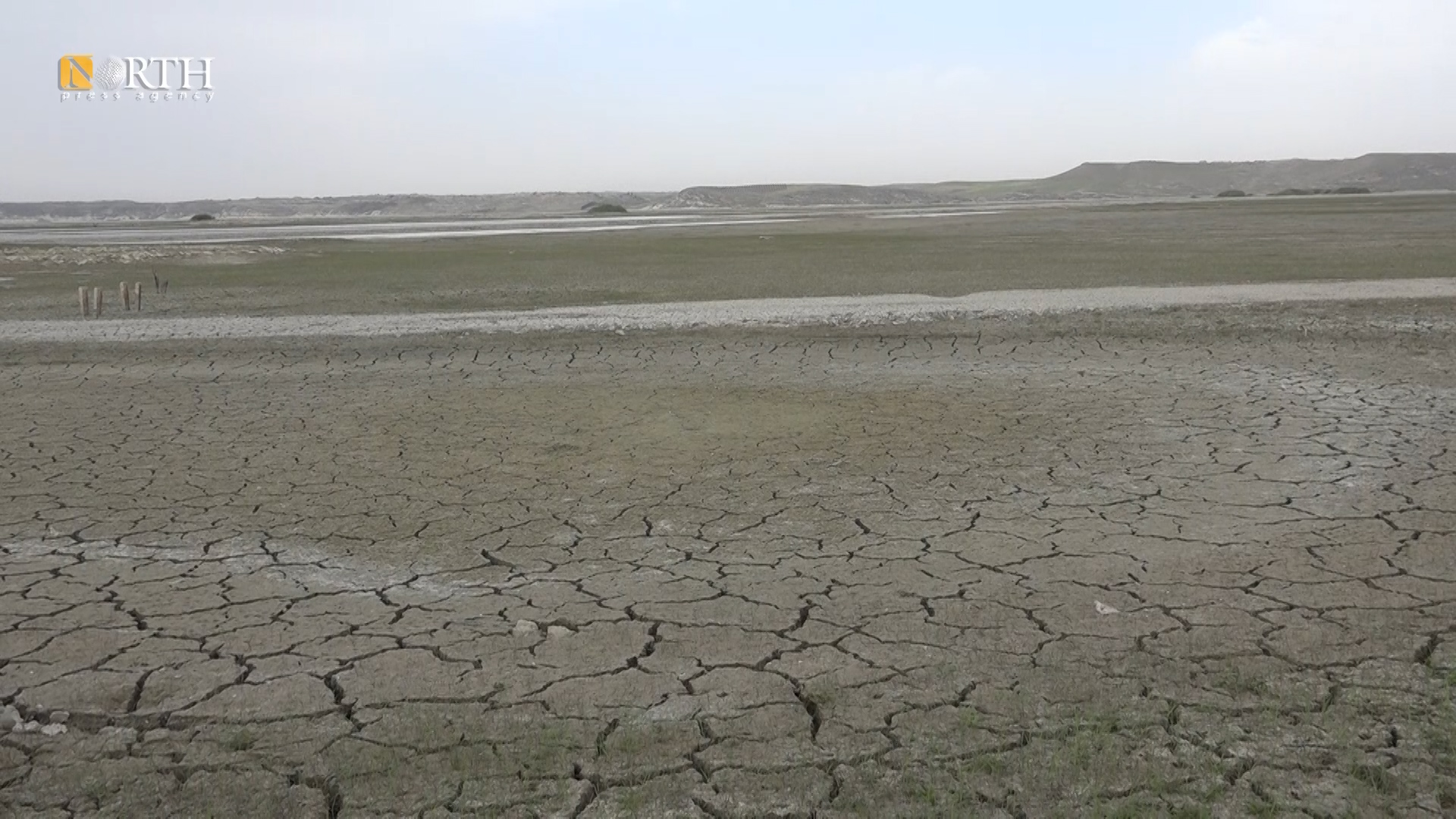
KOBANI, Syria (North Press) – Delayed rains this year affected crops in the Kobani region in northern Syria, and led to the destruction of most of these crops, in addition to a decrease in the water level in the Euphrates River, on which farmers rely to water their crops.
Ibrahim Salim, a farmer from Kobani countryside, wonders what can be done to save his wheat crops after the decrease of the water level by more than 450 meters.
For more than three months, Turkey has limited the flow of the Euphrates into Syria, depriving large numbers of people of usable water. Turkey reduced the flow of water from the Euphrates River into northeast Syria’s dam gradually, reducing the amount of water received to unprecedented lows.
Turkey keeps water in six dams, the largest of which is Ataturk Dam, the second largest in the Middle East, with a storage capacity of 48 billion m³, violating the international agreement they signed with Syria in 1987 which stated that Syria’s share of water coming from Turkey is 500 m³ per second.
The water flow to the Euphrates River is now limited to less than 200 cubic meters, according to the General Administration of Dams in Northeastern Syria.
Agricultural lands in the western countryside of Kobani, as well as other areas in the countryside of Raqqa, Tabqa, and Deir ez-Zor, depend on water directly from the Euphrates River or from wells affected by the river’s water level.
Damaged crops
Salim, from Tel Ahmer village in Kobani’s countryside, says that most of the agricultural land near the river, which is estimated at at least 2,000 hectares, has been damaged due to the lack of irrigation water.
Some farmers in the villages of Zirkutk, Tel Aber, Tel Ahmar, and Boraz, and the sheikhs in the western countryside of Kobani, depend on water directly from the Euphrates River through irrigation hoses using diesel generators.
“There are no wells and there is no water. It dried out three months ago. Well owners are confused, do not know what to do, and they can’t put in the pipes for watering; about 400/450 meters of water dried up,” Salim complained.
The lowering of the river’s water level affected ground wells in villages and agricultural areas around the river. Some people were forced to increase the length of pipes in the well in order to extract water, while some wells completely dried up.
Farmers in the western Kobani countryside estimate that more than 50% of agricultural land has been damaged due to the low water level in the Euphrates River, as some lands were saved from damage with the help of some well owners, who provided groundwater wells to farmers to irrigate their lands.
Ahmed Haj Othman, a farmer from Zirkutk village, said that the fava bean crop in the area has been almost completely destroyed and vegetable orchards are in urgent need of water.
He pointed out that the continued low water level threatens the harvests, especially the wheat crop, in light of the lack of rainfall this year.
“The decrease in water also affected the electricity situation; we receive electricity only three hours per day when it used to reach about 12 hours a day before the water level decreased,” Othman said.
Farmers in the western countryside of Kobani cultivate their land primarily with wheat and barley, in addition to growing beans and some aromatic plants such as cumin, coriander, and summer vegetables.
Polluted water
Muhiyddin Mihana, a resident of Zirkutk village, said that the water level in the lake near the village decreased by about a kilometer, and that drinking water has become polluted and unfit for drinking due to the proliferation of dirt and waste in it.
Hammoud al-Hammadi, an administrator at Tishreen Dam, previously warned North Press of the effects that water shortages have on residents, who drink untreated river water.
The low water level also caused the drinking pumps to be out of service in most areas, according to al-Hammadi.
“We bring water from the Euphrates and it is now not suitable for drinking. We are forced to drink that water since there is no other source. There are diseases that have spread due to water pollution, especially kidney diseases,” Mihana added.