
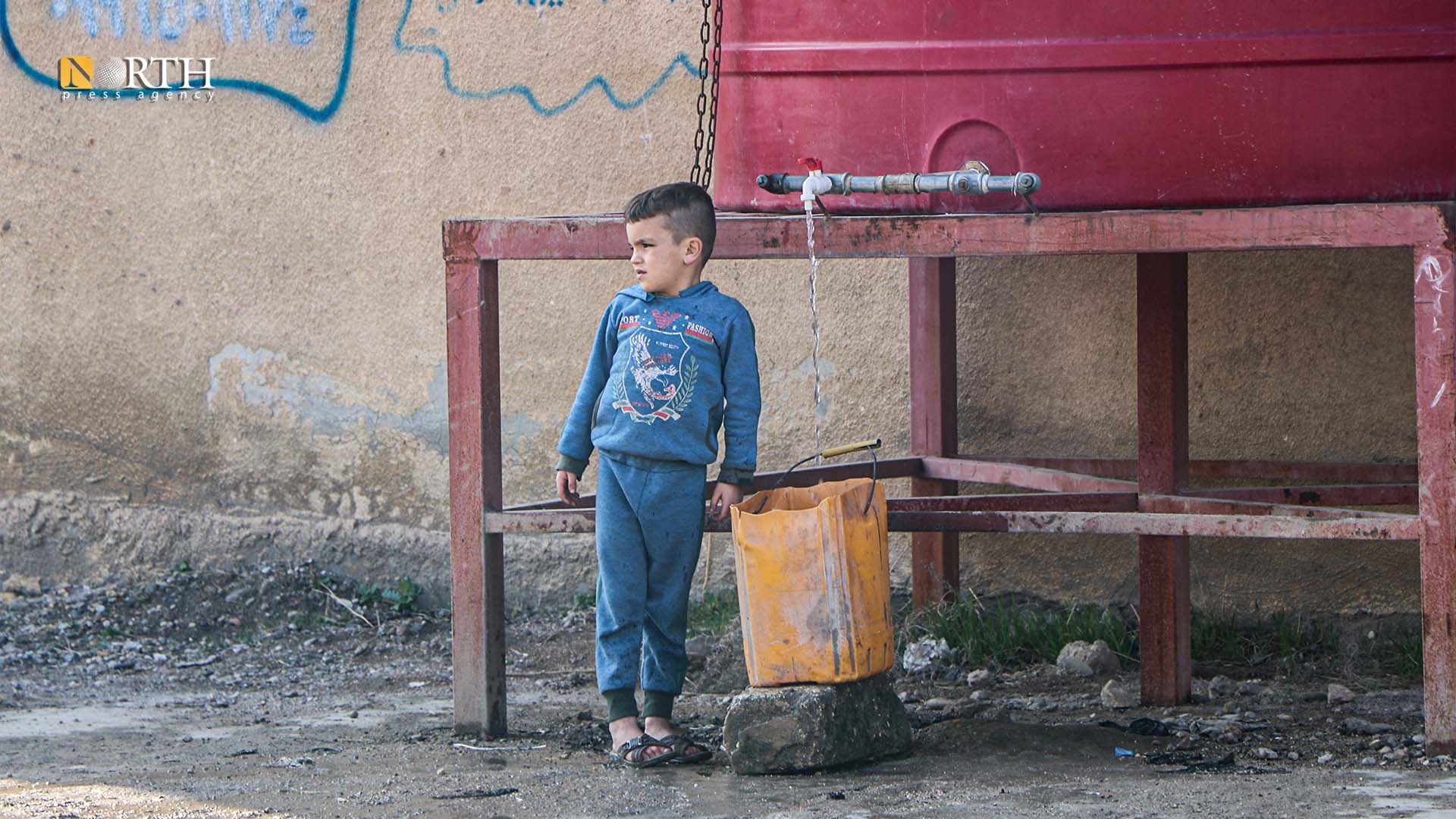
HASAKAH, Syria (North Press) – Radwan Khalifa, a resident of Hasakah in northeastern Syria, is forced on a daily basis to bring empty buckets by motorbike to fill them with water for his family, whether from tankers, reservoirs in the neighborhoods, or from saltwater wells dug by residents.
A process that exhausted him for more than two years, as the residents of the city and its countryside, the camps in the region, the cities of Shaddadi, Tel Tamr, and Hawl suffer from a stifling water crisis which will worsen with the coming of the summer season.
Failed negotiations
On April 12, a fire broke out at the electricity transmission station in Derbasiya city, northeastern Syria, the station that supplies electricity to Alouk water station.
The fire resulted in the cutting of power supply to rural lines and caused Alouk water station to go out of service.
However, despite the maintenance work at the Electricity Transfer Station in Derbasiya, the water did not reach Hasakah and its countryside due to the refusal of Turkish army commanders in Turkish-occupied Sere Kaniye to operate Alouk station in its full capacity.
According to a source from Hasakah’s Water Directorate, they are demanding more electricity to their areas of control in exchange for operating a specified number of water pumps, a demand which grows larger with time.
The source said that negotiations with Turkey under Russian auspices failed as a result of the Turkish request for 25 megawatts of electricity in exchange for operating only two pumps from nine in the morning until nine in the evening, provided that four pumps are to be operated from nine in the evening until nine in the morning.
Alouk water station is the main source of drinking water for the cities of Tel Tamr, Hasakah, Shaddadi, and Hawl, and their countrysides and affiliated camps.
Salty and bitter water
Meanwhile, residents of Hasakah are forced to use salty and bitter water from the wells they have dug in the neighborhoods during the past year as a result of Turkey’s repeated cutoffs of water.
Meanwhile, residents depend on expensive drinking water from tankers, which increases their suffering in light of the difficult economic conditions that they suffer from.
The situation is further exacerbated by the advent of Ramadan, a new severe wave of coronavirus, and high temperatures, which reached 35 degrees Celsius in Hasakah the past several days.
Ahmed Mustafa, a resident of Kalasa neighborhood in Hasakah, says that their suffering is exacerbated daily in light of the inability to secure drinking water.
Mustafa, like the rest of Hasakah’s residents, is forced to pay 10,000 Syrian pounds (SYP) for five barrels of water.
But Ahmed Aliwi, the owner of a water tanker, says that they themselves are being exploited by well owners in the Hama area west of Hasakah.
“I was filling my water tanker truck for 6,000 SYP. They raised it to 12,000 SYP. Today they asked for 14,000,” he added.