
By Lindsey Snell
In January 2018, Turkey launched Operation Olive Branch, a military offensive the Turkish government said was necessary to clear the northern Syrian town of Afrin of terrorists. Turkey claimed the targets included both ISIS and the YPG, the Kurdish, US-backed armed forces which Turkey considers an offshoot of the PKK, a designated terrorist organization in many countries.
A month earlier, most of the Syrian opposition known as the Free Syrian Army (FSA) became part of a collective named the Syrian National Army (SNA), which was under the direct control of the Turkish government. The Afrin invasion was the first major operation undertaken by the SNA.
The Turkish Air Force bombarded Afrin, and the SNA began a ground invasion. Ultimately, hundreds of civilians in Afrin were killed, and hundreds of thousands were displaced. Afrin, once a peaceful and diverse town, devolved into a chaotic hell of warring factions and civilian oppression.
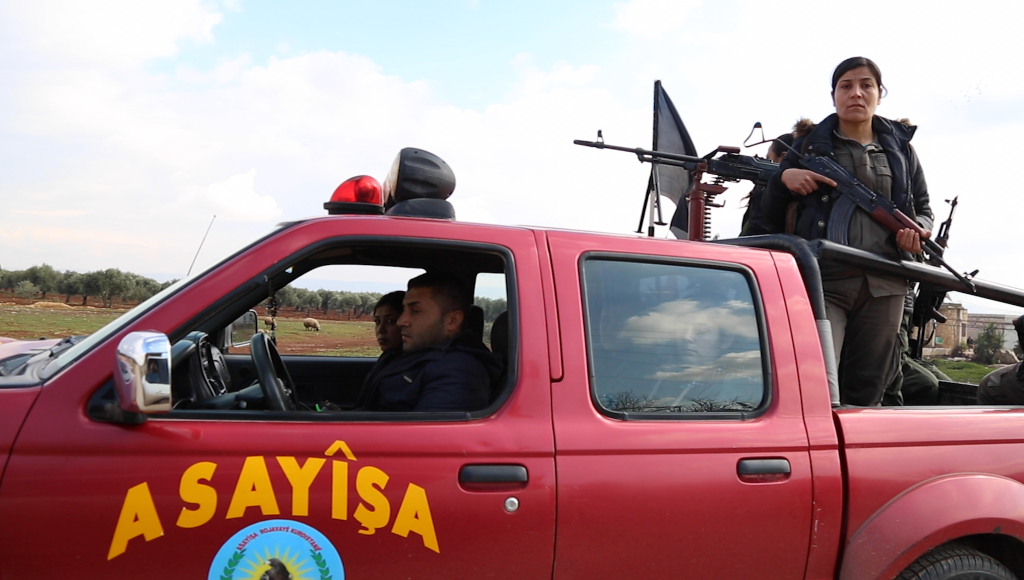
Mustafa Khaled (an alias) is a former SNA leader who would rather not disclose the name of his faction. Khaled left the SNA a few months after the invasion of Afrin. “I am one of many who left the SNA because of what happened in Afrin,” he said. “Participating was a mistake, and Turkey lied to us about why we were going there. There was no ISIS in Afrin; Turkey just wanted to control Afrin. But within a year, most of the fighters who quit went back to the SNA. There is no other way for men to earn a living in Syria.”
Khaled speaks candidly about the damage Turkey and the Turkish-backed SNA factions have inflicted on the local population of Afrin. “From the first day of the invasion, the Kurdish civilians were deliberately displaced. Turkey has brought in Arab and Turkmen people to replace them. The fruits of the labor of the Kurdish people were stolen. The factions would loot everything from civilians’ homes and often, they would sell the home itself, without any papers or permission from the real property owners.”
Khaled said the SNA factions devised an informal system for the sale of stolen homes. “The factions would make a simple, fake contract and sell a stolen house for around $2000. In reality, the cheapest house in Afrin probably costs more than $10,000. But it doesn’t matter, because the homeowners can’t do anything about it.”
Hussam Arshami (an alias), a Hamza Division militant living in Afrin, witnessed the SNA’s home sale scheme when a friend bought a house in 2019. “The house was sold for $3,000 by one of the factions. After, the rightful owner of the house tried to go to the SNA police to file a case against my friend,” he said. “The SNA police aren’t part of any faction, and are supervised by Turks, so people in Afrin thought they would be fairer than the factions. Two days later, the man disappeared. We later learned that the faction who sold the man’s house had kidnapped him and threatened to kill him if he didn’t withdraw the case. So, the man withdrew the case.”
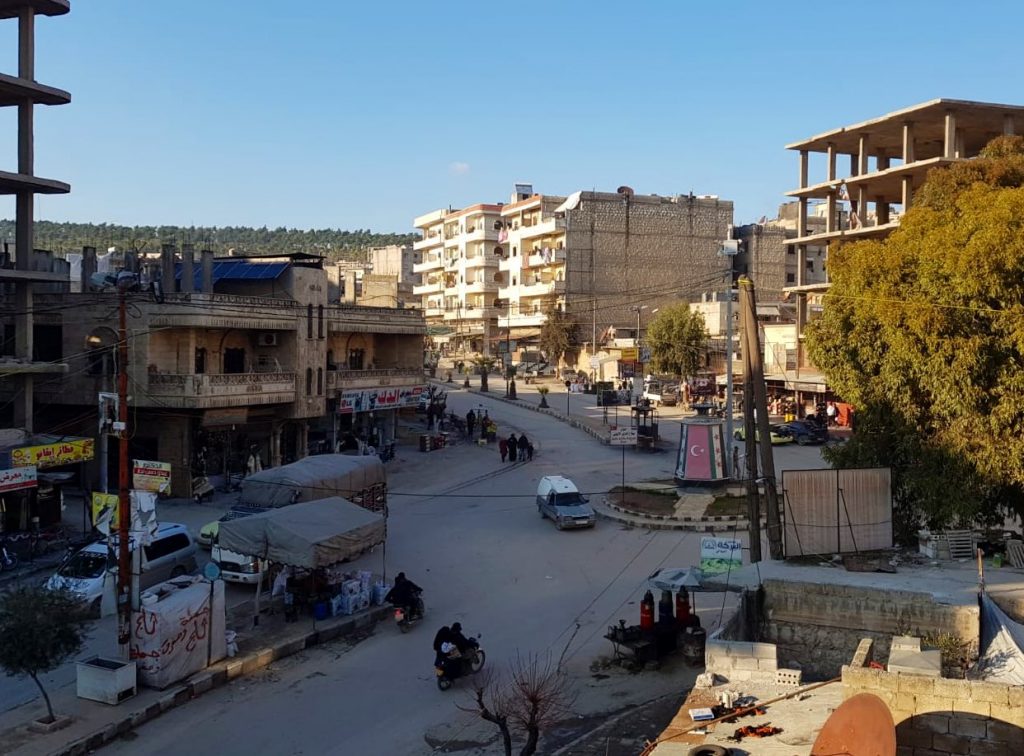
Musafa Khaled says that more than half the houses in Afrin are occupied by people who are not the real owners. “They’re not the real owners, and they didn’t buy or rent the homes from the real owners,” he said. “Kurdish civilians in Afrin who have managed to remain in their homes are forced to pay regular bribes to whichever SNA faction controls the area they are in. But even paying the factions does not guarantee security.”
Khaled remembers an elderly man named Abu Jawan who lived in the Al-Vilaat neighborhood of Afrin. “The Al-Vilaat area is controlled by the Ahrar Sharqiya faction (of the SNA),” he said. “Last summer, Abu Jawan decided to spend some time on a farm he owned outside Afrin. He took his wife and two daughters with him, and so his house in Afrin was left empty.
“After a week, Abu Jawan returned to Afrin to check on his home. Immediately, he noticed the lock on his front door had been broken. When he got inside, he saw that all of his furniture had been stolen. He went to the Ahrar Sharqiya headquarters to ask what had happened, and an Ahrar Sharqiya commander told him that the faction had received information that Abu Jawan’s son was working with the PKK.
“Abu Jawan’s son has never worked with the PKK, and he had been living in Germany for several years at this point. Abu Jawan gave them proof of this, and the Ahrar Sharqiya commander dismissed it immediately. Abu Jawan left the Ahrar Sharqiya headquarters and went to the nearest SNA police station.
“The SNA police took a report from Abu Jawan and then sent him away. Days later, Ahrar Sharqiya members came to Abu Jawan’s home and arrested him. For three days, they beat and tortured this old man. When they finally released him, he fled Afrin. He abandoned not only his home in Afrin, but his farm outside of Afrin, too,” Khaled said. Abu Jawan reportedly fled to Turkey and then to Europe with his family.
“It’s always the same scenario,” Khaled said. “An SNA faction arrests a Kurdish civilian and accuses him of working with the PKK. They beat him and torture him, and then, they ask his family for ransom. The prison in Afrin is filled with Kurdish civilians whose families weren’t able to pay.”
Khaled says the situation in Afrin has become more stable in recent times than it was throughout the first two years of the occupation. “The threats to civilians remain, but in general, I think the civilians have learned how to adapt,” he said. “For example, there is a Kurdish family living in the apartment beneath mine. Three months ago, I saw a man I didn’t recognize enter their home. I was worried for them, so I went and knocked on their front door.
“The elderly woman of the house told me not to worry, and that the man I saw was her son, who lives in the apartment with her,” Khaled continued. “I was surprised. How had I not seen this man in the time I’d been living above this family?”
“The woman told me that in the first year of the occupation, her son had been arrested three times, by three different factions. Each time a faction arrested the man, they tortured him and demanded a ransom payment from the family to secure his release. The accumulated amount they’d paid for their son’s release was more than $8,000. So the son decided to stay inside, only leaving the home when it is absolutely necessary.”
Several months ago, leaders from several of the SNA factions who have a presence in Afrin formed the Joint Committee for the Restoration of Rights. “The Committee’s main purpose is to return stolen properties to their real owners,” Mustafa Khaled said. “But it’s also supposed to be a way for civilians in Afrin to address other grievances.”
Muhammad al-Khatib, a representative from the Jabhat Shamiya faction of the SNA, has tweeted photos from some of the Joint Committee’s meetings. “Not everything facing the committee of returning rights is dark,” he wrote in February. “We found plenty of honest, good people that didn’t deal with illicit money or do anything unjust to others.”
But despite al-Khatib’s posturing on social media, Mustafa Khaled says the initiative has been a failure. “I know some of the representatives from Sultan Murad [faction of the SNA] who are in this Joint Committee. They tell me they haven’t made in returning homes to their owners. And they won’t make progress, because this committee is just for show. It’s just a way for the SNA factions to try to polish their tarnished images in Afrin,” he said.
It is unclear whether the Joint Committee for the Restoration of Rights has returned a single stolen property to date. “I personally know several Afrin families living in cramped apartments who are desperate to get their homes back from Sultan Murad,” Khaled said. “And they have been unable to until now.”
In addition to the SNA’s questionable restitution initiative, there are a number of primarily Turkish NGOs operating in Afrin. “So many organizations are coming here,” Hussam Arshami said. “And some of them do help by giving people food, or medicine. But I think some of them are there just to expand Turkish influence. And when I see photos of these NGO people with young Syrian boys, I feel like they are preparing to use them militarily in the future.”
Instagram is rife with pictures of employees from Turkish NGOs posing with Arab children in Afrin. One employee from ANDA, a Turkish-based NGO boasting partnerships with Turkey’s ruling AKP political party, shared a picture taken at a Turkish government-supported elementary school in Afrin. In it, the employee and school children are making the hand gesture associated with the Grey Wolves, a Turkish nationalist movement which has been banned and labeled a terrorist organization in several countries.
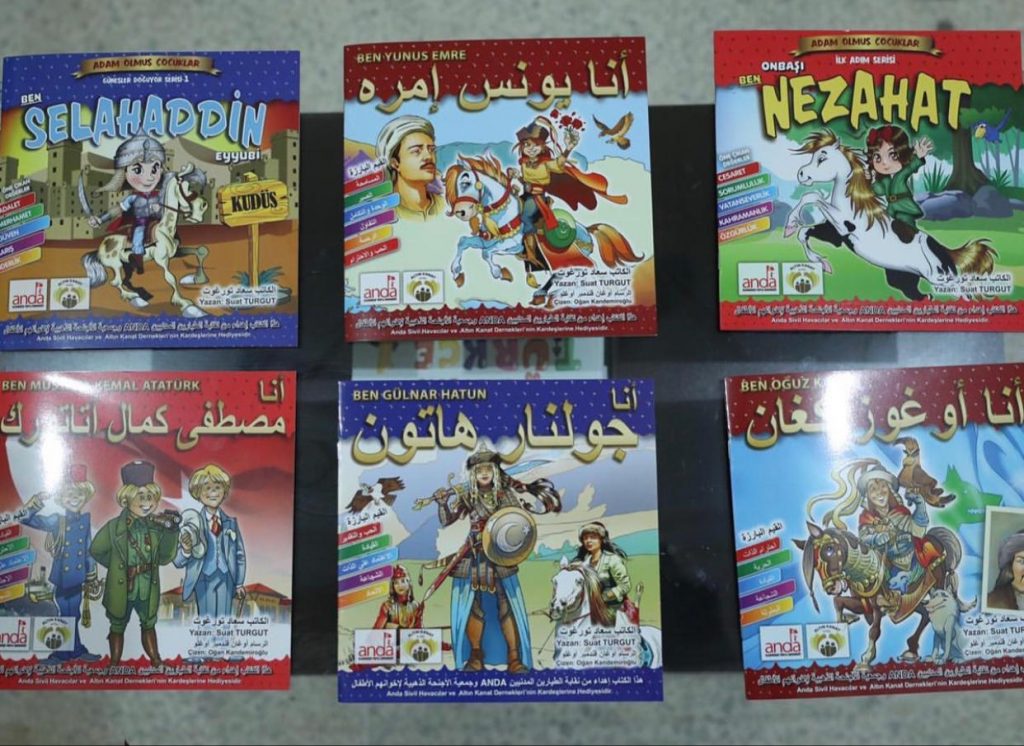
In addition to two orphanages in al-Bab and Afrin, ANDA opened a cultural center in al-Bab which offers Turkish language classes. Pictures on ANDA’s Instagram account show that among the aid offered by the NGO are cartoonish children’s books about famous figures from the Ottoman Empire in Arabic and Turkish.
The Twitter cover photo of ANDA’s general president, Okan Tosun, is a map of the territories formerly under the control of the Ottoman Empire. According to the map, which many Turkish nationalists believe reflect the territory present-day Turkey should control, Afrin is part of this territory. In a February interview with The Independent (Türkçe), Tosun said that part of ANDA’s work is to “emphasize human rights violations experienced in captive Turkish provinces,” among them Crimea, Iraq’s Kirkuk, Cyprus, and Western Thrace, which refers to territory in present-day Greece.
“Yes, of course, Turkey wants to expand influence here,” Mustafa Khaled said. “If I look around my street, I see more signs in Turkish than I do in Arabic. The schools here teach children Turkish. And the NGOs here are Turkish. But I don’t think they’re here just to spread Turkishness.”
“Any Syrian living in Afrin—but not just Afrin, now, Ras al-Ain and Tel Abyad, also—has to register for a special ID card from Turkey that Syrians in other free areas, like Idlib, don’t need. You can’t send your child to school or get electricity without this card. I can’t prove it yet, but I think, somehow, this is a way for Turkey to claim each of us as IDPs, living in this ‘safe zone’ they created. I think they’re using this to take money from the EU for us, because we know Turkey gets money for the EU for hosting Syrian refugees. So, it could be that this EU money is paying the Turkish NGOs in these parts of Syria.”