
Education International backs Kurdish teachers over Syria language decision
QAMISHLI, Syria (North Press) – Education International (EI) on Tuesday expressed solidarity with the Teachers’ Union of North and East Syria (UTNES), calling on Syria’s Education Ministry to reconsider its decision limiting Kurdish-language instruction to three classes per week.
The international federation said the decision threatens students’ right to learn in their mother tongue and could undermine the professional role of Kurdish-language teachers who have developed curricula, educational materials and teaching methods over many years.
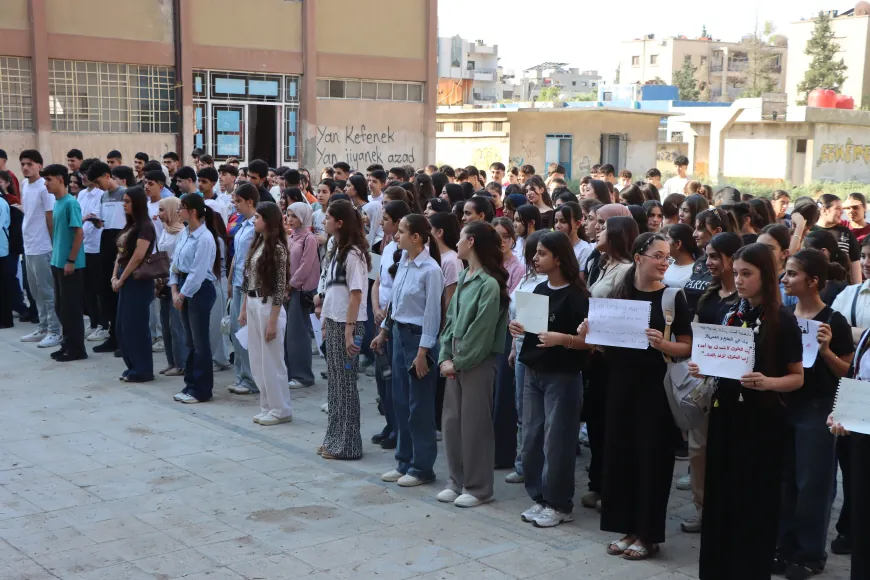
Teachers and education workers staged a peaceful protest outside the Education Directorate in Hasakah, northeastern Syria, on Aug. 30, demanding that Kurdish remain a language of instruction and warning against reducing it to a limited weekly subject.
EI General Secretary David Edwards said access to education in one’s mother tongue is a fundamental educational right and an essential element of quality, inclusive and equitable education.
The organization also warned that reducing Kurdish-language education could affect the livelihoods, working conditions and professional security of teachers who have spent years developing Kurdish curricula and educational expertise.
The Syrian Education Ministry issued instructions in late August allowing Kurdish to be taught as a national language for three classes per week in public and private schools in areas with significant Kurdish populations. During the transitional academic year, students may also choose to study some social science subjects in Kurdish or Arabic.
The decision has triggered protests by Kurdish teachers and students across northeastern Syria. Students in Qamishli, Hasakah, Kobani and other areas have boycotted classes and organized demonstrations, demanding broader recognition of Kurdish as a language of instruction rather than an additional subject.
EI backed UTNES calls for meaningful dialogue between education authorities and teachers’ representatives, urging the transitional government to protect Kurdish-language education and consult educators on future reforms.
The organization said sustainable education policies require the participation of teachers and their unions, whose classroom experience is essential to developing reforms that protect educational rights and social cohesion.