
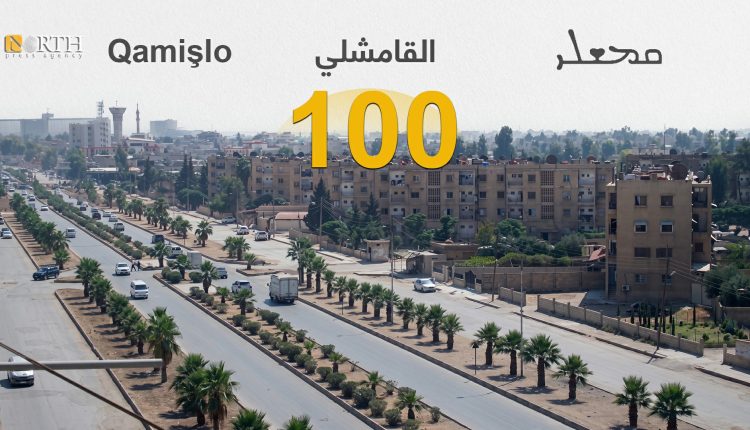
QAMISHLI, Syria (North Press) – A century after the establishment of modern Qamishli, the northeastern Syrian city remains a reflection of the peoples, cultures and histories that shaped the Jazira long before the city emerged as an urban center.
Founded under the French Mandate in 1926, Qamishli grew rapidly on a landscape where Kurdish, Syriac and Assyrian communities had already established roots, alongside Arab tribal and agricultural communities.
The city’s later development was also shaped by people displaced by wars, persecution and political upheaval in neighboring regions, including Armenians. Together, these communities helped turn Qamishli into one of Syria’s most diverse cities.
Before modern Qamishli
The history of the area predates the establishment of the modern city.
The wider Jazira region was home to established Kurdish communities, as well as Syriac and Assyrian populations and Arab tribal communities. Villages, agricultural communities, and pastoral areas extended across the region, while the Jaghjagh River was an important geographical feature.
In his book “The Modern Historical Formation of Syria’s Jazira”, researcher Mohammed Jamal Barout described the immediate area of present-day Qamishli as open countryside crossed by the Jaghjagh River and containing reed-filled marshes.
Barout wrote that the site included a watermill and a farm belonging to Qaddour Bek, known as Zahrat Khazna Farm.
Local accounts also preserve memories of the area before the establishment of the city. Sheikh Mohammed Abdul Razzaq al-Tayy, leader of the Tayy tribe, told North Press that, according to accounts passed down through generations, the first foundation stone of modern Qamishli was laid in Qaddour Bek.
The area was not, therefore, an isolated space without inhabitants or links to surrounding communities. It formed part of the wider social and economic landscape of the Jazira.
The creation of modern Qamishli
The political transformation of the region after World War I changed its future. The establishment of the Syrian-Turkish border separated communities and commercial centers that had previously been connected. Nusaybin, an important historic market town, became part of Turkey, while the area south of the new border came under the French Mandate in Syria.
On Aug. 20, 1926, French forces established a post near Qaddour Bek, marking a decisive stage in the development of modern Qamishli.
French officials viewed the location as strategically important because of its proximity to Nusaybin and its potential to become a new commercial center.
As the town expanded, residents of the surrounding area increasingly turned to Qamishli for trade and services that had previously been centered in Nusaybin.
Abdul Razzaq said the Wusta neighborhood was among the city’s earliest districts and included Syriac, Armenian and Jewish residents.
Shops, schools, mosques and churches gradually appeared, giving the emerging city an increasingly urban character.
Communities rooted in the Jazira
The growth of Qamishli did not begin with the arrival of a single community. Kurdish communities were already established across the Jazira, including in areas surrounding the new city. Syriac and Assyrian communities likewise had deep roots in the region, with villages and religious and cultural institutions predating modern Qamishli.
Arab tribes and agricultural communities also formed part of the social landscape of the Jazira. The establishment of Qamishli brought many of these communities into the same expanding urban space.
At the same time, the city became a place of refuge for people fleeing violence and persecution in neighboring areas.
Armenians arrived from Turkey after the mass killings and deportations of Armenians during the final years of the Ottoman Empire and the upheavals that followed.
Jews from Nusaybin and surrounding areas also became an important part of Qamishli’s early population.
The city therefore developed through a combination of long-established local communities and people displaced from neighboring regions, rather than through one single wave of settlement.
Markets and the making of the city
Qamishli’s markets became places where the different communities interacted and contributed to the city’s economic life.
One of the best-known was Ezra Market, which became closely associated with the Jewish community.
Novelist Abbas Abbas told North Press that the market was known for spices, ghee and cheese. Farmers from surrounding villages brought their products there, giving the market its reputation as a “market of the villages.”
Armenians also became prominent in crafts and skilled professions.
Tigran Ghazarian, an Armenian blacksmith, said members of his community contributed significantly to crafts and professions, as well as medicine, engineering, education and sports.
“We gave a lot to the region, especially in crafts and professions,” Ghazarian told North Press. “At the same time, the people of the region deserve credit for receiving us and playing a major role in protecting us.”
Samir Katta, a Qamishli resident who repairs vehicle tires, highlighted the role of the Syriac community in industry, agriculture and commerce.
He said Syriacs were involved in several longstanding professions, including blacksmithing, textile trading and jewelry, and owned many businesses in the city’s industrial area.
Railway and airport
The arrival of the railway around 1928 accelerated Qamishli’s economic development.
The railway connected the city to wider commercial routes and facilitated the movement of agricultural products and other goods.
Qamishli’s importance increased further with the establishment of its airport in the 1940s, strengthening connections with other Syrian cities and the wider region.
Markets, schools and religious institutions continued to expand alongside the population.
The city gradually developed an urban identity that reflected its diverse communities and their respective languages, religions, professions and traditions.
A changing demographic landscape
Qamishli’s population continued to change throughout the 20th century.
The Jewish community gradually declined, particularly from the 1960s, as members left Syria in successive waves. David Moussa Benhas, known as “Abu Albert,” was among the last Jews to remain in the city, according to Abdul Razzaq.
Christian communities also experienced significant emigration over the decades, while Kurdish and Arab populations remained central to the city’s social and economic life.
The Baath Party’s policies also altered the demographic and political landscape of northeastern Syria. Novelist Abbas criticized those policies, saying they had a significant impact on the region.
“Unfortunately, the party brought about demographic changes that greatly affected the region,” he told North Press.
For Kurds in particular, state policies affecting citizenship, land and settlement became an important part of the modern history of the Jazira.
A century of shared history
Qamishli’s centenary is therefore more than the anniversary of a city founded under the French Mandate. Its modern urban history began in 1926, but the communities that shaped the surrounding Jazira had much deeper roots.
Kurds, Syriacs, Assyrians, Arabs, Armenians, Assyrians, Syriacs and Jews were already part of the region’s social landscape. They built neighborhoods, markets, schools, places of worship and businesses that remain part of Qamishli’s historical memory.
A century later, the city carries all of these layers. Its history is one of continuity and displacement, coexistence and political change — a history in which communities with deep roots in the Jazira lived alongside those who arrived seeking safety and a new beginning.
That layered history is what made Qamishli what it is today: a city whose identity cannot be separated from the peoples of the Jazira and the generations who built their lives along the Jaghjagh River.