
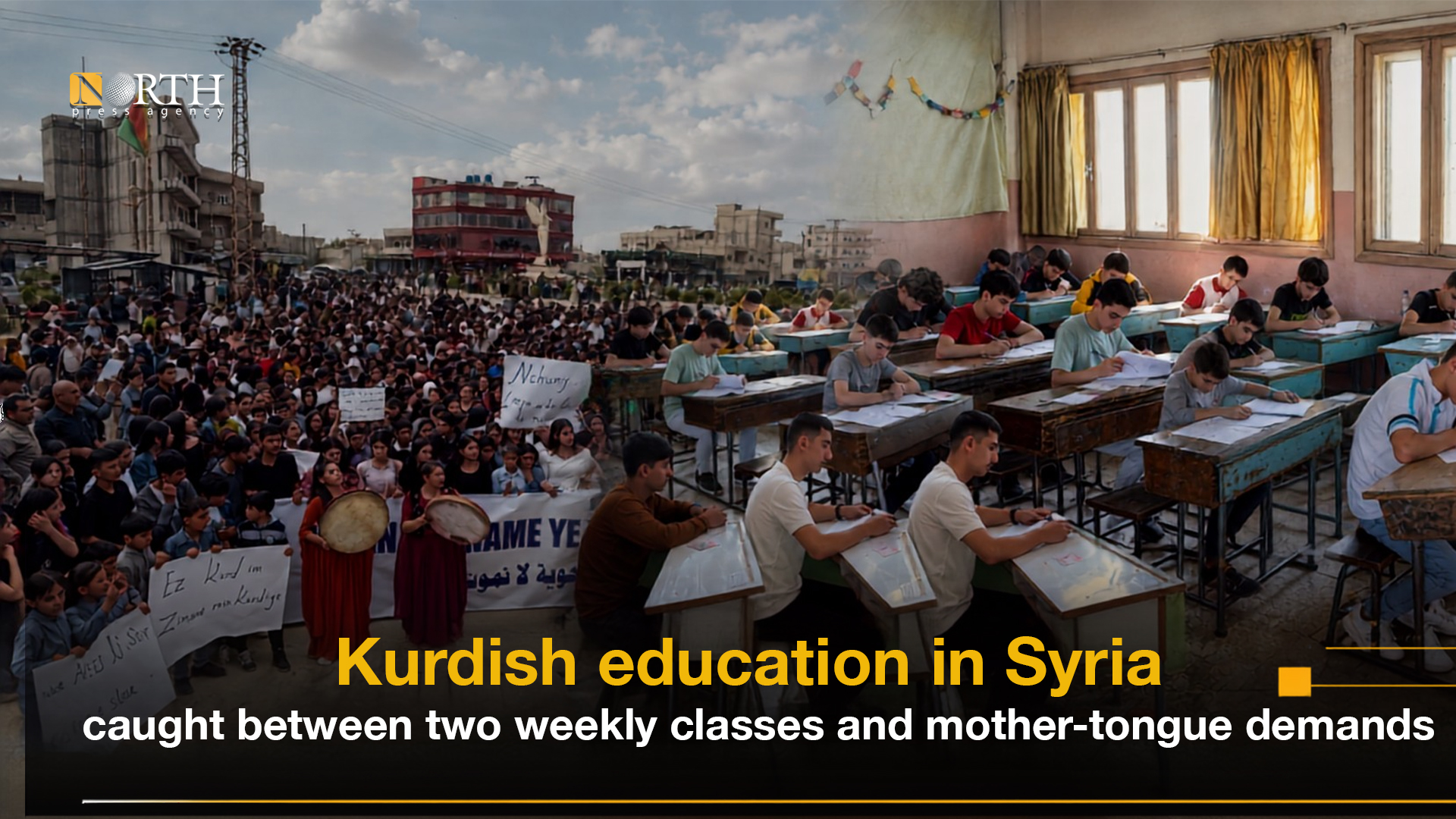
QAMISHLI, Syria (North Press) – Presidential Decree No. 13 of 2026, which addresses the cultural and linguistic rights of Kurds in Syria, has reopened debate over the future of Kurdish-language education amid disagreement between the Syrian transitional government and education institutions affiliated with the Autonomous Administration of North and East Syria (AANES) over how those rights should be implemented in schools.
While the government is moving to introduce Kurdish as a subject in the official curriculum, with two classes per week, Kurdish representatives are calling for broader instruction that would make Kurdish a language of education alongside Arabic, particularly in Kurdish-majority areas.
The dispute goes beyond the number of weekly classes to questions about what kind of education system can preserve the mother tongue and the cultural identity of different communities without separating regions from a shared national education system.
Historic recognition
Samar Habib, a faculty member at the Higher Institute for Population Research and Studies at Damascus University, says that Presidential Decree No. 13 of 2026 represents a “historic turning point” in Syria’s educational and social policies.
The decree recognizes Kurds as an integral part of the Syrian people and their linguistic and cultural identity as an inseparable component of the country’s broader national identity, Habib adds.
She indicates that the decree’s importance goes beyond recognizing cultural and linguistic rights and tasking the Ministry of Education, under Decision No. 943, with preparing curricula. It also addresses historical grievances by nullifying the legal effects of the exceptional 1962 census in Hasakah Governorate, according to Habib.
From an educational and social sciences perspective, the decree marks a shift from policies of exclusion and forced Arabization toward legal recognition and national inclusion, Habib points out, while noting a gap between symbolic recognition and educational empowerment.
Education in the language or education of the language?
Habib says the decree treats Kurdish as an elective subject or cultural activity rather than a language of instruction, describing the distinction between “learning a language” and “receiving education in mother-tongue” as academically crucial.
Limiting Kurdish instruction to two classes a week would not provide the functional proficiency needed to protect the mother tongue or ensure its transmission across generations, she said.
Habib bases her position on four main frameworks, including multicultural education, which she says assumes that linguistic recognition strengthens the political legitimacy of the state and promotes the integration of communities within a shared civic framework.
She also cites education-related human rights, referring to Article 30 of the Convention on the Rights of the Child and the 1992 UN Declaration on the Rights of Persons Belonging to National or Ethnic, Religious and Linguistic Minorities. These frameworks, she says, support the right to learn in one’s mother tongue without separating communities from the wider state context.
A third framework is social integration, which views schools as tools for national solidarity rather than fragmentation, she says.
The fourth draws on UNESCO frameworks on mother-tongue education and studies that, according to Habib, indicate that developing academic language proficiency requires five to seven years of sustained and intensive exposure. Early education in the mother tongue also improves students’ achievement in the state’s official language, she notes.
Three-track education model
Habib proposes a three-track education model that could be implemented gradually over three to five years to overcome the limitations of the two-class-per-week approach.
The first track would be parallel bilingual education, with subjects such as science and social studies taught in both Kurdish and Arabic in areas with high Kurdish population concentrations, including Hasakah, Qamishli, Afrin and Kobani.
The second track would involve language support programs, with four to six Kurdish classes per week alongside intensive extracurricular activities in areas with medium or mixed population concentrations.
The third track would consist of integrated multicultural curricula that incorporate the history and culture of Kurds and other communities into national curricula for all students in Syria, helping strengthen social integration.
Habib stresses that the model would require developing teaching staff through accelerated training programs lasting six to 12 months, alongside regional expertise and the establishment of educational and linguistic proficiency tests.
Implementation would also require the participation of local councils and different social communities to prevent perceptions of reverse marginalization, she notes.
She proposed establishing a special coordination unit within the Ministry of Education to manage a gradual and experimental rollout, initially testing the model in 15 to 20 schools before expanding it nationwide.
“Teaching Kurdish as an independent subject for two classes a week is an essential and politically acceptable step to break with the historical rupture, but it is insufficient educationally,” Habib indicates.
“Genuine protection of the mother tongue requires a gradual transition toward a bilingual education model, while strictly preserving Arabic and national education as common elements for all Syrians,” she adds.
“A step in the wrong direction”
Ibrahim Khalil, a Kurdish writer and linguist based in Germany, takes a different view, saying there is a contradiction between official statements describing Kurds as an “integral part of the Syrian fabric” and what he described as the Syrian government’s treatment of them as a “large community.”
Khalil tells North Press that this contradiction lies at the heart of the disagreement between the Syrian transitional government and the AANES over Kurdish-language education.
Teaching two optional Kurdish classes a week cannot be considered a national gain or a positive step toward resolving the Kurdish issue in Syria, he adds. Instead, he describes it as “a step in the wrong direction toward national assimilation and the Arabization of what remains of the Kurds.”
A second official language
Khalil points out that a national solution would require recognizing Kurdish as a second official language and opening public primary schools in Kurdish-majority areas where instruction would be conducted entirely in Kurdish, with one daily Arabic class. He proposes making Arabic, alongside Kurdish, a required subject whose failure would affect students’ promotion.
The two languages could then alternate instructional roles at the preparatory and secondary levels, he says, alongside the creation of a “Kurdish Education Department” within Syria’s Ministry of Education.
In higher education, Khalil proposes initially establishing Kurdish literature departments at faculties of arts across Syrian universities or designating four institutes to train Kurdish-language teachers in Hasakah, Qamishli, Afrin and Kobani.
“This is the minimum that could meet the aspirations of the Kurdish people in Syria while preserving their language and heritage,” he says.
Two competing models
The current dispute places the Syrian government and Kurdish educational institutions before two different approaches to Kurdish-language education.
The first would incorporate Kurdish into the official curriculum as an independent subject, while the second calls for a model in which Kurdish becomes a language of instruction in Kurdish-majority areas alongside Arabic.
Habib considers two weekly Kurdish classes a viable first step that could eventually develop into a bilingual model. Khalil, however, argues that this approach would not ensure the protection of the Kurdish language and that recognizing Kurdish as a second official language and using it as a language of instruction in Kurdish areas are the minimum requirements.
The challenge for Syria’s education system remains finding a formula that guarantees the linguistic and cultural rights of Kurds while maintaining Arabic as a shared language within a national education system capable of accommodating the country’s linguistic and cultural diversity.