
UNICEF warns ERW still pose deadly threat to children across Syria
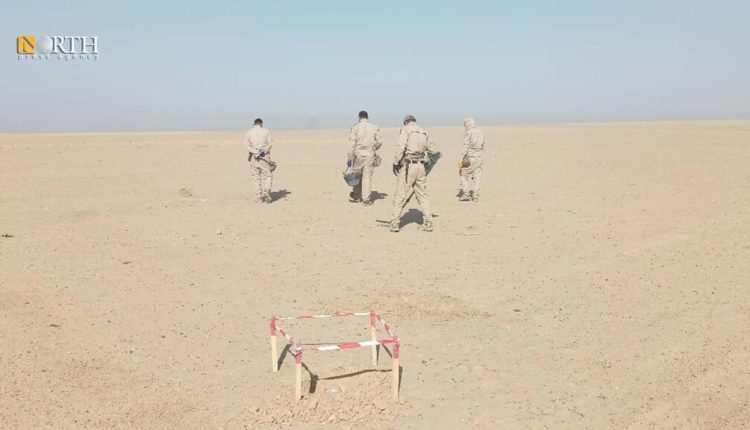
QAMISHLI, Syria (North Press) – On the International Day for Mine Awareness and Assistance in Mine Action, UNICEF warned on Saturday that children in Syria remain at severe risk from explosive remnants of war (ERW), despite the decline in active hostilities.
The agency called for urgent and sustained investment in mine action, including clearance, victim assistance, and explosive ordnance risk education (EORE), describing these efforts as essential for recovery and long-term stability.
Since December 2024, at least 1,891 civilian casualties linked to ERW have been recorded across Syria, including 698 people killed and 1,193 injured. Children accounted for 30 percent of those killed and 40 percent of those injured between December 2024 and February 2026, figures UNICEF said are likely underreported.
An estimated five million children currently live in areas contaminated with landmines and ERW. UNICEF estimates that around 324,000 explosive remnants remain scattered across roads, fields, homes, and schools, posing what it described as a constant and largely invisible danger.
The risks are rising as more than three million displaced people return to communities heavily affected by conflict, often without adequate information about contamination.
Children are particularly vulnerable as they resume daily activities and move through unfamiliar or damaged environments.
“Peace cannot take root where the ground remains unsafe,” said Meritxell Relaño Arana, UNICEF Representative in Syria. “Explosive ordnance risk education is a life-saving intervention that equips children and families with the knowledge to stay safe.”
UNICEF said it works with 38 partners across clearance, victim assistance, advocacy, and risk education. In 2025, UNICEF and its partners reached around 850,000 children and caregivers with risk awareness messages and trained nearly 400 professionals.
The agency also supported the development of a national EORE framework integrated into training curricula in cooperation with the Ministry of Education.
UNICEF warned that children who survive blasts often face lifelong consequences, including physical injuries amid a weakened healthcare system, psychological trauma, school exclusion, and increased poverty for their families.
The agency called on the Syrian government, donors, and the international community to scale up EORE programs, accelerate clearance of contaminated areas, and provide long-term support for survivors.